World index ... Europe ... Russia
Travelers word index

Russia

Continents
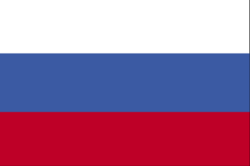
Russian flag

Russia is located in Northern Asia (the area west of the Urals is considered part of Europe), bordering the Arctic Ocean, between Europe and the North Pacific Ocean.

Russia has borders with Aland Islands for 1340km, Azerbaijan for 284km, Belarus for 959km, China for 3645km, Estonia for 294km, Finland for 1340km, Georgia for 723km, North Korea for 19km, Kazakhstan for 6846km, Lithuania for 227km, Latvia for 217km, Mongolia for 3485km, Norway for 196km, Poland for 206km and Ukraine for 1576km.

Land in Russia is broad plain with low hills west of Urals; vast coniferous forest and tundra in Siberia; uplands and mountains along southern border regions.

Russian land covers an area of 17075200 square kilometers which is approximately 1.8 times the size of the US

As for the Russian climate; ranges from steppes in the south through humid continental in much of European Russia; subarctic in Siberia to tundra climate in the polar north; winters vary from cool along Black Sea coast to frigid in Siberia; summers vary from warm in the steppes to cool along Arctic coast.

Russian(s) speak Russian, many minority languages.

Russia country profile, Travel advice for Russia

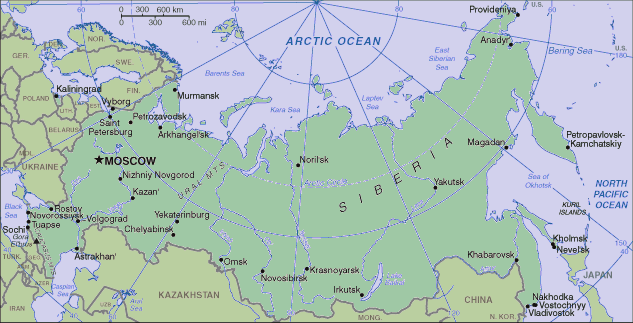
Russian Map
Places of note in Russia
Москва
Saint Petersburg
Novosibirsk
Yekaterinburg
Nizhniy Novgorod
Samara
Omsk
Kazan'
Rostov-na-Donu
Chelyabinsk
Ufa
Perm'
Saratov
Tol'yatti
Krasnodar
Ul'yanovsk
Izhevsk
Yaroslavl'
Barnaul
Vladivostok
Irkutsk
Khabarovsk Vtoroy
Orenburg
Novokuznetsk
Ryazan'
Tyumen'
Lipetsk
Penza
Astrakhan'
Makhachkala
Tomsk
Kemerovo
Tula
Kirov
Cheboksary
Regions of Russia
Adygeya
Aginskiy Buryatskiy Avtonomnyy Okrug
Altay
Altayskiy Kray
Amurskaya Oblast'
Arkhangel'skaya Oblast'
Astrakhanskaya Oblast'
Bashkortostan
Belgorodskaya Oblast'
Bryanskaya Oblast'
Buryatiya
Chechnya and Ingushetiya
Chelyabinskaya Oblast'
Chitinskaya Oblast'
Chukotskiy Avtonomnyy Okrug
Chuvashiya
Dagestan
Evenkiyskiy Avtonomnyy Okrug
Ingushetiya
Irkutskaya Oblast'
Ivanovskaya Oblast'
Kabardino-Balkariya
Kaliningradskaya Oblast'
Kalmykiya
Kaluzhskaya Oblast'
Kamchatskaya Oblast'
Karachayevo-Cherkesiya
Kareliya
Kemerovskaya Oblast'
Khabarovskiy Kray
Khakasiya
Khanty-Mansiyskiy Avtonomnyy Okrug
Kirovskaya Oblast'
Komi
Komi-Permyatskiy Avtonomnyy Okrug
Koryakskiy Avtonomnyy Okrug
Kostromskaya Oblast'
Krasnodarskiy Kray
Krasnoyarskiy Kray
Kurganskaya Oblast'
Kurskaya Oblast'
Leningradskaya Oblast'
Lipetskaya Oblast'
Magadanskaya Oblast'
Mariy-El
Mordoviya
Moskovskaya Oblast'
Moskva
Murmanskaya Oblast'
Nenetskiy Avtonomnyy Okrug
Nizhegorodskaya Oblast'
Novgorodskaya Oblast'
Novosibirskaya Oblast'
Omskaya Oblast'
Orenburgskaya Oblast'
Orlovskaya Oblast'
Penzenskaya Oblast'
Permskaya Oblast'
Primorskiy Kray
Pskovskaya Oblast'
Rostovskaya Oblast'
RSJA
Russia (general)
Ryazanskaya Oblast'
Sakhalinskaya Oblast'
Sakha (Yakutiya)
Samarskaya Oblast'
Sankt-Peterburg
Saratovskaya Oblast'
Severnaya Osetiya-Alaniya
Smolenskaya Oblast'
Stavropol'skiy Kray
Sverdlovskaya Oblast'
Tambovskaya Oblast'
Tatarstan
Taymyrskiy (Dolgano-Nenetskiy) Avtonomnyy Okrug
Tomskaya Oblast'
Tul'skaya Oblast'
Tverskaya Oblast'
Tyumenskaya Oblast'
Tyva
Udmurtiya
Ul'yanovskaya Oblast'
Ust'-Ordynskiy Buryatskiy Avtonomnyy Okrug
Vladimirskaya Oblast'
Volgogradskaya Oblast'
Vologodskaya Oblast'
Voronezhskaya Oblast'
Yamalo-Nenetskiy Avtonomnyy Okrug
Yaroslavskaya Oblast'
Yevreyskaya Avtonomnaya Oblast'

Founded in the 12th century, the Principality of Muscovy, was able to emerge from over 200 years of Mongol domination (13th-15th centuries) and to gradually conquer and absorb surrounding principalities. In the early 17th century, a new Romanov Dynasty continued this policy of expansion across Siberia to the Pacific. Under PETER I (ruled 1682-1725), hegemony was extended to the Baltic Sea and the country was renamed the Russian Empire. During the 19th century, more territorial acquisitions were made in Europe and Asia. Repeated devastating defeats of the Russian army in World War I led to widespread rioting in the major cities of the Russian Empire and to the overthrow in 1917 of the imperial household. The Communists under Vladimir LENIN seized power soon after and formed the USSR. The brutal rule of Iosif STALIN (1928-53) strengthened communist rule and Russian dominance of the Soviet Union at a cost of tens of millions of lives. The Soviet economy and society stagnated in the following decades until General Secretary Mikhail GORBACHEV (1985-91) introduced glasnost (openness) and perestroika (restructuring) in an attempt to modernize Communism, but his initiatives inadvertently released forces that by December 1991 splintered the USSR into Russia and 14 other independent republics. Since then, Russia has struggled in its efforts to build a democratic political system and market economy to replace the strict social, political, and economic controls of the Communist period. While some progress has been made on the economic front, recent years have seen a recentralization of power under Vladimir PUTIN and the erosion of nascent democratic institutions. A determined guerrilla conflict still plagues Russia in Chechnya and threatens to destabilize the North Caucasus region.

Country profile: Russia

map of Russia Russia has been striving to find its new place in the world since the Soviet Union ceased to be in 1991.

A new political order has been established and the economy has seen steady growth since the collapse of 1998.

At the same time, fears have been expressed that the country's long history of authoritarian rule did not end with Communism and Chechnya remains a very painful thorn in Russia's flesh.

The country impresses with its diversity and size. Spanning 10 time zones, this Eurasian land mass covers more than 17m sq km. Its climate ranges from the Arctic north to the generally temperate south.

Winter Palace, part of State Hermitage, St Petersburg

Russia has vast natural resources, not least in oil and gas. World oil prices are a key factor in determining economic strength.

In the privatisation years of the 1990s Russia provided entrepreneurs with the potential for rich pickings. A small group of people, often referred to as oligarchs, acquired vast interests in the energy and media sectors.

Some analysts believed that the then president, Boris Yeltsin, allowed their influence to extend too far into the political field but President Putin soon made it clear that there was no question of that with him in charge.

Some oligarchs found themselves facing criminal investigation and one or two household names felt it necessary to leave the country. One of them, Mikhail Khodorkovsky, who headed the Yukos oil company, is now serving eight years in a Siberian penal colony having been convicted on tax and fraud charges. He had not confined his activities to business but had let his support for liberal politics be known.

The Kremlin has taken steps to reassert control over the oil and gas sectors. The Russian state now has a stake of more than 50% in the giant gas company Gazprom which supplies about a quarter of Europe's gas needs. Agreement has also been reached that Russian gas will be supplied to China.

Chechnya and the West

While Russians make up over 80% of the population and Orthodox Christianity is the main religion, there are many other ethnic and religious groups. Muslims are concentrated among the Volga Tatars and the Bashkirs and in the North Caucasus.

Snow in Red Square, Moscow Chechnya remains prominent in the headlines. Many thousands have died since Russian troops were first sent in to put down a separatist rebellion in 1994 and guerrilla fighters continue to mount attacks. However, the Kremlin faced less criticism from the West over its actions in Chechnya in the aftermath of the 11 September attacks on the US.

Since then, Moscow has presented its war against Chechen separatism as part of the global war against international terrorism. It insists that its hard-line policies there are working and that peace is returning to the republic.

This has frequently been called into question as violence flares with tragic regularity across Chechnya and the wider North Caucasus.

Russia's supportive policy on the US-led campaign against international terrorism also had an impact on the country's relations with Nato. The two sides agreed in May 2002 to establish the Nato-Russia Council giving Russia an equal role with Nato countries in decision making on policy to counter terrorism and other security threats.

Nevertheless, Russia was firm in its opposition to the US-led military action against Iraq in the spring of 2003, insisting that UN weapons inspectors be given as much time as they needed to do their work.

Despite concerns expressed by Washington, Moscow and Tehran agreed early in 2005 that Russia would supply fuel for Iran's Bushehr nuclear reactor. Amid increasing international concern over Iran's nuclear programme, Russia has so far taken a very cautious approach on sanctions.

It has consistently shown that its desire to build a new relationship with the US will not deter it from going its own way on key issues.

President: Vladimir Vladimirovich Putin

Vladimir Putin was elected to a second term as Russian president by a landslide in March 2004 with around 70% of the vote. His nearest rival, the Communist candidate, mustered 14%.

Russian president

Western observers were quick to criticise media bias in favour of Mr Putin during the campaign.

They had been similarly critical when United Russia, the party backed by the president, won a landslide victory in parliamentary elections the previous December and liberal parties lost virtually all their seats.

Concerns about Mr Putin's attitude to the media are not new. They came to the fore when independent TV broadcasters critical of the Kremlin were forced off the air in his first term. Not everyone was convinced by the president's insistence that this was business, not politics.

Vladimir Putin started his career in the ranks of the KGB. From 1990 he worked in the St Petersburg administration, before moving to Moscow in 1996. By August 1999 he was prime minister.

Mr Putin was named acting president by his predecessor, Boris Yeltsin, who introduced him as the man who could "unite around himself those who will revive Great Russia".

He went on to win presidential elections in May 2000, having gained widespread popularity for his pledge to take a tough line against Chechen rebels. They have not gone away.

In the aftermath of the bloodbath which ended the Beslan school siege in September 2004, Mr Putin controversially took over control of the appointment of regional governors who had been directly elected for the previous decade. He said the move was intended to tighten the Kremlin's grip on the regions. Critics saw it as undermining democracy.

Mr Putin has said he wants to modernise Russia and has been credited with introducing economic reforms which have balanced the budget and cut inflation. As the birth rate falls and health problems persist across the country, he promises to seek ways of stemming a rapid decline in the population.

Mr Putin was born in St Petersburg in 1952. Under the current constitution, his second term must also be his last.

  • Prime minister: Mikhail Fradkov
  • Foreign minister: Sergei Lavrov
  • Finance minister: Alexei Kudrin
  • Defence minister: Sergei Ivanov

    In recent years the Kremlin has secured greater control over Russia's big national TV networks - Channel One, RTR and NTV - and critics say independent reporting has suffered as a result.

    Bringing court cases against two of the country's biggest tycoons, Boris Berezovsky and Vladimir Gusinsky, and acting through the giant energy groups Gazprom and Lukoil, the Kremlin wrested control of NTV in 2001 and ordered the closure of TV-6 in 2002.

    Supporters of independence of Russia's NTV, April 2001, Moscow

    TV-6 was replaced by TVS, which soldiered on as Russia's only private national network until the authorities pulled the plug in 2003, officially for financial reasons.

    Russia's broadcasting market is very competitive; state-owned or influenced TV networks attract the biggest audiences. Hundreds of radio stations crowd the dial; traditional state-run networks compete with music-based commercial FM stations.

    An English-language satellite channel, Russia Today, was launched in late 2005. The news-based station is funded by the Kremlin and aims to present "global news from a Russian perspective".

    There are more than 400 daily newspaper titles, catering for every taste and persuasion. All of the major nationals are based in Moscow, but many Russians living in the regions prefer to take local papers instead. Several influential dailies have been bought by companies with close links to the Kremlin.

    The conflict in Chechnya has been blamed for government attacks on press freedom. Journalists have been killed in Chechnya while others have disappeared or have been abducted.

    And in Moscow and elsewhere journalists have been harassed or physically abused. Reporters investigating the affairs of the political and corporate elite are said to be particularly at risk.

    Media rights organisation Reporters Without Borders has expressed concern at "mounting press freedom violations" in Vladimir Putin's Russia, including "the absence of pluralism in news and information, an intensifying crackdown against journalists... and the drastic state of press freedom in Chechnya".

    The press

  • Komsomolskaya Pravda - mass circulation, left-leaning daily, controlled by tycoon Vladimir Potanin
  • Kommersant - daily, business-orientated, controlled by steel tycoon Alisher Usmanov
  • Moskovskiy Komsomolets - popular privately-owned Moscow daily
  • Izvestia - popular daily, owned by state-run gas monopoly Gazprom
  • Rossiyskaya Gazeta - government-owned daily
  • Nezavisimaya Gazeta - influential privately-owned daily
  • Trud - left-leaning daily, owned by Promsvyazbank
  • Argumentiy i Faktiy - popular weekly, owned by Promsvyazbank
  • Novaya Gazeta - twice-weekly, known for its investigative journalism
  • The Moscow Times - English-language daily
  • The Moscow News - English-language weekly

    Television

  • Russia TV Channel - national network, run by state-owned Russian State Television and Radio Broadcasting Company (RTR)
  • Channel One - national network, 51% owned by state, 49% by private shareholders
  • NTV - national network, owned by state-run Gazprom
  • Centre TV - commercial, Moscow area
  • Ren TV - Moscow-based commercial station with strong regional network
  • Russia Today - state-funded, international English-language news channel, via satellite

    Radio

  • Radio Russia - national network run by state-owned Russian State Television and Radio Broadcasting Company (RTR)
  • Moscow Echo - influential private station
  • Radio Mayak - state-run national network
  • Russkoye Radio - major private network, music-based
  • Voice of Russia - external service, broadcasts in English and other languages

    News agencies

  • Itar-Tass - state-owned, pages in English
  • RIA-Novosti - state-owned, pages in English
  • Interfax - private, pages in English

    Russia ended 2005 with its seventh straight year of growth, averaging 6.4% annually since the financial crisis of 1998. Although high oil prices and a relatively cheap ruble are important drivers of this economic rebound, since 2000 investment and consumer-driven demand have played a noticeably increasing role. Real fixed capital investments have averaged gains greater than 10% over the last five years, and real personal incomes have realized average increases over 12%. During this time, poverty has declined steadily and the middle class has continued to expand. Russia has also improved its international financial position since the 1998 financial crisis, with its foreign debt declining from 90% of GDP to around 31%. Strong oil export earnings have allowed Russia to increase its foreign reserves from only $12 billion to some $180 billion at yearend 2005. These achievements, along with a renewed government effort to advance structural reforms, have raised business and investor confidence in Russia's economic prospects. Nevertheless, serious problems persist. Economic growth slowed to 5.9% for 2005 while inflation remains high. Oil, natural gas, metals, and timber account for more than 80% of exports, leaving the country vulnerable to swings in world prices. Russia's manufacturing base is dilapidated and must be replaced or modernized if the country is to achieve broad-based economic growth. Other problems include a weak banking system, a poor business climate that discourages both domestic and foreign investors, corruption, and widespread lack of trust in institutions. In addition, a string of investigations launched against a major Russian oil company, culminating with the arrest of its CEO in the fall of 2003 and the acquisition of the company by a state owned firm, have raised concerns by some observers that President PUTIN is granting more influence to forces within his government that desire to reassert state control over the economy. State control has increased in the past year with a number of large acquisitions. Most fundamentally, Russia has made little progress in building the rule of law, the bedrock of a modern market economy.

    Russian natural resources include wide natural resource base including major deposits of oil, natural gas, coal, and many strategic minerals, timber
    note: formidable obstacles of climate, terrain, and distance hinder exploitation of natural resources

    largest country in the world in terms of area but unfavorably located in relation to major sea lanes of the world; despite its size, much of the country lacks proper soils and climates (either too cold or too dry) for agriculture; Mount El'brus is Europe's tallest peak

    Russian religion is Russian Orthodox 15-20%, Muslim 10-15%, other Christian 2% (2006 est.).

    Natural hazards in Russia include permafrost over much of Siberia is a major impediment to development; volcanic activity in the Kuril Islands; volcanoes and earthquakes on the Kamchatka Peninsula; spring floods and summer/autumn forest fires throughout Siberia and parts of European Russia.

    Travel Advice on Russia

    Russian Federation

    This advice has been reviewed and reissued.  The overall level of the advice has not changed.

    SUMMARY

    • Because of the security situation in the North Caucasus, we advise against all travel to Chechnya, Ingushetia, Dagestan and to Budyonnovsky, Levokumsky, Neftekumsky, Stepnovsky and Kurskoy, which are regions in eastern and southern Stavropol Krai that border Dagestan and Chechnya.

    • We advise against all but essential travel to North Ossetia, Karachai-Cherkessia and Kabardino-Balkaria (including the Elbrus area).  Please see the Local Travel section of this Travel Advice for more information.

    • You should be aware of the threat from terrorism.  Attacks could be indiscriminate and against civilian targets, including places frequented by foreigners.  Attacks have occurred most frequently in Moscow and in the North Caucasus.

    • Around 215,000 British nationals visit Russia every year.  Most visits are trouble-free.  The main type of incidents for which British nationals require consular assistance in Russia are minor, for example registration problems or lost or stolen passports and migration cards.  However, you should be vigilant at all times and also watch out for pickpockets and street crime, especially in large cities and in busy areas, e.g. railway concourses.  Since 2005 there has been an increase in racially motivated attacks; visitors of Asian or Afro-Caribbean descent should take extra care.

    • We strongly recommend that you obtain comprehensive travel and medical insurance before travelling. You should check any exclusions, and that your policy covers you for any activities you may wish to undertake. More information is available on the Travel Insurance pages of the FCO website.


    SAFETY AND SECURITY

    Crime
    As in most countries, cities in Russia have their fair share of petty crime.  You should be alert at all times to the possibility of mugging, pickpocketing and theft from vehicles or hotel rooms.  Be particularly alert to groups of women and children who beg, and pickpockets around the main railway concourses.
    Take care when drinking with or meeting casual or new acquaintances in bars, restaurants or night-clubs, as there have been incidents of robbery and violence involving foreigners, amongst them British nationals.  Do not leave your drinks unattended as they may then be drugged.
    Incidents of armed violence in major cities are usually linked to criminal/business activities and are not usually directed against foreigners.  There have also been bomb attacks linked to criminal disputes.
    Racially motivated attacks by racist "skinhead" groups do occur in Russia.  Racially motivated attacks increase around 20 April, the anniversary of Adolf Hitler’s birthday.  Although the great majority of visitors experience no difficulties, there has been an increase in the number of attacks on foreign nationals since 2005, especially in large urban areas.  In St Petersburg a student from Congo was killed in September 2005 and an Indian medical student was stabbed to death in September 2006.  In Voronezh in October 2005 a student from Peru was murdered and another Peruvian and a Spanish student badly hurt.  On 4 December 2006 two Vietnamese citizens were admitted to a Moscow hospital with knife wounds, although the cause of the attack has yet to be determined.  We recommend that travellers of Asian or Afro-Caribbean descent take extra care.
    On 21 August 2006 an explosion in a Moscow market caused approximately twelve fatalities, with thirty-five injured.  No British citizens were among the casualties.  The authorities have established that this was a racially motivated act and two men have been arrested.
    On the night of 24-25 November 2006 an improvised explosive device was detonated and another defused at a hostel belonging to Moscow State University; no injuries were reported and an investigation has been launched.
    In St Petersburg there has been a sharp increase in street crime since April 2004; tourists have been specifically targeted.  Since April 2005 the number of cases of tourists being held up at knifepoint on the metro and buses have increased. These crimes are carried out by well-organised gangs.  You should be especially aware of pickpockets in the main tourist areas. Incidents of bogus police officers harassing and robbing tourists have also been reported. If you are stopped always insist on seeing ID.  Avoid openly carrying expensive items, or anything that might easily identify you as a tourist.
    There are a number of services offering addresses and contact information for Russian women who are looking to become romantically engaged with Western Europeans.  A number of prospective suitors have entered into correspondence, only later to be defrauded. If this occurs, there is little that the British Government can do to assist in the recovery of any capital outlay.  We advise that you exercise the appropriate level of caution if entering into correspondence.
    Political Situation

    Russia Country Profile.
    The next major elections will be the Duma (parliamentary) elections, timetabled for December 2007; Presidential elections have been scheduled for March 2008.
    Local Travel
    We advise against all travel to Chechnya, Ingushetia, Dagestan and to Budyonnovsky, Levokumsky, Neftekumsky, Stepnovsky and Kurskoy, which are regions in eastern and southern Stavropol Krai that border Chechnya and Dagestan. 
    We advise against all but essential travel to North Ossetia, Karachai-Cherkessia and Kabardino-Balkaria (including the Elbrus area).  Terrorism and kidnapping in the region remains a serious problem and you are advised to take security advice before travelling.
    As well as the ongoing conflict in Chechnya, terrorist attacks have occurred throughout this region, including incidents in Beslan and Vladikavkaz, North Ossetia, Nalchik, the capital of Kabardino-Balkaria and Makhachkala, the capital of Dagestan.  Further violence in the North Caucasus region is likely.
    Kidnapping in the region is common and Westerners are particularly vulnerable: four Western hostages, including three Britons, were murdered in Chechnya in December 1998 and a Dutch aid worker was kidnapped in Dagestan in August 2002 and spent 21 months in captivity.
    You should be aware of travel restrictions for foreigners in North Ossetia.  You should travel only to the towns of Vladikavkaz, Beslan, Alagira and Ardona along the following connecting roads:  Nazran – Besland – Nalchik (road M-29); Varkhny Lars – Vladikavkaz (roadA-301), Nizhny Zaramag – Alagir (road R297); Alagir – Ardon – road M-29 (road R-298); roads connecting Vladikavkaz with road M-29; and the road connecting Vladikavkaz airport (Beslan) with road M-29).
    The following railway connections are also permitted:  Nazran-Beslan-Murtazovo; Vladikavkaz-Beslan; Alagir-Elkhotovo; and Gudermes-Mozdok-Prokhladnaya.
    The North Caucasus remains an unstable and potentially dangerous region.  The Russian authorities take a particularly strict attitude towards security and compliance with official regulations.  If you intend to travel to the North Caucasus region, it is vital that you have the correct documentation including an appropriate visa for the purpose of your visit, and that you comply fully with registration requirements.
    If you travel to these parts of Russia despite this advice, you are taking a serious risk, and must accept that the ability of the FCO and the British Embassy in Moscow to help in the case of an emergency is severely limited.
    Cross-border traffic with Georgia and Azerbaijan is also subject to restrictions.
    Road Safety
    You may drive a car in Russia for a limited period if you hold an international driving license.  For further information on driving restrictions, check with an international driving organisation.
    Road conditions can often be poor, especially outside the major cities.
    You should comply with all local speed limits.  The standard speed limit for built-up areas is 60 kph (37 mph), outside built-up areas 90 kph (55 mph) and 100 kph (62 mph) on motorways (Brest-Moscow).  Visiting motorists who have held a driving licence for less than two years must not exceed 70 kph (43 mph).  It is common practice for traffic police to stop motorists for spot checks.  You should be aware that there is a zero tolerance policy towards drinking and driving.
    If travelling by taxi, use officially marked taxis and do not share them with strangers.  We advise against flagging down unofficial taxis.
    Rail Safety
    On 12 June 2005, a passenger train heading to Moscow from Chechnya was derailed by an explosion.
    If you are travelling by overnight train and have the use of a sleeping compartment, store valuables in the container under the bed/seat.
    Do not leave your sleeping compartment unoccupied as some compartments only have a simple lock on the sliding door. On some trains there may be an additional security device, which can be attached to the fitted handle/lock unit.  There may also be a steel switch at head-height on the door panel which, when pulled down, prevents the closed door from being slid open.
    Air Safety
    On 22 August 2006 a Pulkovo Airlines flight from Anapa to St Petersburg crashed near Donetsk (Ukraine).  All 170 passengers died in this incident.
    Two Russian airliners on internal flights crashed on 24 August 2004.  Russian investigations have now confirmed that both aircraft were destroyed by suicide bombers. You should be aware that security on Russian internal flights is not as high as that for international flights.  Technical safety on scheduled Russian internal and external flights is now broadly in compliance with international norms, although there remain some concerns over the safety of internal flights (and some charter flights) in the light of an air crash in Irkutsk in July 2006.


    LOCAL LAWS AND CUSTOMS

    You should not become involved with drugs.  Penalties are severe and the courts impose long sentences for those found in possession of even small quantities of drugs, regardless of whether they are "hard" or "soft"

    Homosexuality is legal in Russia and there is a reasonably tolerant attitude to homosexuality in major urban areas.  There is still, a degree of intolerance amongst some sections of the population, and you should however be careful about open displays of affection in public.

    The photographing of any military installation, establishment or site of strategic importance is prohibited; this includes airports.  You are likely to have your film confiscated, be detained for questioning and possibly arrested if you do not observe this rule.


    ENTRY REQUIREMENTS

    All foreign nationals entering Russia must fill in a migration card.  These cards have recently changed from bilingual (Russian/English) to Russian only cards.  Information in response to the questions on the cards can still be completed in English; however this can be difficult for non-Russian speakers.  A sample card plus translation can be found on the website of the British Embassy Moscow

    The card is in two identical parts.  One part will be retained by the Immigration Officer on arrival.  You should keep the other part with your passport and show it, along with your passport, to the police, if they stop you for an identity check during your stay.  You should hand in the second part to the Immigration Officer on your departure from Russia.  You must complete a new migration card each time you enter Russia, even if you have a multiple entry visa.  If you lose the second part of the card you will be fined, and your departure from the country could be delayed.

    Visas are required to enter Russia.  During periods of high demand, for example during the summer holidays, you should apply for your visa well in advance.  If you live in England, Wales or Northern Ireland you should apply to the Russian Embassy in London: http://www.great-britain.mid.ru.  If you live in Scotland, you should apply to the Russian Consulate General in Edinburgh.

    The Embassy in London can normally process visas in 15 working days, and you can submit an application by post or in person. If you want to get a visa more quickly it is possible to queue in person and pay an extra fee, though the numbers processed in this way per day are limited.  You must have an exit visa to leave Russia. Most entry visas include an exit visa. However, some entry visas including certain types of student visas, do not include an exit visa. If this is the case your sponsor, not the Embassy or Consulates, will need to obtain the exit visa for you before you can leave the country. Before you travel to Russia ensure that you are aware of the terms and conditions attached to your visa and check that the dates and details which have been entered on your visa are correct.  Presenting documentation which contains incorrect information to immigration officials can lead to severe inconvenience and in some cases could result in refusal of entry.

    You must register your visa within three working days of arrival in Russia with the local branch of the Ministry of Internal Affairs.  Most major hotels will do this automatically.  If you are staying in private accommodation the owner of the property must do this for you.  You need not register a visa if your visit is for under three days.

    If your passport has less than six months to run, you may be refused entry to Russia.  You are advised to get a replacement passport before travelling.

    Single parents or other adults travelling alone with children should be aware that some countries require documentary evidence of parental responsibility before allowing lone parents to enter the country or, in some cases, before permitting the children to leave the country.  For further information on exactly what will be required at immigration please contact the Russian Embassy in London http://www.great-britain.mid.ru.

    If you intend to travel by train on popular routes such as Warsaw-Moscow or St Petersburg-Kiev you will need to obtain a transit visa for Belarus before travelling.

    Dual Nationality

    Under international law, the British Embassy or Consulates cannot formally intervene with the Russian authorities on behalf of dual Russian/British citizens who encounter difficulties whilst in Russia.

    If you come to Russia to renew your Russian international passport, you should be aware that it may take up to four months for a new passport to be issued.  You will have to remain in Russia throughout this period.  If this happens, the British Embassy or Consulates cannot obtain an exit visa for your British passport.

    Parents should note that children born overseas and added to their Russian passports by Russian Embassies may now have to obtain their own passport to exit Russia.  There have been instances where a parent has renewed their own passport but the authorities have refused to add the child to it until the child's claim to Russian citizenship is properly substantiated.  Parents should check the Russian Nationality Act and contact their nearest Russian Embassy or Consulate to ensure that their child has a claim to Russian citizenship, and that they have the necessary paperwork to prove this before travelling to Russia to renew passports.

    Customs

    You may import into the country up to 10,000 US dollars (or equivalent) without declaring it.  You may export from the country up to 3,000 US dollars without declaring it.  If you export from the country currency or travellers cheques worth between 3,000 and 10,000 US dollars, it must be declared on departure.

    If you import into the country a sum of money over 10,000 US dollars or certain categories of goods such as more costly electrical items, jewellery or antiques and valuable musical instruments you must complete a customs declaration form (available at all ports of entry) on arrival.

    If you wish to import certain sophisticated electronic items (e.g.  Global Positioning System instruments), you must get an operating licence from the Russian authorities before you travel.  If you are unsure whether you should declare an item or need an operating license you should check with the Embassy of the Russian Federation: http://www.great-britain.mid.ru before your departure.

    If you export from the country currency or travellers cheques worth between 3,000 and 10,000 US Dollars it must be declared on departure.  Since 31 July 2005, a limit of the equivalent of 10,000 dollars has been set on the amount of roubles and foreign currency that can be taken out of Russia.

    If you complete a declaration form you must ensure that it is stamped by a Customs official at your port of entry or it will not be valid.  If you fail to complete a declaration form on arrival or to get it validated by Customs officials your foreign currency and non-declared items may be confiscated when you leave Russia and you may be fined.


    HEALTH

    A Reciprocal Health Care Agreement operates between the UK and Russia. This entitles British nationals to free treatment in a Russian hospital.  However, any treatment you receive is likely to be limited.  We strongly recommend that you obtain comprehensive travel and medical insurance before travelling. You should check any exclusions, and that your policy covers you for any activities you may wish to undertake. Further information can be found on the Travel Insurance page of the FCO website.

    Food poisoning, tuberculosis and rabies are prevalent throughout Russia.  There is also a risk of tick-borne encephalitis in rural and wooded areas.  Incidences of infection with HIV continue to increase and the Chief Public Health Officer has recently announced that there are 370,000 officially registered cases in Russia.  Tap water is not drinkable anywhere in Russia. Caution should be exercised and local advice sought. Bottled mineral water is widely available.

    You should seek medical advice before travelling and ensure that all appropriate vaccinations are up to date.  For further information on health, check the Department of Health's website at:  www.dh.gov.uk.

    Avian Influenza (Bird Flu)

    There have been reports of outbreaks of avian influenza in a number of regions in Russia, including Tula, Tambov, Kurgan, Chelyabinsk, Krasnodar and Novosibirsk. The European Union has banned imports of live birds and feathers from Russia (with the exception of Kaliningrad and some areas adjacent to the Finnish Border) as a precautionary measure. No human infections or deaths have been reported.

    The risk to humans from avian influenza is believed to be very low.  As a precaution, you should avoid visiting live animal markets, poultry farms and other places where you may come into close contact with domestic, caged or wild birds; and ensure poultry and egg dishes are thoroughly cooked.

    You should read this advice in conjunction with the: Avian and Pandemic Influenza Factsheet, which gives more detailed information and advice.

    NATURAL DISASTERS

    There are occasional occurrences of flooding in Russia, mainly in Siberia, and also earthquakes in the North Caucasus and in the Far Eastern region.


    GENERAL

    If things go wrong when overseas, please see: What We Can Do To Help

    It is a legal requirement that you carry your passport at all times in the Russian Federation.  A copy will not be sufficient.  If you are asked for ID and cannot produce your passport, you will be fined.  It is standard practice for Russian immigration services to retain copies of visiting cruise passengers passports for immigration purposes. Information from the photocopied documents is entered onto the Russian Immigration Service computer system at a later date; photocopies are destroyed after 6-12 months.

    As well as full insurance cover for medical treatment and accidents, we recommend that you obtain cover for unexpected losses such as cancelled flights, stolen cash, cards, passport or luggage.

    We advise all British visitors and residents, particularly those visiting remote parts of Russia, to register with the Consular Sections of the British Embassy, Moscow or the British Consulates-General in Ekaterinburg and St Petersburg. The contact details of the Consulates-General can be accessed by following the hyperlink “UK Overseas Mission: Russian Federation” below.

    Money

    Russian currency (roubles) is not widely available in the UK, although the Post Office can order it in (this takes up to three days). If you wish to purchase roubles in Russia, we advise that you take US dollars or Euros to change. All dollar or euro notes should be in good condition. You should only change money at banks, hotels and recognised exchange kiosks. It is an offence to change money from street traders. It is illegal to pay directly with dollars or Euros.

    Most hotels, restaurants and larger shops accept credit cards, but smaller shops do not. ATMs exist in most major cities. Travellers cheques are not widely accepted.


  • What is this world index all about?