World index ... Europe ... Latvia
Travelers word index

Latvia

Continents
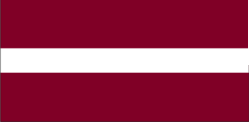
Latvian flag

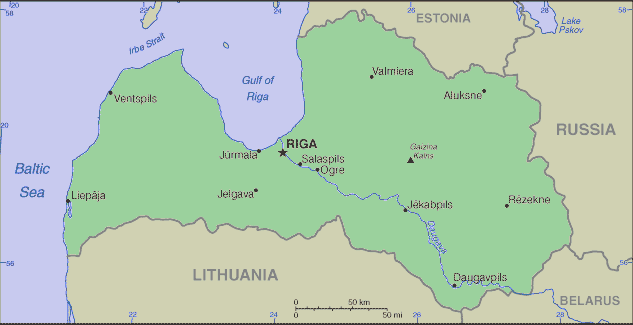
Latvia is located in Eastern Europe, bordering the Baltic Sea, between Estonia and Lithuania.

Latvia has borders with Belarus for 141km, Estonia for 339km, Lithuania for 453km and Russia for 217km.
Land in Latvia is low plain.

Latvian land covers an area of 64589 square kilometers which is slightly larger than West Virginia

As for the Latvian climate; maritime; wet, moderate winters.

Latvian(s) speak Latvian (official) 58.2%, Russian 37.5%, Lithuanian and other 4.3% (2000 census).

Latvia country profile, Travel advice for Latvia

Latvian Map
Places of note in Latvia
Rīga
Daugavpils
Vec-Liepāja
Jelgava
Jūrmala
Ventspils
Rēzekne
Jēkabpils
Valmiyera
Ogre
Tukums
Cēsis
Salaspils
Kuldīga
Olaine
Saldus
Talsi
Dobele
Krāslava
Bauska
Ludza
Sigulda
Līvāni
Gulbene
Madona
Limbaži
Aizkraukle
Preiļi
Balvi
Valka
Smiltene
Aizpute
Lielvārde
Ķekava
Vecumnieki
Regions of Latvia
Aizkraukles Rajons
Alūksnes Rajons
Balvu Rajons
Bauskas Rajons
Cēsu Rajons
Daugavpils
Daugavpils Rajons
Dobeles Rajons
Gulbenes Rajons
Jēkabpils Rajons
Jelgava
Jelgavas Rajons
Jūrmala
Krāslavas Rajons
Kuldīgas Rajons
Latvia (general)
Liepāja
Liepājas Rajons
Limbažu Rajons
Ludzas Rajons
Madonas Rajons
Ogres Rajons
Preiļu Rajons
Rēzekne
Rēzeknes Rajons
Rīga
Rīgas Rajons
Saldus Rajons
Talsu Rajons
Tukuma Rajons
Valkas Rajons
Valmieras Rajons
Ventspils
Ventspils Rajons

After a brief period of independence between the two World Wars, Latvia was annexed by the USSR in 1940. It reestablished its independence in 1991 following the breakup of the Soviet Union. Although the last Russian troops left in 1994, the status of the Russian minority (some 30% of the population) remains of concern to Moscow. Latvia joined both NATO and the EU in the spring of 2004.

Country profile: Latvia

Map of LatviaSituated in north-eastern Europe with a coastline along the Baltic Sea, Latvia is geographically the middle of the three former Soviet Baltic republics.

It has language links with Lithuania to the south and historical and ecumenical ties with Estonia to the north.

Not much more than a decade after it declared independence following the collapse of the USSR, Latvia was welcomed as an EU member in May 2004. The move came just weeks after it joined Nato. These developments would have been extremely hard to imagine in not-so-distant Soviet times.

For centuries Latvia was primarily an agricultural country, with seafaring, fishing and forestry as other important factors in its economy.

Skyline of Riga, 2005 Latvia was under foreign dominion from the 13th until the 20th century. After the first world war it declared independence which Russia recognised in 1920.

Two decades later, following a pact between Stalin and Hitler, Soviet troops invaded in 1940 and Latvia was absorbed into the Soviet Union. Nazi forces pushed the Soviets back in 1941 but the Red Army returned in 1944 and remained for half a century.

During the Soviet period, which ended in 1991, Latvia underwent heavy industrialisation, and experienced a big influx of immigrants from other parts of the USSR, mainly Russia.

About a quarter of the population is Russian-speaking and the rights of this section of society have been a thorny issue since independence. Government reforms introduced in 2004 to restrict the use of the Russian language in schools remain controversial.

Legislation on citizenship was toughened up in 2006. Candidates who fail a Latvian language test three times will be denied citizenship. People without citizenship are entitled neither to vote nor to obtain an EU passport.

There are tensions between Latvia and Russia over border issues. The two countries have yet to sign a treaty formally delineating the border.

Like its Baltic neighbours, in the 10 years since independence Latvia has made a rapid transformation to embrace the free market.

President: Vaira Vike-Freiberga

Prime minister: Aigars Kalvitis

Latvian PM

The ruling centre-right coalition led by Aigars Kalvitis of the centre-right People's Party became Latvia's first government to win re-election in October 2006. It was the country's fifth post-independence general election and the first since Latvia joined the EU and Nato.

The People's Party won 23 seats, while coalition partners the Union of Greens and Farmers took 18 and the First Party 10, giving the coalition 51 seats in the 100-seat parliament. Soon after the election, the government moved to strengthen its position in the legislature by inviting the conservative For Fatherland and Freedom Party with eight MPs to join too.

At the time of the election, Latvia was the poorest country in the EU but had its fastest growing economy. Mr Kalvitis pledged to continue to pursue policies designed to boost the free market.

One of the key challenges lies in keeping inflation down. Latvia aims to join the eurozone in 2008, although the prime minister has indicated that there is some flexibility over the target date.

He was first asked to form a government - the twelfth since independence - when the short-lived minority coalition led by his predecessor, Indulis Emsis of the Greens' and Farmers' Union, collapsed in October 2004.

A former agriculture and economy minister, he has promised to strive for political stability.

  • Foreign minister: Artis Pabriks
  • Finance minister: Oskars Spurdzins

    Latvia's TV market is dominated by the commercial LNT, two networks operated by the national public broadcaster, commercial TV3 Latvia and the Baltic variants of the main Russian networks.

    Dozens of stations sprang up after independence, but their numbers fell back after a broadcasting law was introduced in 1995.

    Public radio and TV are financed by state subsidies and advertising revenue.

    The media operate freely, with few legal restrictions on their work. A law provides prison terms for libel and incitement of racial hatred. A wide range of political viewpoints are represented by some 140 newspapers.

    The press

  • Diena - daily
  • Neatkariga Rita Avize (NRA) - broadsheet, in Latvian
  • Dienas Bizness - business tabloid in Latvian, affiliated to Diena
  • Telegraf - main Russian-language daily
  • Latvijas Avize - tabloid, daily
  • Chas - Russian-language daily
  • Biznes & Baltiya - business broadsheet in Russian
  • Vesti Segodnya - Russian-language daily
  • Vakara Avize Vakara Zinas - evening tabloid, in Latvian
  • Television

  • Latvian Television (LTV) - public, operates LTV1 and LTV7
  • Latvian Independent Television (LNT) - main terrestrial commercial channel
  • TV3 Latvia - commercial
  • TV5 - commercial

    Radio

  • Latvian Radio - public, operates four national networks
  • Radio SWH - commercial
  • Easy FM - commercial
  • Radio NABA - public/university station
  • Radio Skonto - commercial
  • News agencies

  • LETA - English-language pages
  • BNS (Baltic News Service)

    Latvia's transitional economy recovered from the 1998 Russian financial crisis, largely due to the government's budget stringency and a gradual reorientation of exports toward EU countries, lessening Latvia's trade dependency on Russia. The majority of companies, banks, and real estate have been privatized, although the state still holds sizable stakes in a few large enterprises. Latvia officially joined the World Trade Organization in February 1999. EU membership, a top foreign policy goal, came in May 2004. The current account and internal government deficits remain major concerns, but the government's efforts to increase efficiency in revenue collection may lessen the budget deficit. A growing perception that many of Latvia's banks facilitate illicit activity could damage the country's vibrant financial sector.

    Latvian natural resources include peat, limestone, dolomite, amber, hydropower, wood, arable land

    most of the country is composed of fertile, low-lying plains, with some hills in the east

    Latvian religion is Lutheran, Roman Catholic, Russian Orthodox.

    Natural hazards in Latvia include NA.

    Travel Advice on Latvia

    Latvia

    This advice has been reviewed and reissued with amendments to the Health section (EHIC) and General section (EU Aviation Regulations).  The overall level of the advice has not changed.

    SUMMARY

    • The threat from terrorism is low.  But you should be aware of the global risk of indiscriminate terrorist attacks which could be against civilian targets, including places frequented by foreigners.

    • If you visit to forested areas you should seek medical advice about inoculations against rabies and tick-borne encephalitis.

    • Around 75,000 British tourists visit Latvia every year.  Most visits to Latvia are trouble-free.  The main type of incident for which British nationals require consular assistance in Latvia is for lost/stolen passports.

    • Road-hauliers should be prepared for severe delays at all Lithuania-Latvia border crossing points.

    • There have been a number of reports recently of foreign tourists being charged extortionate prices for drinks in bars in Riga.  Check the price of drinks before you order, especially if a stranger asks you to buy a drink for them.

    • We strongly recommend that you obtain comprehensive travel and medical insurance before travelling.  You should check any exclusions, and that your policy covers you for the activities you want to undertake.  Please see:  Travel Insurance.


    SAFETY AND SECURITY

    Crime

    There has been an increase in the number of incidents relating to muggings of foreign nationals (some have had drinks spiked in casinos and clubs before being mugged).  When walking you should be alert to the threat of pickpocketing and other forms of theft.  Always avoid unlit streets and parks at night, and be extra vigilant if walking alone.

    There have been a number of reports recently of foreign tourists being charged extortionate prices for drinks in bars.  Some have then been assaulted or forced to withdraw money from a cashpoint to pay for the bill.  You can help avoid situations like this by ensuring that you check the price of drinks before ordering, pay for one round at a time and seek recommendations for bars from trustworthy sources like your hotel or other holidaymakers.  A search of the internet can also reveal good and bad feedback on individual bars and clubs.

    Car theft is rife.  Wherever possible guarded car parks should be used and valuables kept out of sight.

    Political Situation
    Latvia Country Profile

    Local Travel

    Road-hauliers should be prepared for severe delays at all Lithuania-Latvia border crossing points.

    Road Safety

    Drivers should carry original vehicle registration documents, when crossing the border into Latvia (including for motorcycles).  Those who do not have these documents will not be allowed to take their vehicle back out of Latvia.

    Road traffic accidents are common.  Drivers should not attempt to move a vehicle, which has been involved in an accident, even if it is blocking the road, until the police give permission.  In winter, equip your car for severe conditions.

    Do not drink and drive.  The legal limit is 0.5promille.  Those found over the limit face a fine and immediate imprisonment.

    Winter tyres are required between 1 December and 1 March.  Local law states that drivers must use their headlights at all times, including during daylight hours.


    LOCAL LAWS AND CUSTOMS

    You should not become involved with drugs.  Possession of even very small quantities of drugs can lead to imprisonment.


    ENTRY REQUIREMENTS

    It is the responsibility of all British nationals to ensure that they meet the requirements of Latvian immigration laws.  Latvia joined the European Union on 1 May 2004.
    British Citizen passport holders do not require a visa for stays of up to three months.  British passport holders, whose nationality is shown as anything other than a British Citizen must contact your nearest Latvian Embassy to determine whether you require a visa for entry to Latvia.
    Visitors holding a British Citizen’s passport can remain in Latvia for up to 90 days without a residence permit.  British nationals intending to live and work in Latvia will need to obtain a residence permit from the Latvian Office of Citizenship and Migration Affairs.
    You are required to have health insurance on entering Latvia.  Those who require visas for Latvia need to show policies upon arrival in Latvia.


    HEALTH

    We strongly recommend that you obtain comprehensive travel and medical insurance before travelling.  You should check any exclusions, and that your policy covers you for the activities you want to undertake.  Please see:  Travel Insurance.
    The Form E111 is no longer valid.  You should obtain a European Health Insurance Card (EHIC) before leaving the UK.  The EHIC is not a substitute for medical and travel insurance, but entitles you to emergency medical treatment on the same terms as Latvian nationals.  You will not be covered for medical repatriation, on-going medical treatment or treatment of a non-urgent nature.  For more information about how to obtain the EHIC please see:  Europe and the EHIC.

    Tick-borne encephalitis is a problem in Latvia, especially during the summer months from May to August.  The incidence of mumps is on the increase and rabies is endemic in the region.

    Following a recent outbreak of meningitis in the Latgale region, travellers are advised to seek medical advice before travelling to that region.  Visitors should take precautions such as avoiding crowded places.

    You should seek medical advice before travelling and ensure that all appropriate vaccinations are up to date.  For further information on health, check the Department of Health’s website at:  www.dh.gov.uk

    Avian Influenza (Bird Flu)

    There have been no reported cases of Avian Influenza (also known as Bird Flu) in Latvia during the current series of outbreaks.  But The World Health Organisation (WHO) has confirmed cases elsewhere in the region.
    You should read this advice in conjunction with Avian and Pandemic Influenza Factsheet, which gives more detailed advice and information.


    GENERAL

    If things go wrong when overseas, please see:  What We Can Do To Help.
    EU Aviation Regulations
    The revised EU-wide security measures that came into effect for all passengers departing from UK airports in November 2006 are also being implemented in Latvia.  For more details about this please see:  DfT - Airline Security Update.
    For identification purposes, you should carry a photocopy of your passport at all times. If possible your passport and other important documents should be left in hotel safes.
    You should bring plenty of warm clothing if you intend to travel to Latvia in the winter (October to March).  There is plenty of snow on the ground and temperatures drop to minus 25 degrees or below.
    All major credit cards are accepted and there are plenty of ATM machines for withdrawing local currency using Cirrus and credit cards.
    European Union
    Information on the EU can be found at:  Travelling and Living in the EU (pdf) and Britain in the EU.


  • What is this world index all about?