
 Search
Traveling Luck for Estonia. Estonia, Europe
Estonia is located in Eastern Europe, bordering the Baltic Sea and Gulf of Finland, between Latvia and Russia.
Land in Estonia is marshy, lowlands; flat in the north, hilly in the south.
Estonian land covers an area of 45226 square kilometers which is slightly smaller than New Hampshire and Vermont combined
Estonia has borders with Latvia for 343km and Russia for 338.60000000000002km.
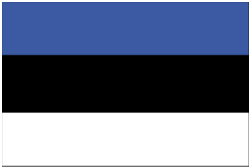 Estonian national flag (Flag of Estonia)
 Estonia country profile
 Travel advice for Estonia
As for the Estonian climate; maritime, wet, moderate winters, cool summers.
Estonian(s) speak Estonian (official) 67.3%, Russian 29.7%, other 2.3%, unknown 0.7% (2000 census).
Places of note in Estonia
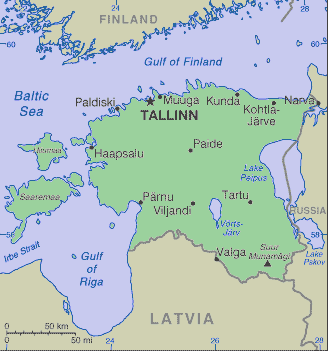 Estonian map
Regions of Estonia
After centuries of Danish, Swedish, German, and Russian rule, Estonia attained independence in 1918. Forcibly incorporated into the USSR in 1940, it regained its freedom in 1991, with the collapse of the Soviet Union. Since the last Russian troops left in 1994, Estonia has been free to promote economic and political ties with Western Europe. It joined both NATO and the EU in the spring of 2004.
Estonia, as a new member of the World Trade Organization and the European Union, has transitioned effectively to a modern market economy with strong ties to the West, including the pegging of its currency to the euro. The economy benefits from strong electronics and telecommunications sectors and is greatly influenced by developments in Finland, Sweden, and Germany, three major trading partners. The current account deficit remains high; however, the state budget is essentially in balance, and public debt is low.
Estonian natural resources include oil shale, peat, phosphorite, clay, limestone, sand, dolomite, arable land, sea mud
the mainland terrain is flat, boggy, and partly wooded; offshore lie more than 1,500 islands
Estonian religion is Evangelical Lutheran 13.6%, Orthodox 12.8%, other Christian (including Methodist, Seventh-Day Adventist, Roman Catholic, Pentecostal) 1.4%, unaffiliated 34.1%, other and unspecified 32%, none 6.1% (2000 census).
Natural hazards in Estonia include sometimes flooding occurs in the spring.
Travel Advice for Estonia
EstoniaSUMMARY
- The threat from terrorism is low. But you should be aware of the global risk of indiscriminate terrorist attacks which could be against civilian targets, including places frequented by foreigners.
- You should be aware that petty theft, especially in Tallinn Old Town, is becoming increasingly common.
- You must have the original V5 C (Vehicle Registration Document) if driving into Estonia.
- Around 65000 British nationals visit Estonia every year. Most visits are trouble-free. The main type of incident for which British nationals require consular assistance in Estonia is for replacing lost or stolen passports, being a victim of petty crime or being arrested for drug possession.
- We strongly recommend that you obtain comprehensive travel and medical insurance before travelling. You should check any exclusions, and that your policy covers you for the activities you want to undertake. Please see: Travel Insurance.
SAFETY AND SECURITY