
 Search
Traveling Luck for Lithuania. Lithuania, Europe
Lithuania is located in Eastern Europe, bordering the Baltic Sea, between Latvia and Russia.
Land in Lithuania is lowland, many scattered small lakes, fertile soil.
Lithuanian land covers an area of 65200 square kilometers which is slightly larger than West Virginia
Lithuania has borders with Belarus for 660km, Latvia for 576km, Poland for 103km and Russia for 273km.
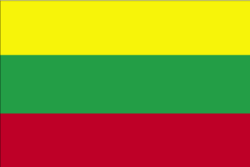 Lithuanian national flag (Flag of Lithuania)
 Lithuania country profile
 Travel advice for Lithuania
As for the Lithuanian climate; transitional, between maritime and continental; wet, moderate winters and summers.
Lithuanian(s) speak Lithuanian (official) 82%, Russian 8%, Polish 5.6%, other and unspecified 4.4% (2001 census).
Places of note in Lithuania
- Vilnius
- Kaunas
- Klaipėda
- Šiauliai
- Panevėžys
- Alytus
- Marijampolė
- Mažeikiai
- Jonava
- Utena
- Kėdainiai
- Telšiai
- Ukmergė
- Visaginas
- Tauragė
- Plungė
- Kretinga
- Šilutė
- Radviliškis
- Palanga
- Druskininkai
- Rokiškis
- Gargždai
- Biržai
- Kuršėnai
- Garliava
- Elektrėnai
- Jurbarkas
- Vilkaviškis
- Raseiniai
- Naujoji Akmenė
- Lentvaris
- Anykščiai
- Grigiškės
- Prienai
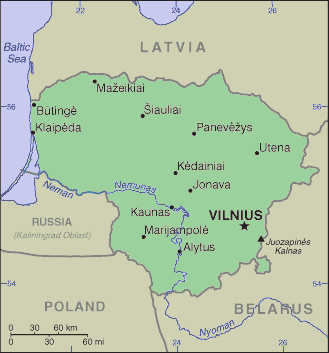 Lithuanian map
Regions of Lithuania
Independent between the two World Wars, Lithuania was annexed by the USSR in 1940. On 11 March 1990, Lithuania became the first of the Soviet republics to declare its independence, but Moscow did not recognize this proclamation until September of 1991 (following the abortive coup in Moscow). The last Russian troops withdrew in 1993. Lithuania subsequently restructured its economy for integration into Western European institutions; it joined both NATO and the EU in the spring of 2004.
Lithuania, the Baltic state that has conducted the most trade with Russia, has slowly rebounded from the 1998 Russian financial crisis. Unemployment dropped from 11% in 2003 to 5.3% in 2005. Growing domestic consumption and increased investment have furthered recovery. Trade has been increasingly oriented toward the West. Lithuania has gained membership in the World Trade Organization and joined the EU in May 2004. Privatization of the large, state-owned utilities, particularly in the energy sector, is nearing completion. Overall, more than 80% of enterprises have been privatized. Foreign government and business support have helped in the transition from the old command economy to a market economy.
Lithuanian natural resources include peat, arable land, amber
fertile central plains are separated by hilly uplands that are ancient glacial deposits
Lithuanian religion is Roman Catholic 79%, Russian Orthodox 4.1%, Protestant (including Lutheran and Evangelical Christian Baptist) 1.9%, other or unspecified 5.5%, none 9.5% (2001 census).
Natural hazards in Lithuania include NA.
Travel Advice for Lithuania
LithuaniaSUMMARY
- The threat from terrorism is low. But you should be aware of the global risk of indiscriminate terrorist attacks which could be against civilian targets, including places frequented by foreigners.
- Road traffic accidents are common. Extra care must be taken at all times when driving, particularly when driving at night.
- Road hauliers should be prepared for severe delays at all Lithuania-Latvia border crossing points.
- You should seek medical advice about inoculations against rabies and tick-borne encephalitis if you intend to visit forested areas.
- Around 25,000 to 30,000 British tourists visit Lithuania every year. The main type of incident for which British nationals require consular assistance in Lithuania is for replacing lost and stolen passports. You should leave your passport in a safe place and keep a copy of it with you for identification purposes.
- We strongly recommend that you obtain comprehensive travel and medical insurance before travelling. You should check any exclusions, and that your policy covers you for the activities you want to undertake. Please see: Travel Insurance
SAFETY AND SECURITY