
 Search
Traveling Luck for Norway. Norway, Europe
Norway is located in Northern Europe, bordering the North Sea and the North Atlantic Ocean, west of Sweden.
Land in Norway is glaciated; mostly high plateaus and rugged mountains broken by fertile valleys; small, scattered plains; coastline deeply indented by fjords; arctic tundra in north.
Norwegian land covers an area of 324220 square kilometers which is slightly larger than New Mexico
Norway has borders with Aland Islands for 727km, Finland for 727km, Russia for 196km and Sweden for 1619km.
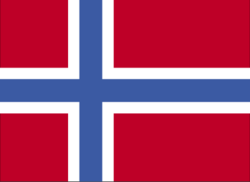 Norwegian national flag (Flag of Norway)
 Norway country profile
 Travel advice for Norway
As for the Norwegian climate; temperate along coast, modified by North Atlantic Current; colder interior with increased precipitation and colder summers; rainy year-round on west coast.
Norwegian(s) speak Bokmal Norwegian (official), Nynorsk Norwegian (official), small Sami- and Finnish-speaking minorities; note - Sami is official in six municipalities.
Places of note in Norway
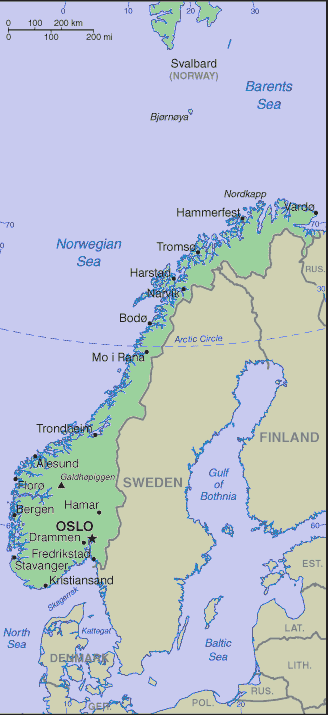 Norwegian map
Regions of Norway
Two centuries of Viking raids into Europe tapered off following the adoption of Christianity by King Olav TRYGGVASON in 994. Conversion of the Norwegian kingdom occurred over the next several decades. In 1397, Norway was absorbed into a union with Denmark that lasted more than four centuries. In 1814, Norwegians resisted the cession of their country to Sweden and adopted a new constitution. Sweden then invaded Norway but agreed to let Norway keep its constitution in return for accepting the union under a Swedish king. Rising nationalism throughout the 19th century led to a 1905 referendum granting Norway independence. Although Norway remained neutral in World War I, it suffered heavy losses to its shipping. Norway proclaimed its neutrality at the outset of World War II, but was nonetheless occupied for five years by Nazi Germany (1940-45). In 1949, neutrality was abandoned and Norway became a member of NATO. Discovery of oil and gas in adjacent waters in the late 1960s boosted Norway's economic fortunes. The current focus is on containing spending on the extensive welfare system and planning for the time when petroleum reserves are depleted. In referenda held in 1972 and 1994, Norway rejected joining the EU.
The Norwegian economy is a prosperous bastion of welfare capitalism, featuring a combination of free market activity and government intervention. The government controls key areas such as the vital petroleum sector (through large-scale state enterprises). The country is richly endowed with natural resources - petroleum, hydropower, fish, forests, and minerals - and is highly dependent on its oil production and international oil prices, with oil and gas accounting for one-third of exports. Only Saudi Arabia and Russia export more oil than Norway. Norway opted to stay out of the EU during a referendum in November 1994; nonetheless, it contributes sizably to the EU budget. The government has moved ahead with privatization. Norwegians worry about that time in the next two decades when the oil and gas will begin to run out; accordingly, Norway has been saving its oil-boosted budget surpluses in a Government Petroleum Fund, which is invested abroad and now is valued at more than $150 billion. After lackluster growth of 1% in 2002 and 0.5% in 2003, GDP growth picked up to 3.3% in 2004 and to 3.7% in 2005.
Norwegian natural resources include petroleum, natural gas, iron ore, copper, lead, zinc, titanium, pyrites, nickel, fish, timber, hydropower
about two-thirds mountains; some 50,000 islands off its much indented coastline; strategic location adjacent to sea lanes and air routes in North Atlantic; one of most rugged and longest coastlines in the world
Norwegian religion is Church of Norway 85.7%, Pentecostal 1%, Roman Catholic 1%, other Christian 2.4%, Muslim 1.8%, other 8.1% (2004).
Natural hazards in Norway include rockslides, avalanches.
Travel Advice for Norway
NorwaySUMMARY
- The threat from terrorism is low. But you should be aware of the global risk of indiscriminate terrorist attacks, which could be against civilian targets, including places frequented by foreigners.
- Around 250,000 British tourists visit Norway every year. Most visits are trouble-free. The main type of incident for which British nationals require consular assistance in Norway is for arrests for drugs offences and replacing lost or stolen passports. Petty crime does occur but at a low level compared to other European countries.
- You should be aware that drugs and drink driving laws are stricter in Norway than in the UK.
- We strongly recommend that comprehensive travel and medical insurance is obtained before travelling. You should check any exclusions, and that your policy covers you for the activities you want to undertake. Please see: Travel Insurance.
SAFETY AND SECURITY
Norwegian authorities allow the importation of up to a maximum of 10kgs (combined total) of meat and cheese for personal consumption. If you have any other import queries may contact http://www.defra.gov.uk/animalh/int-trde/gen-inf/controls.htm for additional information.
ENTRY REQUIREMENTS
HEALTH
GENERAL
OTHER