World index ... Europe ... Aland Islands
Travelers word index

Aland Islands

Continents
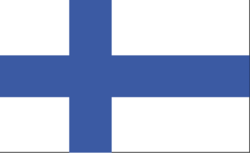
Finnish flag

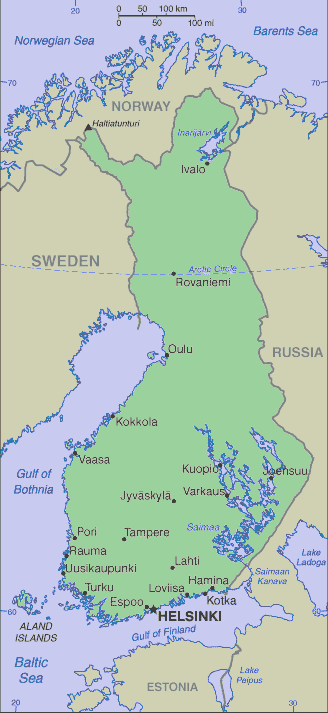
Finland is located in Northern Europe, bordering the Baltic Sea, Gulf of Bothnia, and Gulf of Finland, between Sweden and Russia.

Aland Islands has borders with Norway for 727km, Russia for 1340km and Sweden for 614km.
Land in Finland is mostly low, flat to rolling plains interspersed with lakes and low hills.

Finnish land covers an area of 338145 square kilometers which is slightly smaller than Montana

As for the Finnish climate; cold temperate; potentially subarctic but comparatively mild because of moderating influence of the North Atlantic Current, Baltic Sea, and more than 60,000 lakes.

Finn(s) speak Finnish 92% (official), Swedish 5.6% (official), other 2.4% (small Sami- and Russian-speaking minorities) (2003).

Aland Islands country profile, Travel advice for Aland Islands

Finnish Map
Places of note in Aland Islands
Helsinki
Espoo
Tampere
Turku
Oulu
Lahti
Kuopio
Jyväskylä
Pori
Lappeenranta
Vasa
Kotka
Joensuu
Hämeenlinna
Borgå
Mikkeli
Hyvinkää
Järvenpää
Nurmijärvi
Rauma
Lojo
Karleby
Kajaani
Jyväskylän Maalaiskunta
Rovaniemi
Tuusula
Kirkkonummi
Seinäjoki
Kerava
Kouvola
Imatra
Nokia
Savonlinna
Riihimäki
Vihti
Regions of Aland Islands
Ahvenanmaa
Etelä-Suomen Lääni
(FI02)
(FI03)
(FI04)
(FI05)
(FI07)
(FI09)
(FI10)
(FI11)
(FI12)
Finland (general)
Itä-Suomen Lääni
Länsi-Suomen Lääni
Lappi
Oulu Lääni

Finland was a province and then a grand duchy under Sweden from the 12th to the 19th centuries and an autonomous grand duchy of Russia after 1809. It won its complete independence in 1917. During World War II, it was able to successfully defend its freedom and resist invasions by the Soviet Union - albeit with some loss of territory. In the subsequent half century, the Finns made a remarkable transformation from a farm/forest economy to a diversified modern industrial economy; per capita income is now on par with Western Europe. As a member of the European Union, Finland was the only Nordic state to join the euro system at its initiation in January 1999.

Country profile: Finland

Map of FinlandAround two-thirds of Finland is covered in forest and about a tenth by water. In the far north the White Nights, during which the sun does not set, last for around 10 weeks of the summer. In winter the same area goes through nearly eight weeks when the sun never rises above the horizon.

This wild northern landscape inspired Finland's greatest composer Jean Sibelius. His work came to symbolise the country's struggle for independence in the early 20th century after centuries under the domination of its neighbours.

Hundreds of years of Swedish rule were followed by a further century of Russian control. The country displays distinctive elements of past Scandinavian and Russian links in its style and culture.

Independence in 1917 failed to stem the demands of Finland's giant eastern neighbour. World War II saw fierce fighting along Finland's eastern border.

Helsinki, cathedral and square Finnish troops mounted a vigorous response to Soviet forces and stalled their advance, but the country was eventually forced to cede 10% of its territory and make extensive war reparation payments to the Soviets.

The collapse of the Soviet Union in the early 1990s allowed Finland to step out of the Cold War shadow. It applied for membership of the EU soon after its friendship treaty with the Soviet Union became void in 1991, becoming a full member in 1995.

Finland is the only Nordic EU member to adopt the euro as the national currency.

The country invests heavily in education, training and research, investment which pays dividends by delivering one of the best educated and trained workforces in the world. This has been a key factor in the development of a modern, competitive economy in which a cutting-edge telecommunications sector has been added to the traditional timber and metals industries.

President: Tarja Halonen

Finnish president

Tarja Halonen became Finland's first woman president in 2000 and was re-elected in January 2006. She comes from the centre-left of the country's politics.

The role of the president is focused mainly on foreign policy.

Prime minister: Matti Vanhanen

Matti Vanhanen took over as prime minister in June 2003. His predecessor, Anneli Jaatteenmaki, resigned in a row over allegations about the use of leaked secret information to help secure what turned out to be a short-lived election victory two months earlier. She was subsequently acquitted in court on related charges.

Finnish prime minister

Like his predecessor, Mr Vanhanen is a member of the Centre Party which governs in a centre-left coalition with the Social Democrats and the Swedish People's Party.

He has made tackling unemployment one of his priorities. Just under 10 per cent of the workforce is jobless.

Mr Vanhanen, a former journalist, was defence minister before becoming prime minister at 47.

He was a candidate in the presidential election in January 2006 but was knocked out of the race when he came third in the first round.

  • Foreign minister: Erkki Tuomioja
  • Interior minister: Kari Rajamaeki
  • Finance minister: Eero Heinaeluoma

    Finland's broadcasting sector is very dynamic and the country is digitising its transmission network. Analogue TV broadcasts are expected to end in 2007.

    Public YLE operates radio and TV networks. New stations have emerged in a market once dominated by YLE and the established private broadcaster MTV. Pay-TV channels are provided by pan-Nordic operator Canal+.

    Finnish law gives every citizen the right to publish printed material, and guarantees the right of reply. Newspapers are privately owned and reflect a range of political views.

    The press

  • Helsingin Sanomat - Helsinki daily, English-language pages
  • Ilta-Sanomat - Helsinki, evening daily
  • Hufvudstadsbladet - Helsinki, Swedish-language daily
  • Kauppalehti - Helsinki, business daily
  • Taloussanomat - Helsinki, business daily
  • Aamulehti - Tampere, daily
  • Turun Sanomat - Turku, daily
  • Demari - Helsinki, organ of Social Democratic Party
  • Kansan Uutiset - Helsinki, organ of Left Alliance
  • Iltalehti - Helsinki, evening daily

    Television

  • Yleisradio Oy (YLE) - public, operates several channels in Finnish and Swedish
  • MTV3 - private
  • Nelonen (Channel 4) - private

    Radio

  • Yleisradio Oy (YLE) - public, operates several channels in Finnish, Swedish and Sa'mi (Lappish) and external service Radio Finland
  • Classic FM - commercial
  • Kiss FM - commercial
  • Radio Nova - national, commercial
  • NRJ - commercial

    News agency

  • Finnish News Agency - Suomen Tietotoimisto (STT) - in Finnish, Swedish and English

    Finland has a highly industrialized, largely free-market economy with per capita output roughly that of the UK, France, Germany, and Italy. Its key economic sector is manufacturing - principally the wood, metals, engineering, telecommunications, and electronics industries. Trade is important; exports equal two-fifths of GDP. Finland excels in high-tech exports, e.g., mobile phones. Except for timber and several minerals, Finland depends on imports of raw materials, energy, and some components for manufactured goods. Because of the climate, agricultural development is limited to maintaining self-sufficiency in basic products. Forestry, an important export earner, provides a secondary occupation for the rural population. Rapidly increasing integration with Western Europe - Finland was one of the 12 countries joining the European Economic and Monetary Union (EMU) - will dominate the economic picture over the next several years. High unemployment remains a persistent problem.

    Finnish natural resources include timber, iron ore, copper, lead, zinc, chromite, nickel, gold, silver, limestone

    long boundary with Russia; Helsinki is northernmost national capital on European continent; population concentrated on small southwestern coastal plain

    Finnish religion is Lutheran National Church 84.2%, Greek Orthodox in Finland 1.1%, other Christian 1.1%, other 0.1%, none 13.5% (2003).

    Natural hazards in Finland include NA.

    Travel Advice on Aland Islands

    Finland

    This advice has been reviewed and reissued with amendments to the Summary and Terrorism section.  The overall level of the advice has not changed.

    SUMMARY

    • The threat from terrorism in Finland is low.  Attacks could be indiscriminate and against civilian targets.

    • Finland can be affected by severe cold weather in the winter months, particularly in the North. You should be prepared for harsh conditions and if driving in the winter months cars should be winterised.

    • Most visits to Finland are trouble-free. The main type of incident for which British nationals require consular assistance in Finland is for replacing lost and stolen passports.

    • We strongly recommend that you obtain comprehensive travel and medical insurance before travelling. You should check any exclusions, and that your policy covers you for the activities you want to undertake. Please see: Travel Insurance.


    SAFETY AND SECURITY

    EU Aviation Regulations
    The revised EU-wide security measures that came into effect for all passengers departing from UK airports in November 2006 are also being implemented in Finland.  For more details about this please see:  DfT - Airline Security Update.
    Remember the currency for Finland is the Euro.
    Finland, and in particular the north of the country, does get affected by severe cold weather during the winter months.  Temperatures can be extremely low and if you visit in winter you should come prepared for these harsh conditions.  The spring and summer months can be very pleasant and temperatures are generally on a par with the UK.
    Information on the EU can be found at: Travelling and Living in the EU (pdf) and Britain in the EU.


  • What is this world index all about?