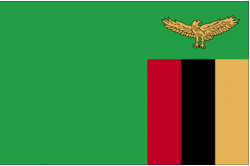
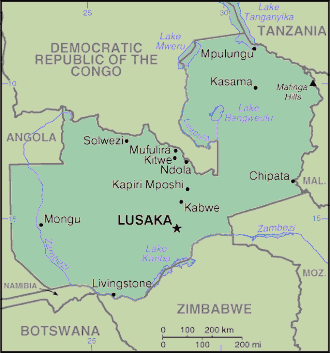
Zambia is located in Southern Africa, east of Angola.
Land in Zambia is mostly high plateau with some hills and mountains.
Zambian land covers an area of 752614 square kilometers which is slightly larger than Texas
As for the Zambian climate; tropical; modified by altitude; rainy season (October to April).
Zambian(s) speak English (official), major vernaculars - Bemba, Kaonda, Lozi, Lunda, Luvale, Nyanja, Tonga, and about 70 other indigenous languages.
The territory of Northern Rhodesia was administered by the [British] South Africa Company from 1891 until it was taken over by the UK in 1923. During the 1920s and 1930s, advances in mining spurred development and immigration. The name was changed to Zambia upon independence in 1964. In the 1980s and 1990s, declining copper prices and a prolonged drought hurt the economy. Elections in 1991 brought an end to one-party rule, but the subsequent vote in 1996 saw blatant harassment of opposition parties. The election in 2001 was marked by administrative problems with three parties filing a legal petition challenging the election of ruling party candidate Levy MWANAWASA. The new president launched an anti-corruption campaign in 2002, which resulted in the prosecution of former President Frederick CHILUBA and some officials of his administration.
Country profile: Zambia
Zambia has moved from being a major copper producer and potentially one of the continent's richest countries at independence in 1964 to one of the world's poorest.
A colonial legacy, mismanagement, debt and disease are said to have contributed to the country's tribulations.
Politically, it switched from colonial government into an era of one-party rule lasting 27 years. A multi-party system emerged in the early 1990s.
Zambia is landlocked and sparsely populated by more than 70 ethnic groups, many of them Bantu-speaking. It has some spectacular scenery, including the Victoria Falls along the Zambezi river, the Bangweulu Swamps and the Luangwa river valley.
AT-A-GLANCE- Politics: President Mwanawasa won a second term in 2006, months after suffering a minor stroke
- Economy: Improved copper prices and investment in mining have improved prospects for export earnings
- International: Thousands of refugees from the Angolan civil war have yet to return home
In the late 1960s it was the third largest copper miner, after the US and the Soviet Union. World copper prices collapsed in 1975 with devastating effects on the economy.
The World Bank has urged Zambia to develop other sources of revenue - including tourism and agriculture. Even so, copper accounts for most of Zambia's foreign earnings and there is optimism about the future of the industry, which was privatised in the 1990s. Electronics manufacturers have fuelled demand and investment in mines has grown.
Aids is blamed for decimating the cream of Zambian professionals - including engineers and politicians - and malaria is a major problem. Millions of Zambians live below the World Bank poverty threshold of $1 a day.
Zambia hosts tens of thousands of refugees who have fled fighting in the Democratic Republic of Congo.
- Full name: Republic of Zambia
- Population: 11 million (UN, 2005)
- Capital: Lusaka
- Area: 752,614 sq km (290,586 sq miles)
- Major language: English (official), Bemba, Lozi, Nyanja, Tonga
- Major religions: Christianity, indigenous beliefs, Hinduism, Islam
- Life expectancy: 38 years (men), 37 years (women) (UN)
- Monetary unit: 1 Kwacha = 100 ngwee
- Main exports: Copper, minerals, tobacco
- GNI per capita: US $490 (World Bank, 2006)
- Internet domain: .zm
- International dialling code: +260
President: Levy Mwanawasa
President Levy Mwanawasa won a second term in September 2006, having campaigned on his economic record.
Mr Mwanawasa took 43% of the vote compared with the 29% of his main rival, Michael Sata, who alleged that he had been cheated of victory. Some unrest followed the vote.
Mr Mwanawasa began his first term after a narrow election win in 2001.
Though initially seen by some as a handpicked puppet of his predecessor Frederick Chiluba, he was quick to remove Mr Chiluba's aides from the government.
He has made the fight against corruption a centrepiece of his presidency, giving the green light to investigations into alleged graft during the Chiluba era. He pressed for the former president's immunity from prosecution to be lifted.
Western donors have praised him for boosting economic growth to above 5% and attracting foreign investments, helped by his anti-graft campaign.
The International Monetary Fund, World Bank and Western donors have rewarded Mr Mwanawasa by cutting Zambia's foreign debt to $502 million from an estimated $7.2 billion in June 2005.
His success followed some years in the political wilderness. He resigned from the government in 1994, citing corruption as the reason. Supporters and detractors alike agree that he displays a high level of integrity in his public life.
Mr Mwanawasa was born in 1948, and is married with six children. He has been a practising lawyer since 1973. In his most famous case, he defended former vice president Lt-Gen Christon Tembo and others, who were charged in 1989 with plotting to overthrow Kenneth Kaunda.
The president's health is an issue, especially for his opponents. He was involved in a near-fatal road accident in 1992 which left him with slurred speech. In April 2006 he suffered a minor stroke.
State-run radio and television services dominate Zambia's broadcasting scene. Private radio stations offer little political reporting.
The authorities make use of several laws, including libel and security laws, to intimidate journalists, especially those who have reported on corruption. Defaming the president is a criminal offence.
FM relays of BBC World Service and Radio France Internationale are on the air in Lusaka and Kitwe. Multichannel pay-TV services are available.
The press
Zambia Daily Mail - state-owned
Times of Zambia - state-owned
The Post - private
Sunday Times of Zambia - state-owned
Television
Zambia National Broadcasting Corporation (ZNBC) - single-channel state-run TV
Radio
Zambia National Broadcasting Corporation (ZNBC) - state-run radio operates three services; multilingual Radio 1 and English-language Radio 2 and Radio 4
QFM - private Lusaka music station
Radio Phoenix - private
Radio Icengelo - church-owned
Breeze FM - private station in Chipata
Yatsani Radio - Catholic station
Radio Choice - private station in Lusaka
News agency
Zambia News Agency (Zana)Despite progress in privatization and budgetary reform, Zambia's economic growth remains somewhat below the 6%-7% needed to reduce poverty significantly. Privatization of government-owned copper mines relieved the government from covering mammoth losses generated by the industry and greatly improved the chances for copper mining to return to profitability and spur economic growth. Copper output has increased steadily since 2004, due to higher copper prices and the opening of new mines. The maize harvest was again good in 2005, helping boost GDP and agricultural exports. Cooperation continues with international bodies on programs to reduce poverty, including a new lending arrangement with the IMF in the second quarter of 2004. A tighter monetary policy will help cut inflation, but Zambia still has a serious problem with high public debt.
Zambian natural resources include copper, cobalt, zinc, lead, coal, emeralds, gold, silver, uranium, hydropower
landlocked; the Zambezi forms a natural riverine boundary with Zimbabwe
Zambian religion is Christian 50%-75%, Muslim and Hindu 24%-49%, indigenous beliefs 1%.
Natural hazards in Zambia include periodic drought, tropical storms (November to April).
Zambia
This advice has been reviewed and reissued with an amendment to the Health section (rabies). The overall level of the advice has not changed.
SUMMARY
- We advise against all but essential travel to the parts of the north western Copperbelt, Central and Luapula provinces, which are close to the border with the Democratic Republic of Congo (DRC), particularly after dark. There are continuing reports of armed cross-border raids from the DRC. You should also be aware of landmines in this area, and on the borders with Angola and Mozambique.
- The threat from terrorism is low. But you should be aware of the global risk of indiscriminate terrorist attacks which could be against civilian targets, including places frequented by foreigners.
- Around 100,000 British tourists visit Zambia every year and most visits are trouble free, although armed robberies and car hijackings are on the increase. The main types of incident for which British nationals require consular assistance in Zambia are for stolen passports and drug and immigration offences.
- We strongly recommend that you obtain comprehensive travel and medical insurance before travelling. You should check any exclusions, and that your policy covers you for the activities you want to undertake. Please see: Travel Insurance
SAFETY AND SECURITY
Political Situation
Zambia Country Profile
Avoid large crowds, demonstrations and obvious political gatherings. Trouble on the streets can be spontaneous. For example there are occasional student demonstrations, which can lead to violence, at the University of Zambia on the Great East Road, which is the main route to and from Lusaka International Airport.
Local Travel
We advise against all but essential travel to the parts of the north western Copperbelt, Central and Luapula provinces, which are close to the order with the Democratic Republic of Congo (DRC), particularly after dark.
There are continuing reports of armed cross-border raids from the DRC. These are often cattle or food raids, targeting border villages, but some have been attributed to the Congolese Mai Mai faction. Travel in the bush for hunting or prospecting along this border is not advised. The use of legitimate border crossings is safe, though Congolese officials may request payments.
The border area between Zambia and Angola also remains sensitive. However, talks about the opening of official border crossing points between the two countries in North Western Province, with a view to easing the movement of people and trade are ongoing.
Landmines are a danger in Zambia's border areas, particularly those neighbouring Angola, the DRC and Mozambique. British residents who consider their presence essential in these border areas should be cautious about venturing off the main roads.
Wild animals in the bush are unpredictable and do kill. Whether travelling on land or water, you are at risk of potentially fatal animal attacks. It is important to observe local regulations at all times and always to follow your tour or safari guide’s instructions.
Adventure sports, such as those on offer in the Victoria Falls area, carry inherent risks. Serious accidents and deaths occasionally occur. The medical care available in such emergencies varies greatly in quality. Participants should follow operators’ safety instructions closely. Your insurance policy must cover any adventure sports you may wish to undertake.
Road Safety
The Zambian Road Traffic Commission allows holders of UK driving licences to drive in Zambia for up to 90 days. Anyone intending to stay longer than 90 days will need to obtain an International Driving Permit or a Zambian driving licence.
Road travel at night in rural areas can be hazardous. Abandoned vehicles, pedestrians and stray animals are a danger to road users. Many roads are severely pot-holed or otherwise unsafe, especially during the rainy season (November-April) when bridges and roads risk being washed away by sudden floods. There are frequent fatal crashes. There are also dangers in urban areas, including in Lusaka: vehicles are often poorly lit, inadequately maintained and badly driven. There have been incidents of road rage. No matter the provocation, care should be taken not to retaliate particularly by gesticulating.
Travel by long-distance public transport can be hazardous owing to poor standards of driving, lack of rest periods for drivers on long journeys, dilapidated vehicles and poor road conditions. Minibuses used in urban areas are usually severely overcrowded, poorly maintained and badly driven.
Air Safety
The EU has published a list of air carriers that are subject to an operating ban or restrictions within the community. You should check the following link to see whether this will affect your travel: http://europa.eu.int/comm/transport/air/safety/flywell_en.htm.
LOCAL LAWS AND CUSTOMS
The possession or use of narcotics, including soft drugs such as marijuana, is strictly prohibited. Customs may ask to see prescriptions for any medication brought into the country. Drug taking and smuggling is an offence. The punishments can be severe. Prisons in Zambia are basic and overcrowded with little sanitation and inadequate food and medical services.
The possession of pornographic material is illegal in Zambia and offenders may be jailed and/or deported.
Homosexuality is illegal in Zambia and those caught engaging in homosexual acts can be sentenced to several years’ imprisonment.
It is an offence to use a cellphone whilst driving.
The Zambian authorities do not always inform the British High Commission when British Nationals have been arrested. If you are detained, you may insist on your right to contact a British consular officer.
ENTRY REQUIREMENTS
British passport holders require a visa to enter Zambia. It is best to obtain visas prior to travel in order to avoid any potential problems with the airlines or with the Zambian Immigration Authorities – see volunteer workers below. Visas can be obtained from the Zambian High Commission in London – see address below. However, single entry visit visas are available at all ports of entry at a cost of £35. You must pay in Sterling. It is important to carry the exact amount with you, as change may not be available. For further information on Zambian visa requirements you should contact: Zambian representation in the UK, rather than relying solely on advice from sponsoring organisations and local non-governmental organisations (NGOs). On leaving Zambia, non-residents pay a departure tax of US$25, payable in Dollars. Residents can pay either US$25 or the Kwacha equivalent.
There is a special provision for day visitors coming across the border from Zimbabwe into Livingstone. They pay only a fee of US$10 for a "Day Tripper Visa" but they must exit Zambia on the same day before the border closes at 18:00 hours.
Zambia does not recognise dual nationality. So it is important to be able to produce a passport bearing the exit stamp from the country from which you have travelled.
Any non-Zambian national overstaying their visa, not renewing their residence permit or working without a permit, including volunteer workers who should obtain business visas from the Zambian High Commission in London prior to departure or upon arrival in Lusaka, risk arrest, imprisonment and deportation. Agents claiming to be able to obtain residence and work permits from the Immigration Department for foreign nationals may be bogus and the documents they provide may be forged.
Single parents or other adults travelling alone with children should be aware that some countries require documentary evidence of parental responsibility before allowing lone parents to enter the country or, in some cases, before permitting the children to leave the country. For further information on exactly what will be required at immigration, please contact the Zambian representation in the UK.
HEALTH
We strongly recommend that before travelling, you obtain comprehensive travel and medical insurance, which should include cover for medical evacuation by air ambulance. You should check any exclusions, and that your policy covers you for the activities you want to undertake. Please see: Travel Insurance
On arrival in Zambia, customs officials may ask to see prescriptions for any medication brought into the country.
Medical facilities and communications are poor, especially in rural areas. Even basic drugs and clean needles may not be available. In the event of a serious accident or illness, emergency services are limited. You should know your blood group. You should carry a sterile medical kit including needles, dressings etc.
Malaria, including cerebral malaria, is endemic in Zambia and poses a serious risk, particularly to visitors from non-endemic countries. You should take adequate precautions against being bitten by mosquitoes. More than three-quarters of British travellers who contracted malaria in 2005 did not take preventive measures, such as malaria prevention tablets. However, malaria can occur despite appropriate prevention, and therefore you should promptly seek medical care in the event of a fever or flu-like illness in country or in the first year following your return from travelling to a malaria risk country. Before travelling you should seek medical advice about the malaria risk in Zambia.
Rabies is common in animals. The rabies virus is transmitted through the saliva of infected animals and transmitted to humans through bites, scratches or contact of saliva with broken skin and can be fatal once symptoms manifest themselves. All travellers who have possibly been exposed to the rabies virus, whether by bites, scratches or other exposure, should seek medical advice without delay (even if pre-exposure vaccine was received). This also applies to travellers in low risk areas in case other animal-transmitted infections are present, or the animal may have strayed across the border from an endemic country. More information can be found on the National Travel Health Network and Centre website at: http://www.nathnac.org
There is a high prevalence of tuberculosis (TB) throughout the country.
HIV/AIDS affects a high proportion of the population and you should be particularly alert to the dangers of unprotected sex.
Outbreaks of cholera and dysentery are endemic and are especially prevalent during the rainy season (November-April). The border at Chiengi was closed by the Zambian Government after an outbreak of cholera in the area. It has since re-opened. Drinking water should be filtered and boiled or bought in brand bottles with unbroken seals. You should only eat food, which has been thoroughly cooked, and for which basic hygiene precautions have been taken. Food purchased from local street vendors may not meet adequate hygiene standards.
You should seek medical advice before travelling and ensure that all appropriate vaccinations are up to date. For further information on health, check the Department of Health’s website at: www.dh.gov.uk
GENERAL
If things go wrong when overseas, please see: What We Can Do To Help
Long-term visitors and residents should register on arrival with the British High Commission in Lusaka.
Money
ATMs are available within Lusaka and some of the major towns in Zambia. The major credit cards are increasingly accepted by the larger shops, hotels, restaurants and tour operators though paper rather than electronic transactions are the norm. You should ensure that credit cards are swiped no more than necessary and that all carbons are destroyed. In Lusaka you should use reputable banks and Bureaux de Change to exchange money or use ATMs, as counterfeit US$100 and Zambian Kwacha 50,000 notes are in circulation.