
 Search
Traveling Luck for Namibia. Namibia, Africa
Namibia is located in Southern Africa, bordering the South Atlantic Ocean, between Angola and South Africa.
Land in Namibia is mostly high plateau; Namib Desert along coast; Kalahari Desert in east.
Namibian land covers an area of 825418 square kilometers which is slightly more than half the size of Alaska
Namibia has borders with Angola for 1376km, Botswana for 1360km, South Africa for 967km and Zambia for 233km.
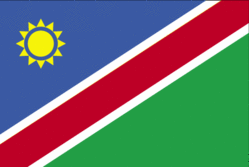 Namibian national flag (Flag of Namibia)
 Namibia country profile
 Travel advice for Namibia
As for the Namibian climate; desert; hot, dry; rainfall sparse and erratic.
Namibian(s) speak English 7% (official), Afrikaans common language of most of the population and about 60% of the white population, German 32%, indigenous languages (Oshivambo, Herero, Nama).
Places of note in Namibia
- Windhoek
- Rundu
- Walvisbaai
- Oshakati
- Swakopmund
- Katima Mulilo
- Grootfontein
- Rehoboth
- Otjiwarongo
- Okahandja
- Gobabis
- Keetmanshoop
- Lüderitz
- Mariental
- Tsumeb
- Khorixas
- Omaruru
- Bethanie
- Ongwediva
- Usakos
- Ondangwa
- Oranjemund
- Otjimbingwe
- Karibib
- Warmbad
- Outjo
- Karasburg
- Okakarara
- Opuwo
- Otavi
- Arandis
- Hentiesbaai
- Aranos
- Ongandjera
- Oshikango
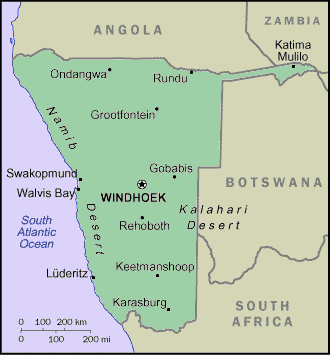 Namibian map
Regions of Namibia
- Caprivi
- Erongo
- Hardap
- Karas
- Khomas
- Kunene
- Namibia (general)
- Ohangwena
- Okavango
- Omaheke
- Omusati
- Oshana
- Oshikoto
- Otjozondjupa
- (WA01)
- (WA02)
- (WA03)
- (WA04)
- (WA05)
- (WA06)
- (WA07)
- (WA08)
- (WA09)
- (WA10)
- (WA11)
- (WA12)
- (WA13)
- (WA14)
- (WA15)
- (WA16)
- (WA17)
- (WA18)
- (WA20)
- (WA22)
- (WA23)
- (WA24)
- (WA25)
- (WA26)
- (WA27)
- (WA40)
South Africa occupied the German colony of South-West Africa during World War I and administered it as a mandate until after World War II, when it annexed the territory. In 1966 the Marxist South-West Africa People's Organization (SWAPO) guerrilla group launched a war of independence for the area that was soon named Namibia, but it was not until 1988 that South Africa agreed to end its administration in accordance with a UN peace plan for the entire region. Namibia won its independence in 1990 and has been governed by SWAPO since. Hifikepunye POHAMBA was elected president in November 2004 in a landslide victory replacing Sam NUJOMA who led the country during its first 14 years of self rule.
The economy is heavily dependent on the extraction and processing of minerals for export. Mining accounts for 20% of GDP. Rich alluvial diamond deposits make Namibia a primary source for gem-quality diamonds. Namibia is the fourth-largest exporter of nonfuel minerals in Africa, the world's fifth-largest producer of uranium, and the producer of large quantities of lead, zinc, tin, silver, and tungsten. The mining sector employs only about 3% of the population while about half of the population depends on subsistence agriculture for its livelihood. Namibia normally imports about 50% of its cereal requirements; in drought years food shortages are a major problem in rural areas. A high per capita GDP, relative to the region, hides the world's worst inequality of income distribution. The Namibian economy is closely linked to South Africa with the Namibian dollar pegged one-to-one to the South African rand. Privatization of several enterprises in coming years may stimulate long-run foreign investment. Increased fish production and mining of zinc, copper, uranium, and silver spurred growth in 2003-05.
Namibian natural resources include diamonds, copper, uranium, gold, lead, tin, lithium, cadmium, zinc, salt, hydropower, fish
note: suspected deposits of oil, coal, and iron ore
first country in the world to incorporate the protection of the environment into its constitution; some 14% of the land is protected, including virtually the entire Namib Desert coastal strip
Namibian religion is Christian 80% to 90% (Lutheran 50% at least), indigenous beliefs 10% to 20%.
Natural hazards in Namibia include prolonged periods of drought.
Travel Advice for Namibia
NamibiaSUMMARY
- If travelling along the Caprivi Strip, stick to the well-travelled routes.
- The threat from terrorism is low. But you should be aware of the global risk of indiscriminate terrorist attacks which could be against civilian targets, including places frequented by foreigners.
- Most visits to Namibia are trouble free. The main types of incident for which British nationals require consular assistance in Namibia are road accidents and muggings (three and six cases respectively in 2005). You should avoid driving at night as wildlife and livestock pose a serious hazard.
- You should carry some form of identification with you at all times. A photocopy of the relevant pages from your passport is sufficient.
- We strongly recommend that you obtain comprehensive travel and medical insurance before travelling. You should check any exclusions and that your policy cover you for the activities you want to undertake. Please see: Travel Insurance.
SAFETY AND SECURITY
Crime
Theft from vehicles, particularly at service stations, and street crime are common. Take sensible precautions. Keep your vehicle locked, and valuable possessions out of sight.
Beware of pickpockets in town centres. Avoid using taxis if possible, and never take one alone. Do not enter townships at night unless accompanied by someone with local knowledge.
Take sensible precautions. Safeguard valuables and cash. Deposit them in hotel safes, where practical. Keep separate copies of important documents, including passports.
Local Travel
If you travel along the Trans-Caprivi Highway between Rundu and Katima Mulilo (in the Caprivi Strip), or in other remote areas of northern Namibia, you should travel during daylight hours and stick to well travelled routes. The Namibian authorities are clearing unexploded ordinance from areas that are barred to public access.
Road Safety
You can drive in Namibia with an UK Photo Driving Licence. If you wish to hire a car, you should also bring the paper counterpart with you. You must carry your licence at all times and produce it on request at roadblocks leading in and out of Windhoek and other major towns and cities. You are not allowed to use a mobile phone whilst driving.
It is easy to lapse into a false sense of security on Namibian roads, because most are well maintained and there is little traffic. But there have been a number of fatal accidents on gravel/dirt roads, especially on bends in the road. It is dangerous to exceed the speed limit of 80km.
During the rainy seasons many roads can become impassable.
You should avoid driving at night outside the towns as wildlife and stray livestock can pose a serious hazard. Tyre punctures are common on the gravel roads; if possible, carry two spare tyres. It may also be necessary to adjust tyre pressures to suit differing road conditions. Keep your petrol tank topped up, as there are long distances between petrol stations.
Air Safety
The EU has published a list of air carriers that are subject to an operating ban or restrictions within the community. You should check the following link to see whether this will affect your travel: http://europa.eu.int/comm/transport/air/safety/flywell_en.htm.
LOCAL LAWS AND CUSTOMS
Homosexuality is tolerated.
There are no formal rules and regulations limiting photography by tourists in Namibia, but we are aware that some people have been detained for taking pictures of State House and properties where the President is residing. There are also parts of Namibia that require a permit to enter and it would be wise to check about photography when applying for these permits. Likewise, if the army or police are protecting a building or place, check before taking any photographs. If in doubt, err on the side of caution.
ENTRY REQUIREMENTS
If you intend to work or reside in Namibia for a period over 90 days, you must contact the Namibian High Commission in London and apply for the required visa before travelling.
Single parents and other adults travelling alone with children should be aware that some countries require documentary evidence of parental responsibility before allowing lone parents to enter the country or, in some cases, before permitting the children to leave the country. For further information on exactly what will be required at immigration, please contact the Namibian High Commission in London: Namibian representation in the UK.
HEALTH
There are good medical facilities in Windhoek. Evacuation from remote areas can take time.
Since July 2006, there has been an outbreak of polio in Namibia. Since that time the Namibian authorities have co-ordinated a mass vaccination campaign. You should ensure that your polio vaccination is up to date. This means having a booster dose of the polio vaccine if you have not had one within the last ten years. You should consider carrying your vaccination card with you. Further information about polio may be found at NaTHNaC: global status of poliomyelitis.
Malaria is endemic in the north of Namibia, and presents a serious health risk during the main rainy season from January – April. More than three-quarters of British travellers who contracted malaria in 2005 did not take preventive measures, such as taking malaria prevention tablets. However, malaria can occur despite appropriate prevention, and therefore you should promptly seek medical care in the event of a fever or flu-like illness in country or in the first year following your return from travelling to a malaria risk country. Before travelling you should seek medical advice about the malaria risk in Namibia.
Namibia has one of the highest rates of HIV/AIDs infection in the world. You should be alert to the dangers of unprotected sex.
Some people suffer skin problems from Namibia's hot and dry climate. There is, for the same reason, a serious risk of dehydration. When travelling outside main cities, you should ensure that you carry a good supply of drinkable water with you.
You should seek medical advice before travelling and ensure that all appropriate vaccinations are up-to-date. For further information on health, check the Department of Health’s website at: www.dh.gov.uk.
GENERAL
You should carry some form of identification with you at all times. A photocopy of the relevant pages from your passport is sufficient.
Money
Credit and Cirrus bankcards can be used in some Namibian cash machines.The Namibian Dollar is tied to the South African Rand, which is accepted everywhere in Namibia.
OTHER