
 Search
Traveling Luck for Angola. Angola, Africa
Angola is located in Southern Africa, bordering the South Atlantic Ocean, between Namibia and Democratic Republic of the Congo.
Land in Angola is narrow coastal plain rises abruptly to vast interior plateau.
Angolan land covers an area of 1246700 square kilometers which is slightly less than twice the size of Texas
Angola has borders with Congo (Kinshasa) for 2511km, Congo (Brazzaville) for 201km, Namibia for 1376km and Zambia for 1110km.
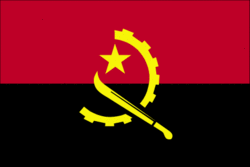 Angolan national flag (Flag of Angola)
 Angola country profile
 Travel advice for Angola
As for the Angolan climate; semiarid in south and along coast to Luanda; north has cool, dry season (May to October) and hot, rainy season (November to April).
Angolan(s) speak Portuguese (official), Bantu and other African languages.
Places of note in Angola
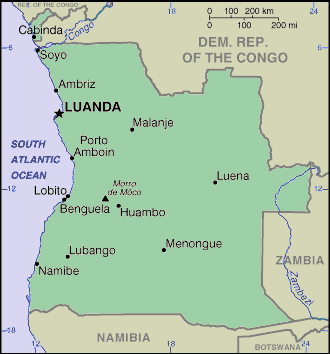 Angolan map
Regions of Angola
Angola is slowly rebuilding its country after the end of a 27-year civil war in 2002. Fighting between the Popular Movement for the Liberation of Angola (MPLA), led by Jose Eduardo DOS SANTOS, and the National Union for the Total Independence of Angola (UNITA), led by Jonas SAVIMBI, followed independence from Portugal in 1975. Peace seemed imminent in 1992 when Angola held national elections, but UNITA renewed fighting after being beaten by the MPLA at the polls. Up to 1.5 million lives may have been lost - and 4 million people displaced - in the quarter century of fighting. SAVIMBI's death in 2002 ended UNITA's insurgency and strengthened the MPLA's hold on power. DOS SANTOS has pledged to hold legislative elections in 2006.
Angola's high growth rate is driven by its oil sector, with record oil prices and rising petroleum production. Oil production and its supporting activities contribute about half of GDP and 90% of exports. Increased oil production supported 12% growth in 2004 and 19% growth in 2005. A postwar reconstruction boom and resettlement of displaced persons has led to high rates of growth in construction and agriculture as well. Much of the country's infrastructure is still damaged or undeveloped from the 27-year-long civil war. Remnants of the conflict such as widespread land mines still mar the countryside even though an apparently durable peace was established after the death of rebel leader Jonas SAVIMBI in February 2002. Subsistence agriculture provides the main livelihood for half of the population, but half of the country's food must still be imported. In 2005, the government started using a $2 billion line of credit from China to rebuild Angola's public infrastructure, and several large-scale projects are scheduled for completion by 2006. The central bank in 2003 implemented an exchange rate stabilization program using foreign exchange reserves to buy kwanzas out of circulation, a policy that was more sustainable in 2005 because of strong oil export earnings, and has significantly reduced inflation. Consumer inflation declined from 325% in 2000 to about 18% in 2005, but the stabilization policy places pressure on international net liquidity. To fully take advantage of its rich national resources - gold, diamonds, extensive forests, Atlantic fisheries, and large oil deposits - Angola will need to continue reforming government policies and to reduce corruption. The government has made sufficient progress on reforms recommended by the IMF such as promoting greater transparency in government spending but continues to be without a formal monitoring agreement with the institution.
Angolan natural resources include petroleum, diamonds, iron ore, phosphates, copper, feldspar, gold, bauxite, uranium
the province of Cabinda is an exclave, separated from the rest of the country by the Democratic Republic of the Congo
Angolan religion is indigenous beliefs 47%, Roman Catholic 38%, Protestant 15% (1998 est.).
Natural hazards in Angola include locally heavy rainfall causes periodic flooding on the plateau.
Travel Advice for Angola
AngolaSUMMARY
- We advise against all but essential travel to North and South Lunda Provinces, where you may be subject to movement restrictions or detention, and the interior of Cabinda Province, where there continue to be reports of violent incidents.
- You should only travel to areas of Angola outside Luanda in the company of persons or organisations experienced in local conditions, as travel can be difficult and dangerous.
- There is a high level of crime in Luanda. You should not walk around Luanda after dark.
- Most visits to Angola are trouble free. The main type of incident for which British nationals require consular assistance is in relation to passports and identity documents. You should carry certified copies of passports and/or identity documents with you at all times.
- You should register with the Embassy on arrival, and de-register on departure.
- The threat from terrorism is low. But you should be aware of the global risk of indiscriminate terrorist attacks, which could be against civilian targets, including places frequented by foreigners.
- We strongly recommend that you obtain comprehensive travel and medical insurance before travelling. You should check any exclusions, and that your policy covers you for the activities you want to undertake. Please see: Travel Insurance.
SAFETY AND SECURITY
There is a high level of crime in Luanda. Muggings (particularly to steal mobile phones), car-jackings and armed robberies can occur in any area at any time. A high proportion of the civil population is armed. Avoid walking around Luanda after dark.
Political Situation
Angola country profile
Local Travel
We advise against all but essential travel to North and South Lunda Provinces. The Angolan authorities are sensitive to the presence of foreigners in the diamond producing areas and you may be subject to movement restrictions or detention by the security forces. The presence of diamonds also increases the threat of crime and banditry.
Outside major urban areas, mines and unexploded ordnance are a significant problem. There have been incidents of mines exploding, with loss of life, in places previously thought to be safe. Even in "cleared" areas, you should keep to well-established routes and take local advice on the up to date situation from the United Nations or an international Non Governmental Organisation.
During the rainy season (November-April), bridges and roads risk being washed away by sudden floods and there is an increased chance of mines becoming displaced.
LOCAL LAWS AND CUSTOMS
ENTRY REQUIREMENTS
You should check all requirements with Angolan representation in the UK. Applications for visit or work visas for Angola must be made at the Angolan Embassy accredited to your country of residence.
Single parents or other adults travelling alone with children should be aware that some countries require documentary evidence of parental responsibility before allowing lone parents to enter the country or, in some cases, before permitting the children to leave the country. For further information on exactly what will be required at immigration, please contact Angolan representation in the UK.
HEALTH
There are several competent clinics run by expatriate organisations in Luanda, but otherwise health care is limited.
There was an outbreak of cholera in early 2006 in Luanda, which spread to many provinces in Angola. Cases are still being reported. Up to date information can be obtained from the World Health Organisation website. Routine food and hygiene measures should be observed whilst travelling in all parts of Angola (medical practitioners can advise). You should take particular care with any foods bought at the roadside or in the markets, drink or use only boiled/bottled water, and avoid ice in drinks. If you suffer from diarrhoea during a visit to one of the affected areas in Angola you should consult a doctor immediately.
Rabies is endemic in most African countries. The rabies virus is transmitted through the saliva of infected animals and transmitted to humans through bites, scratches or contact of saliva with broken skin and can be fatal once symptoms manifest themselves. All travellers who have possibly been exposed to the rabies virus, whether by bites, scratches or other exposure, should seek medical advice without delay (even if pre-exposure vaccine was received). This also applies to travellers in low risk areas in case other animal-transmitted infections are present, or the animal may have strayed across the border from an endemic country. More information can be found on the National Travel Health Network and Centre website at: http://www.nathnac.org.
GENERAL
Our Embassy in Angola does not issue passports. Before you set off, you should ensure that your passport is valid for at least six months and has several unused pages remaining. Applications for new passports are accepted by the Consular Section at the British High Commission in Pretoria in person or by courier (if a courier is used, the cost will have to borne by the applicant.) In an emergency only, the British Embassy in Luanda can issue an Emergency or Temporary Passport. However, Emergency Passports are valid for a single journey only back to the UK using agreed transit points as necessary, or to Commonwealth countries providing prior arrangement exists with the authorities of the Commonwealth country concerned. The British Embassy in Luanda will be able to advise you which of these options suits your circumstances, and can supply the name of local courier companies in Angola.
You should register with the British Embassy in Luanda on arrival and de-register before leaving, either in person or via the British Embassy in Luanda , If you plan to travel outside the capital you should advise the Embassy of your destination.
Credit cards are only accepted in a very limited number of hotels and restaurants. Always ask whether your card will be accepted before incurring expenditure. Cash withdrawals are not possible. The very small number of Multicaixa ATMs in Luanda do not accept foreign cards. Travellers' cheques are not accepted. Funds may be sent from the UK to Angola (but not in the other direction) by Western Union who have a number of agencies in Luanda and elsewhere and whose details are listed on their website. You should bring enough cash for your needs or ensure that your sponsoring company or agency has made suitable arrangements. It is illegal to take kwanzas (the local currency) out of the country.