
 Search
Traveling Luck for Botswana. Botswana, Africa
Botswana is located in Southern Africa, north of South Africa.
Land in Botswana is predominantly flat to gently rolling tableland; Kalahari Desert in southwest.
Motswana (singular), Batswana (plural) land covers an area of 600370 square kilometers which is slightly smaller than Texas
Botswana has borders with Namibia for 1360km, South Africa for 1840km and Zimbabwe for 813km.
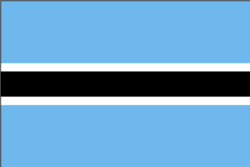 Motswana (singular), Batswana (plural) national flag (Flag of Botswana)
 Botswana country profile
 Travel advice for Botswana
As for the Motswana (singular), Batswana (plural) climate; semiarid; warm winters and hot summers.
Motswana (singular), Batswana (plural) speak Setswana 78.2%, Kalanga 7.9%, Sekgalagadi 2.8%, English 2.1% (official), other 8.6%, unspecified 0.4% (2001 census).
Places of note in Botswana
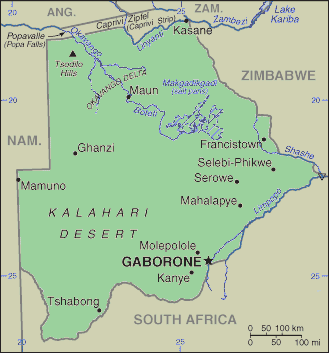 Motswana (singular), Batswana (plural) map
Regions of Botswana
Formerly the British protectorate of Bechuanaland, Botswana adopted its new name upon independence in 1966. Four decades of uninterrupted civilian leadership, progressive social policies, and significant capital investment have created one of the most dynamic economies in Africa. Mineral extraction, principally diamond mining, dominates economic activity, though tourism is a growing sector due to the country's conservation practices and extensive nature preserves. Botswana has one of the world's highest known rates of HIV/AIDS infection, but also one of Africa's most progressive and comprehensive programs for dealing with the disease.
Botswana has maintained one of the world's highest economic growth rates since independence in 1966. Through fiscal discipline and sound management, Botswana has transformed itself from one of the poorest countries in the world to a middle-income country with a per capita GDP of $10,000 in 2005. Two major investment services rank Botswana as the best credit risk in Africa. Diamond mining has fueled much of the expansion and currently accounts for more than one-third of GDP and for 70-80% of export earnings. Tourism, financial services, subsistence farming, and cattle raising are other key sectors. On the downside, the government must deal with high rates of unemployment and poverty. Unemployment officially is 23.8%, but unofficial estimates place it closer to 40%. HIV/AIDS infection rates are the second highest in the world and threaten Botswana's impressive economic gains. An expected leveling off in diamond mining production overshadows long-term prospects.
Motswana (singular), Batswana (plural) natural resources include diamonds, copper, nickel, salt, soda ash, potash, coal, iron ore, silver
landlocked; population concentrated in eastern part of the country
Motswana (singular), Batswana (plural) religion is Christian 71.6%, Badimo 6%, other 1.4%, unspecified 0.4%, none 20.6% (2001 census).
Natural hazards in Botswana include periodic droughts; seasonal August winds blow from the west, carrying sand and dust across the country, which can obscure visibility.
Travel Advice for Botswana
BotswanaSUMMARY
- Wildlife and livestock on Botswana’s roads make driving hazardous. Avoid driving at night.
- You should be aware of an increasing incidence of violent crime.
- The threat from terrorism is low. But you should be aware of the global risk of indiscriminate terrorist attacks, which could be against civilian targets, including places frequented by foreigners.
- Around 5,000 British tourists visit Botswana every year. The majority of visits are trouble-free. The main type of incident for which British nationals require consular assistance in Botswana is for replacing lost or stolen passports.
- You should carry some form of identification with you at all times. A photocopy of your passport is sufficient.
- We strongly recommend that you obtain comprehensive travel and medical insurance before travelling. You should check any exclusions, and that your policy covers you for the activities you want to undertake. Please see: Travel Insurance.
SAFETY AND SECURITY
Attacks on tourists are rare but petty and violent crime is increasing, particularly in the major towns of Gaborone, Francistown and Maun. There has been an increase in the number of house burglaries, often by armed gangs. There have been some cases of car jacking, particularly of four by four vehicles. If you are attacked, do not resist. Theft from parked cars does occur. Take sensible precautions. Safeguard valuables and cash. Deposit them in hotel safes, where practical. Keep copies of important documents, including passports in a separate place to the documents themselves.
Political Situation
Botswana Country Profile.
Local Travel
Botswana has good tarmac roads over most of the country but you should be careful when driving off-road. The standard of driving is lower than in the UK and many drivers ignore road safety rules. Dangerous driving, including speeding (the maximum speed limit is 120kph), and driving under the influence of alcohol causes frequent serious and often fatal accidents and deaths all over the country on Botswana’s roads. Driving, particularly outside the major urban areas, is dangerous because wildlife and stray livestock can pose a serious hazard.
Air Safety
The EU has published a list of air carriers that are subject to an operating ban or restrictions within the community. You should check the following link to see whether this will affect your travel: http://europa.eu.int/comm/transport/air/safety/flywell_en.htm
LOCAL LAWS AND CUSTOMS
Homosexuality is illegal in Botswana.
You should carry some form of identification with you at all times.
ENTRY REQUIREMENTS
British visitors do not need visas for South Africa. But if you are planning to enter the country before or after you visit Botswana you must have one clear blank page in your passport for the South African entry stamp otherwise entry will be denied.
Single parents or other adults travelling alone with children should be aware that some countries require documentary evidence of parental responsibility before allowing lone parents to enter the country or, in some cases, before permitting the children to leave the country. For further information on exactly what will be required at immigration, please contact the Botswana High Commission, London.
HEALTH
Health care in Botswana is good in the major towns but medical facilities and communications are limited in rural areas. For serious medical treatment, medical evacuation to the UK or South Africa may be necessary. Private hospitals will not treat patients unless you can pay and health care may be expensive. Outpatients must pay cash before receiving treatment. Emergency patients will only be accepted if you have full insurance cover.
Malaria is prevalent in the northern parts of Botswana, particularly during the rainy season (November-April). Before travelling to this area, you should consult your doctor about suitable anti-malarial medication, and on arrival ensure that you take adequate precautions against being bitten by mosquitoes. More than three-quarters of British travellers who contracted malaria in 2005 did not take preventive measures, such as malaria prevention tablets. However, malaria can occur despite appropriate prevention, and therefore you should promptly seek medical care in the event of a fever or flu-like illness in the first year following your return from travelling to a malaria risk country. Before travelling you should seek medical advice about the malaria risk in Botswana. Southern Botswana is not affected by Malaria.
Botswana has one of the highest HIV/AIDS infection rates in the world. You should be alert to the dangers of unprotected sex. You should also seek immediate medical advice if you are sexually assaulted or otherwise injured.
Anyone intending to camp or walk in the bush should be aware of the risk of tick bites.
You should seek medical advice before travelling and ensure that all appropriate vaccinations are up to date. For further information on health, check the Department of Health website at: www.dh.gov.uk.
GENERAL
Travellers' cheques are accepted at banks, hotels and the airport. ATMs are available in the major towns, but only accept bankers cards showing the Visa sign. ATMs do not accept Maestro cards. Major credit cards are accepted at many shops and restaurants.
You cannot exchange Scottish or Northern Irish bank notes in Botswana.