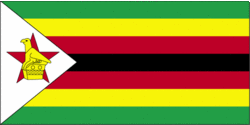
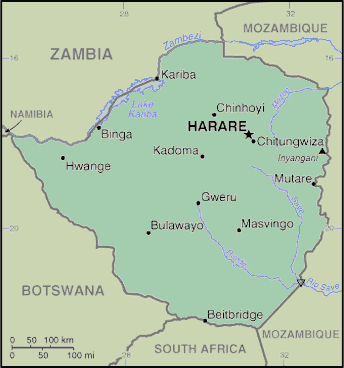
Zimbabwe is located in Southern Africa, between South Africa and Zambia.
Land in Zimbabwe is mostly high plateau with higher central plateau (high veld); mountains in east.
Zimbabwean land covers an area of 390580 square kilometers which is slightly larger than Montana
As for the Zimbabwean climate; tropical; moderated by altitude; rainy season (November to March).
Zimbabwean(s) speak English (official), Shona, Sindebele (the language of the Ndebele, sometimes called Ndebele), numerous but minor tribal dialects.
The UK annexed Southern Rhodesia from the [British] South Africa Company in 1923. A 1961 constitution was formulated that favored whites in power. In 1965 the government unilaterally declared its independence, but the UK did not recognize the act and demanded more complete voting rights for the black African majority in the country (then called Rhodesia). UN sanctions and a guerrilla uprising finally led to free elections in 1979 and independence (as Zimbabwe) in 1980. Robert MUGABE, the nation's first prime minister, has been the country's only ruler (as president since 1987) and has dominated the country's political system since independence. His chaotic land redistribution campaign, which began in 2000, caused an exodus of white farmers, crippled the economy, and ushered in widespread shortages of basic commodities. Ignoring international condemnation, MUGABE rigged the 2002 presidential election to ensure his reelection. Opposition and labor strikes in 2003 were unsuccessful in pressuring MUGABE to retire early; security forces continued their brutal repression of regime opponents. The ruling ZANU-PF party used fraud and intimidation to win a two-thirds majority in the March 2005 parliamentary election, allowing it to amend the constitution at will and recreate the Senate, which had been abolished in the late 1980s. In April 2005, Harare embarked on Operation Restore Order, ostensibly an urban rationalization program, which resulted in the destruction of the homes or businesses of 700,000 mostly poor supporters of the opposition, according to UN estimates.
Country profile: Zimbabwe
The fortunes of Zimbabwe have for more than two decades been tied to President Robert Mugabe, who wrested control from a small white community and put the country on a stable course.
Now, he presides over a nation whose economy is in tatters, where poverty and unemployment are endemic and political strife and repression commonplace.
Zimbabwe is home to the Victoria Falls, one of the natural wonders of the world, the stone enclosures of Great Zimbabwe - remnants of a past empire - and to herds of elephant and other game roaming vast stretches of wilderness.
AT-A-GLANCE- Politics: President Robert Mugabe, in office since 1980, has been accused of resorting to heavy-handed methods to remain in power.
- Economy: Economy in crisis, with rampant inflation, "de-industrialisation" and shortages of food and fuel. Agricultural production is shrinking.
- International: Faces increasing international isolation over human rights abuses and restrictions on freedom.
For years it was a major tobacco producer and a potential bread basket for surrounding countries.
But the forced seizure of almost all white-owned commercial farms, with the stated aim of benefiting landless black Zimbabweans, led to sharp falls in production and precipitated the collapse of the agriculture-based economy. The country has endured rampant inflation and critical food and fuel shortages.
Many Zimbabweans survive on grain handouts. Others have voted with their feet; hundreds of thousands of Zimbabweans, including much-needed professionals, have emigrated.
Aid agencies and critics partly blame food shortages on the land reform programme. The government blames a long-running drought, and Mr Mugabe has accused Britain and its allies of sabotaging the economy in revenge for the redistribution programme.
The government's urban slum demolition drive in 2005 drew more international condemnation. The president said it was an effort to boost law and order and development; critics accused him of destroying slums housing opposition supporters.
Either way, the razing of "illegal structures" left some 700,000 people without jobs or homes, according to UN estimates.
The former Rhodesia has a history of conflict, with white settlers dispossessing the resident population, guerrilla armies forcing the white government to submit to elections, and the post-independence leadership committing atrocities in southern areas where it lacked the support of the Matabele people.
Zimbabwe has had a rocky relationship with the Commonwealth - it was suspended after President Mugabe's controversial re-election in 2002 and later announced that it was pulling out for good.
- Full name: Republic of Zimbabwe
- Population: 12.9 million (UN, 2005)
- Capital: Harare
- Area: 390,759 sq km (150,873 sq miles)
- Major language: English (official), Shona, Sindebele
- Major religions: Christianity, indigenous beliefs
- Life expectancy: 37 years (men), 37 years (women) (UN)
- Monetary unit: 1 Zimbabwe dollar = 100 cents
- Main exports: Tobacco, cotton, agricultural products, gold, minerals
- GNI per capita: US $340 (World Bank, 2006)
- Internet domain: .zw
- International dialling code: +263
President: Robert Mugabe
Robert Mugabe played a key role in ending white rule in Rhodesia and he and his Zanu-PF party have dominated Zimbabwe's politics since independence in 1980.
The main challenge to the octogenarian leader's authority has come from the opposition Movement for Democratic Change (MDC). The MDC says its members have been killed, tortured and harassed by Zanu-PF supporters. The president has accused the party of being a tool of Western powers.
Mr Mugabe was declared the winner of the 2002 presidential elections, considered seriously flawed by the opposition and foreign observers. He received a boost in 2005 when Zanu-PF won more than two-thirds of the votes in parliamentary elections, said by the MDC to be fraudulent.
The size of the win enabled the president to change the constitution, paving the way for the creation of an upper house of parliament, the Senate.
Ideologically, Mr Mugabe belongs to the African liberationist tradition of the 1960s - strong and ruthless leadership, anti-Western, suspicious of capitalism and deeply intolerant of dissent and opposition.
His economic policies are widely seen as being geared to short-term political expediency and the maintenance of power for himself. Mr Mugabe has defended his land reform programme, saying the issue is the "core social question of our time".
Foreign minister: Simbarashe Mumbengegwi
Finance minister: Herbert Murerwa
All broadcasters transmitting from Zimbabwean soil and the main newspapers are state-controlled and toe the government line.
The private press, relatively vigorous in its criticism of the government, has come under severe pressure. A leading privately-owned daily, the Daily News, is subject to a publication ban. The paper and the government had waged war in the courts.
A weekly newspaper, The Zimbabwean, is produced in London and is distributed in Zimbabwe as an international publication, and among Zimbabweans living abroad.
Restrictive media laws, condemned by the EU, the US and media rights organisations, criminalise the publication of inaccurate information. Journalists who fail to register with a government body risk imprisonment.
State-run Zimbabwe Broadcasting Corporation (ZBC) operates the country's only TV and radio stations. ZBC formerly had two TV channels; its second network was leased to private station Joy TV which closed in 2002. Some of its programmes were said to have ruffled government feathers.
Radio is the main source of information for many Zimbabweans. Although there are no private stations, the country is targeted by overseas-based operations. The Voice of the People, set up by former ZBC staff with funding from the Soros Foundation and a Dutch NGO, operates using a leased shortwave transmitter in Madagascar.
Another station, the UK-based SW Radio Africa, aims to give listeners in Zimbabwe "unbiased information". The station's signal was jammed in March 2005, a period coinciding with the run-up to parliamentary elections.
From the US, the government-funded Voice of America (VOA) operates Studio 7, a twice-daily service for listeners in Zimbabwe which aims to be a source of "objective and balanced news".
The press
The Herald - government-owned daily
The Chronicle - Bulawayo-based, government-owned daily
The Financial Gazette - private, business weekly
The Standard - private, weekly
Zimbabwe Independent - private weekly
The Daily Mirror - private
Television
Zimbabwe Broadcasting Corporation (ZBC) - state-run
Radio
Zimbabwe Broadcasting Corporation (ZBC) - state-run, operates four networks SW Radio Africa - studio in London, broadcasts via mediumwave (AM) transmitter based outside Zimbabwe
Voice of the People - studio in Harare, broadcasts to Zimbabwe from hired shortwave transmitter on Madagascar
Studio 7 - based in Washington DC, operated by VOA
News agency/internet
Zimbabwe Inter-Africa News Agency - state-owned
ZimOnline - private, online news
The government of Zimbabwe faces a wide variety of difficult economic problems as it struggles with an unsustainable fiscal deficit, an overvalued exchange rate, soaring inflation, and bare shelves. Its 1998-2002 involvement in the war in the Democratic Republic of the Congo, for example, drained hundreds of millions of dollars from the economy. Badly needed support from the IMF has been suspended because of the government's arrears on past loans, which it began repaying in 2005. The official annual inflation rate rose from 32% in 1998, to 133% at the end of 2004, and 585% at the end of 2005, although private sector estimates put the figure much higher. Meanwhile, the official exchange rate fell from 24 Zimbabwean dollars per US dollar in 1998 to 96,000 in mid-January 2006. The government's land reform program, characterized by chaos and violence, has badly damaged the commercial farming sector, the traditional source of exports and foreign exchange and the provider of 400,000 jobs, turning Zimbabwe into a net importer of food products.
Zimbabwean natural resources include coal, chromium ore, asbestos, gold, nickel, copper, iron ore, vanadium, lithium, tin, platinum group metals
landlocked; the Zambezi forms a natural riverine boundary with Zambia; in full flood (February-April) the massive Victoria Falls on the river forms the world's largest curtain of falling water
Zimbabwean religion is syncretic (part Christian, part indigenous beliefs) 50%, Christian 25%, indigenous beliefs 24%, Muslim and other 1%.
Natural hazards in Zimbabwe include recurring droughts; floods and severe storms are rare.
Zimbabwe
This advice has been reviewed and reissued with amendments to the General section. The overall level of the advice has not changed.
SUMMARY
- There has been a general increase in the level of violent crime. There is a continuing risk of violence at political demonstrations, but main tourist areas have been largely unaffected by political and social unrest.
- We advise against visiting high density, low income, urban suburbs.
- You should avoid engaging in overtly partisan political activity, or in activities that could be construed as such.
- We recommend travel with organised tour operators to well-established destinations. We strongly advise against independent travel, particularly back-packing.
- You should be aware of the global risk of indiscriminate terrorist attacks, which could be against civilian targets, including places frequented by foreigners.
- The main type of incident for which British nationals require consular assistance in Zimbabwe relate to minor crimes where financial assistance is required and/or replacement passports need to be issued.
- We strongly recommend that you obtain comprehensive travel and medical insurance before travelling. You should check any exclusions, and that your policy covers you for the activities you want to undertake. Please see: Travel Insurance
SAFETY AND SECURITY
Crime
Mugging and pick pocketing is common in Harare and other city centres, especially after dark. You should be particularly cautious when leaving banks and cash points. Visitors to Victoria Falls, national parks and other tourist centres should be wary as tourists, particularly backpackers, are the principal targets for casual thieves. Wherever possible, you should travel with a recognised tour group or operator and should always avoid travelling alone. You should avoid visiting the high density (low-income) urban areas where crime is on the increase and incidents of unrest or protests can occur.
Armed car-jacking has become a cause of concern in the major towns in recent years. Thefts from vehicles are common. Drivers should keep their vehicle doors locked and windows closed, and be cautious when travelling particularly at night and at filling stations. There are regular reports of incidents of robberies and car jackings of vehicles using the Harare Airport road. You should be extra vigilant when using this route. If possible, you should not leave vehicles unattended in isolated scenic spots or in unguarded areas in the towns. If an attack takes place, do not resist. Hand over keys and anything else demanded.
The incidences of opportunistic theft, especially of handbags etc, is high and passports are at particular risk. You should take care with baggage in public places, and at reception desks when checking in/out of hotels. Particular care should be taken at Harare International Airport where there has been an increase in such thefts. You should carry photocopies of your passport, although banks will not accept photocopies for monetary transactions. If your passport is lost or stolen, you should immediately inform the police and the British Embassy in Harare.
Political situation
Zimbabwe Country Profile.
There has been both political and social unrest in Zimbabwe for several years. This has affected urban and rural areas, but the principal tourist areas have been largely unaffected. Political violence has resulted in serious injury and deaths to participants are sometimes caught up in the events.
In 2005, the authorities carried out a brutal "clean up" campaign throughout Zimbabwe, particularly in urban areas. This resulted in the destruction of the homes and small businesses of hundreds of thousands of people and some displacement to the rural areas. This caused an increase in tension in urban areas. The current situation is unpredictable, volatile and could deteriorate quickly, without warning. Several civil society organisations regularly organise demonstrations against current economic and social conditions and against government policies. There have also been an increasing number of student demonstrations over the last few months. Any of these can quite quickly develop into nasty situations if the authorities choose to suppress them with force. The Movement for Democratic Change (MDC) opposition party has also threatened a programme of mass demonstrations and civil disobedience.
You should avoid engaging in overtly partisan political activity, or in activities which could be construed as such, including political discussions in public places or criticism of the President. You should also be aware that an open hand is the political symbol of the main opposition political party, the Movement for Democratic Change, and a friendly wave may therefore be misinterpreted as a provocative gesture. The carrying of the main independent newspapers (the Financial Gazette, the Independent, the Standard or the Zimbabwean) and books by banned authors or the wearing of T-shirts with slogans of the main political activist organisation can provoke a hostile reaction from ZANU (PF) supporters.
In the event of increased political tension, you should keep a low profile, exercise caution, stay away from areas where demonstrations may be held, and avoid unnecessary travel to high density suburbs. If a demonstration or disturbance is taking place, you should leave the area as quickly as possible. You should not stay to watch or attempt to photograph it, even from a distance, or use a mobile phone.
Local Travel
You should exercise extreme caution when travelling. Because of current uncertainty in the security situation, we strongly advise against independent travel (particularly backpacking), and recommend that you travel with organised tour operators to well established tourist destinations. We strongly advise that you take up-to-date advice from local contacts about any places that you plan to visit.
Business visitors who are travelling under the auspices of well established Zimbabwe organisations and companies are unlikely to encounter difficulties.
In view of a number of incidents affecting hunting parties, we advise you against hunting trips at this time. (See restrictions on import of weapons below).
There is currently a severe shortage of fuel throughout Zimbabwe, even in major cities. Public transport and services, including internal and external flights with Air Zimbabwe, may be cancelled or not run on schedule. If you are driving, you should think carefully before setting out on long distance journeys and keep your tank topped up as much as possible.
Road Safety
Traffic accidents are a common cause of death and injury. Roads are generally in good condition, although potholes can be dangerous in major cities and towns, but you should avoid driving outside the main towns at night as vehicles are often poorly lit and roads badly marked. Abandoned unlit trailers and heavy goods vehicles are particularly dangerous hazards. Cyclists without lights, pedestrians and stray livestock are additional dangers. Emergency services can provide only limited help in the event of an accident. If you are travelling by car outside Harare, you are advised to carry a comprehensive medical kit.
Police road-blocks are common. You must obey police signals, stop at roadblocks and produce identification if asked to do so. It is an offence to continue driving when the President's motorcade goes past, no matter which side of the road you are on.
You are permitted to drive in Zimbabwe on production of a full UK driving licence.
Buses (mainly privately run minibuses) are overcrowded, inadequately maintained, frequently not insured, and the drivers often reckless. They are not recommended for tourist travel. There have been incidents of assault on tourists hitch hiking and travelling in unlicensed buses.
Rail Safety
The rail system is underdeveloped and poorly maintained, resulting in numerous accidents. Rail travel is not recommended. There have been a number of fatal train crashes. On 28 August 2006, a goods train and a passenger train collided near Victoria Falls killing 7 passengers and on 9 September 2006, a train derailed after hitting a herd of buffalo killing the co-driver and injuring a passenger.
Air Safety
The EU has published a list of air carriers that are subject to an operating ban or restrictions within the European Community. You should check the following link to see whether this will affect your travel: http://europa.eu.int/comm/transport/air/safety/flywell_en.htm. Prospective domestic air travellers should be aware that there are continuing reports by some Zimbabwean media organisations, which express concern about the safety of aircraft used for internal flights.
LOCAL LAWS AND CUSTOMS
Photography of government offices, airports, military establishments, official residences and embassies, in addition to other sensitive facilities, is illegal without special permission from the Ministry of Information. Taking photographs of members of the security services (police & armed forces personnel) and of demonstrations and protests is not permitted. Laws are strictly enforced. You should note that the area around State House in Harare (the President's official residence) is patrolled by armed members of the Presidential Guard. They do not allow loitering, by motorists, cyclists or pedestrians, and photography is strictly prohibited. If possible, you should avoid this area.
It is an offence to hold Zimbabwean and a second nationality. The Zimbabwean authorities may prosecute people found to be in possession of both a Zimbabwean and a British passport. The British Embassy is not in a position to provide the full range of services to people with dual British and Zimbabwean nationality. See What We Can Do To Help.
There are laws against indecency, which effectively make homosexuality illegal in Zimbabwe.
Penalties for possession, use or trafficking in illegal drugs are strict and offenders can expect heavy fines or jail sentences.
It is an offence to make derogatory or insulting comments about President Mugabe.
It is against the law for civilians to wear any form of clothing made from camouflage material.
ENTRY REQUIREMENTS
You will need a visa to visit Zimbabwe. This can be obtained from the Zimbabwean representation in the UK or on arrival in Zimbabwe. The current charge for a single entry visa issued on arrival in Zimbabwe is £35.00 or 55 US Dollars, although this could change. If you have not obtained a visa before travelling, you should bring enough cash with you to pay for your visa on arrival.
Visitors are currently being given entry permission for anything up to 90 days. You are strongly advised to check that the number of days given at the port of entry covers your intended period of stay, although you can apply to have this period renewed and extended if required. We recommend that before you travel you should first check current entry requirements with the Zimbabwean Embassy.
Single parents or other adults travelling alone with children should be aware that some countries require documentary evidence of parental responsibility before allowing lone parents to enter the country or, in some cases, before permitting the children to leave the country. For further information on exactly what will be required at immigration please contact the Zimbabwean representation in the UK.
HEALTH
We strongly recommend that you obtain comprehensive travel and medical insurance before travelling. This should include cover for medical evacuation by air ambulance. You should check any exclusions, and that your policy covers you for the activities you want to undertake. Please see: Travel Insurance.
Private clinics will not treat patients unless they can pay. Medical costs, particularly for evacuation, can be high. There is a shortage of drugs in public hospitals. If you are on medication, you are advised to bring sufficient supplies of your medication to cover the period of your stay.
Although not present in Harare and through much of the Highveld (central districts), malaria is prevalent in most other parts of the country, particularly in low lying border areas including the Zambezi Valley, Victoria Falls, Hwange National Park in the low lying parts of the Eastern Highlands and the Vumba, around Mutare.
More than three quarters of British travellers who contracted malaria in 2005 did not take preventive measures, such as malaria prevention tablets. However, malaria can occur despite appropriate prevention, and you should seek medical care in the event of a fever or flu like illness in the first year following your return from travelling to a malaria risk country. Before travelling you should seek medical advice about the malaria risk in Zimbabwe.
There has been an outbreak of cholera in Harare. Another outbreak in south-east Zimbabwe which was first reported in December 2005, has resulted in several deaths in the districts of Chikomba, Chivhu and Buhera. Routine food and hygiene measures should be observed whilst traveling in all parts of Zimbabwe (medical practitioners can advise). You should take particular care with any foods bought at the roadside or in the markets, drink or use only boiled/bottled water, and avoid ice-cubes. Anyone suffering diarrhoea during a visit to affected areas in Zimbabwe should consult a doctor immediately.
Zimbabwe has one of the world's highest HIV/AIDS infection rates with approximately 20% of the adult population infected.
In January 2007, there have been reports of anthrax in Masvingo province.
You should seek medical advice before travelling and ensure that all appropriate vaccinations are up-to-date. For further information on health, check the Department of Health website at: www.dh.gov.uk.
GENERAL
If things go wrong when overseas, please see: What We Can Do To Help
Hard currency is difficult to come by locally. You need hard currency to pay for hotel charges and entry to Victoria Falls and many other national parks: park entry fees vary from up to 15 pounds sterling or 25 US dollars per person. It is advisable to have small denomination notes, as change is sometimes unavailable. All airlines, with the exception of Air Zimbabwe, now include a departure tax in the price of their tickets.
The Government of Zimbabwe has recently devalued the Zimbabwean dollar and deducted three zeros from the currency. 1,000,000 old Zimbabwean dollars (issued as bearer cheques) are now worth 1,000 new Zimbabwean dollars (bearer cheques). As from 21 August 2006, only the new bearer cheques are valid. There is no limit on the amount of foreign currency a foreign tourist can take out of the country although you may be asked to declare how much foreign currency you have in your possession. You are only allowed to take limited amounts of local currency out of the country. Current limits are Zim $5,000 cash or bearer cheques. Amounts in excess of this must be handed in at the airport/border. It is illegal to exchange foreign currency in Zimbabwe anywhere other than at officially licensed dealers (e.g. banks). If you are using credit cards, you are advised to check the rate of exchange before completing any transaction.
There are frequent power cuts and water shortages.
There is an EU arms embargo on Zimbabwe. It is an offence in UK law to take firearms into Zimbabwe at the current time, even if you intend to bring them back to the UK at the end of your visit.
Long term visitors and residents should register on arrival with the British Embassy in Harare.