World index ... Africa ... Malawi
Travelers word index

Malawi

Continents
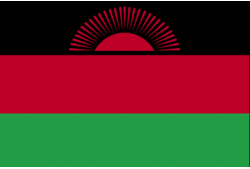
Malawian flag

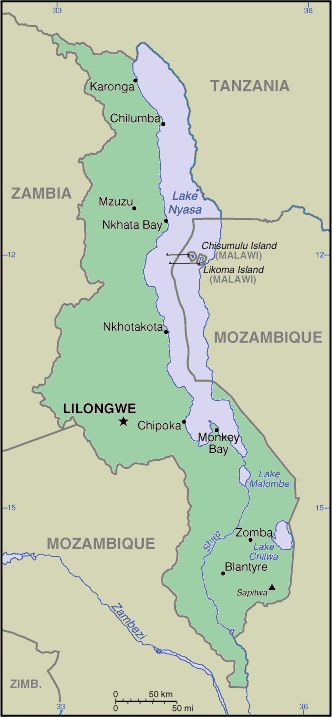
Malawi is located in Southern Africa, east of Zambia.

Malawi has borders with Mozambique for 1569km, Tanzania for 475km and Zambia for 837km.
Land in Malawi is narrow elongated plateau with rolling plains, rounded hills, some mountains.

Malawian land covers an area of 118480 square kilometers which is slightly smaller than Pennsylvania

As for the Malawian climate; sub-tropical; rainy season (November to May); dry season (May to November).

Malawian(s) speak Chichewa 57.2% (official), Chinyanja 12.8%, Chiyao 10.1%, Chitumbuka 9.5%, Chisena 2.7%, Chilomwe 2.4%, Chitonga 1.7%, other 3.6% (1998 census).

Malawi country profile, Travel advice for Malawi

Malawian Map
Places of note in Malawi
Lilongwe
Blantyre
Zomba
Kasungu
Mangochi
Karonga
Salima
Nkhotakota
Liwonde
Nsanje
Rumphi
Mzimba
Balaka
Mchinji
Mulanje
Dedza
Luchenza
Nkhata Bay
Monkey Bay
Mwanza
Mponela
Ntcheu
Chitipa
Thyolo
Dowa
Livingstonia
Chipoka
Phalombe
Chiradzulu
Machinga
Regions of Malawi
Balaka
Blantyre
Chikwawa
Chiradzulu
Chitipa
Dedza
Dowa
Karonga
Kasungu
Likoma
Lilongwe
Machinga
Malawi (general)
Mangochi
Mchinji
(MI10)
(MI14)
Mulanje
Mwanza
Mzimba
Nkhata Bay
Nkhotakota
Nsanje
Ntcheu
Ntchisi
Phalombe
Rumphi
Salima
Thyolo
Zomba

Established in 1891, the British protectorate of Nyasaland became the independent nation of Malawi in 1964. After three decades of one-party rule under President Hastings Kamuzu BANDA the country held multiparty elections in 1994, under a provisional constitution which came into full effect the following year. Current President Bingu wa MUTHARIKA, elected in May 2004 after a failed attempt by the previous president to amend the constitution to permit another term, has struggled to assert his authority against his predecessor, who still leads their shared political party. MUTHARIKA's anti-corruption efforts have led to several high-level arrests and one prominent conviction. Increasing corruption, population growth, increasing pressure on agricultural lands, and the spread of HIV/AIDS pose major problems for the country.

Country profile: Malawi

Map of MalawiFor three decades Malawi's destiny was tied to the whims of its totalitarian president-for-life, Kamuzu Banda, who enjoyed being surrounded by dancing women and who encouraged people to betray relatives who criticised his rule.

In the mid-1990s he buckled under popular pressure to hold elections, and lost - finally giving Malawians a taste for multi-party democracy.

His successor, Bakili Muluzi, removed many of the repressions of the Banda years, but the leadership was accused of corruption. Social problems persist, including poverty and the high rate of HIV-Aids infection.

AT-A-GLANCE


Cyclist in rural Malawi Most Malawians rely on subsistence farming, but the food supply situation is precarious and the country is prone to natural disasters of both extremes - from drought to heavy rainfalls - putting it in constant need of thousands of tonnes of food aid every year.

Malawi has been urged by world financial bodies to free up its economy. Since the mid-1990s it has privatised many loss-making state-run corporations. Its single major natural resource, agricultural land, is under severe pressure from rapid population growth.

Tens of thousands of Malawians die of Aids every year. After years of silence, the authorities spoke out about the crisis. A programme to tackle HIV-Aids was launched in 2004, with President Muluzi revealing that his brother had died from the disease.

Malawi boasts a variety of landscapes, from wetlands and lakes to mountains and forests. National parks and game reserves beckon visitors.

President: Bingu wa Mutharika

Declared winner in disputed election in May 2004

Bingu wa Mutharika, the candidate of the ruling United Democratic Front (UDF), was sworn in on 24 May 2004 after winning presidential elections.

Less than a year later he resigned from the UDF, accusing the party and his predecessor Bakili Muluzi of opposing his high-profile anti-corruption campaign. He formed a new grouping, the Democratic Progressive Party.

Donor countries warned in 2005 that a power struggle between the president and his predecessor was diverting the government's attention from pressing problems, including food shortages.

Mr Mutharika had been hand-picked by the outgoing President Muluzi as the UDF candidate after parliament refused to accept an amendment to the constitution allowing Mr Muluzi to stand for a third term. Perceived as a relative outsider, his nomination surprised many UDF members and led to several defections.

The run-up to the poll was overshadowed by opposition claims of irregularities. European Union and Commonweath observers said although voting passed peacefully, they were concerned about "serious inadequacies" in the poll.

Mr Mutharika is an economist and a former secretary-general of the Common Market for Eastern and Southern Africa (Comesa). He has also worked for the World Bank and the UN.

  • Foreign minister: Davis Katsonga
  • Finance minister: Goodall Gondwe

    Radio is the chief source of information for many Malawians. State-run MBC is the main national broadcaster. Television was introduced in 1999.

    Privately-owned publications present a range of opinions, although the government has used libel and other laws to put pressure on newspaper journalists.

    BBC World Service is available on FM in Blantyre, Lilongwe and Mzuzu.

    The press

  • The Nation - daily
  • The Daily Times - owned by opposition party
  • Malawi News - weekly
  • Boma Lathu - monthly, Chichewa-language

    Television

  • Television Malawi (TVM) - state-run

    Radio

  • Malawi Broadcasting Corporation - state-run, operates national networks Radio One and Radio Two
  • Capital Radio - privately-owned
  • MIJ FM - Blantyre-based, operated by Malawi Institute of Journalism
  • FM 101 Power - privately-owned
  • Zodiac Broadcasting Station (ZBS) - private
  • Radio Maria - Catholic station

    News agency

  • Malawi News Agency (Mana)

    Landlocked Malawi ranks among the world's least developed countries. The economy is predominately agricultural, with about 90% of the population living in rural areas. Agriculture accounted for nearly 36% of GDP and 80% of export revenues in 2005. The performance of the tobacco sector is key to short-term growth as tobacco accounts for over 60% of exports. The economy depends on substantial inflows of economic assistance from the IMF, the World Bank, and individual donor nations. In late 2000, Malawi was approved for relief under the Heavily Indebted Poor Countries (HIPC) program. The government faces strong challenges, including developing a market economy, improving educational facilities, facing up to environmental problems, dealing with the rapidly growing problem of HIV/AIDS, and satisfying foreign donors that fiscal discipline is being tightened. In 2005, President MUTHARIKA championed an anticorruption campaign. Malawi's recent fiscal policy performance has been very strong, but a serious drought in 2005 and 2006 will heighten pressure on the government to increase spending.

    Malawian natural resources include limestone, arable land, hydropower, unexploited deposits of uranium, coal, and bauxite

    landlocked; Lake Nyasa, some 580 km long, is the country's most prominent physical feature

    Malawian religion is Christian 79.9%, Muslim 12.8%, other 3%, none 4.3% (1998 census).

    Natural hazards in Malawi include NA.

    Travel Advice on Malawi

    Malawi

    This advice has been reviewed and reissued with amendments to the Health section (Rabies).  The overall level of the advice has not changed.

    SUMMARY

    • Driving can be hazardous.  Drive carefully and avoid travel after dark.  Always wear seat belts.

    • The threat from terrorism is low.  But you should be aware of the global risk of indiscriminate terrorist attacks which could be against civilian targets, including places frequented by foreigners.

    • Most visits to Malawi are trouble free.  The main type of incident for which British nationals require consular assistance in Malawi is for replacing stolen passports.

    • You should carry some form of identification (i.e., your passport) with you at all times.

    • We strongly recommend that you obtain comprehensive travel and medical insurance.  You should check any exclusions, and that your policy covers you for any activities you want to undertake.  Please see:  Travel Insurance.


    SAFETY AND SECURITY

    Crime
    Be alert to muggers, bag-snatchers and con men.  You should exercise caution with over-friendly people who approach you offering to act as tour-guides.  Do not accept food or drink from strangers.  There have been cases of people being robbed after eating drugged food.
    In Lilongwe, the majority of attacks on visitors take place on Kenyatta Drive and around the bus station.  You should take particular care when visiting these areas, especially after dark.  Most Malawi vendors are friendly.  But there have been incidents of tourist harassment by vendors (for example at lakeside resorts), including occasionally with threats of violence.
    Armed car jacking is a risk, especially for drivers of four by four vehicles.  If you are attacked do not resist.  Hand over car keys and anything else demanded and stay calm.  It is dangerous to resist or act impulsively.  Drivers have been shot.
    House burglaries, including by armed gangs are also a risk.  There has been an increase in burglaries in wealthy residential areas in recent months.  Be alert to anything unusual.  Security precautions at home are as important as on the streets.
    Take sensible precautions.  Safeguard valuables and cash.  Deposit them in hotel safes, where practical.  Keep copies of important documents, including passports in a separate place to the documents themselves.

    Political Situation


    Malawi Country Profile
    Road Safety
    UK driving licences are acceptable in Malawi for up to 90 days; international driving licences for up to a year.
    Driving in Malawi can be hazardous, especially in the rainy season (December - March).  The number of deaths per vehicles on the road is the highest in the world.  Drive carefully and avoid travel after dark.  Potholes, animals and abandoned vehicles often cause serious accidents, as do vehicles travelling at night without lights.  Travel between towns by public minibus or pick-up truck is not recommended.  Vehicles are often in poor condition and overloaded.  Fatal accidents are frequent, and emergency services are basic.
    On 1 July 2006 speed traps and breathalyser tests were introduced on Malawi’s roads.  Drivers convicted of offences will face a fine and/or imprisonment.  The blood alcohol limit is 0.08g per 100ml of blood, the same as in the UK.
    Air Safety

    The EU has published a list of air carriers that are subject to an operating ban or restrictions within the community.  You should check the following link to see whether this will affect your travel: http://europa.eu.int/comm/transport/air/safety/flywell_en.htm


    LOCAL LAWS AND CUSTOMS

    Drug taking and smuggling is an offence.  This includes the purchase and use of cannabis.  The punishment can be severe.

    Buying uncut precious stones is illegal.

    Outside the main tourist areas, women should cover legs and shoulders so as not to offend local sensitivities.

    Homosexuality is illegal in Malawi.


    ENTRY REQUIREMENTS

    British nationals do not require visas for tourist visits.  Visitors are usually granted 30-day tourist visas on arrival; these can be renewed up to a maximum of 90 days.

    Passports should be valid for at least 6 months from the proposed date of entry.

    You are not allowed to work as a volunteer, even unpaid, on a tourist visa.  For details on entry requirements as a volunteer, contact the Malawian High Commission in London for Advice.

    The Malawian High Commission can also advise on other types of entry requirement, and the procedure for longer stays.

    Single parents or other adults travelling alone with children should be aware that some countries require documentary evidence of parental responsibility before allowing lone parents to enter the country and/or before permitting the children to leave the country.

    For further information on Malawi’s immigration requirements please contact the Malawian High Commission in London.


    HEALTH

    We strongly recommend that you obtain comprehensive travel and medical insurance before travelling, covering medical evacuation.  You should check any exclusions, and that your policy covers you for any activities you want to undertake.  Please see:  Travel Insurance.
    Healthcare standards, particularly in the rural areas, are generally poor.
    Malawi has a very high HIV/AIDS infection rate.  You should be alert to the dangers of unprotected sex.
    Malaria is endemic and you should seek advice about suitable anti-malarial tablets before travelling.  More than three-quarters of British travellers who contracted malaria in 2005 did not take preventive measures, such as malaria prevention tablets.  However, malaria can occur despite appropriate prevention, and therefore you should promptly seek medical care in the event of a fever or flu-like illness in the first year following your return from travelling to a malaria risk country.  Before travelling you should seek medical advice about the malaria risk in Malawi.
    Rabies is endemic in most African countries.  The rabies virus is transmitted through the saliva of infected animals and transmitted to humans through bites, scratches or contact of saliva with broken skin and can be fatal once symptoms manifest themselves.  All travellers who have possibly been exposed to the rabies virus, whether by bites, scratches or other exposure, should seek medical advice without delay (even if pre-exposure vaccine was received).  This also applies to travellers in low risk areas in case other animal-transmitted infections are present, or the animal may have strayed across the border from an endemic country.  More information can be found on the National Travel Health Network and Centre website at: http://www.nathnac.org
    Drinking water may not be safe, especially in rural areas.  Bilharzia exists in many lakeshore areas and rivers.  Outbreaks of gastric intestinal infections and cholera occur, especially during the rainy season (December to March).  Tsetse flies carrying sleeping sickness exist in some of the national parks.
    You should seek medical advice before travelling and ensure that all appropriate vaccinations are up to date.  For further information on health, check the Department of Health’s website at www.dh.gov.uk. 


    GENERAL

    If things go wrong when overseas, please see:  What We Can Do To Help.
    You should carry identity documents (i.e., your passport) at all times and keep a photocopy of your passport and other important documents in a safe place.
    All non-Malawian passport holders leaving the country by air are required to pay departure tax of $30 in dollars cash.  This tax applies to adults and children over 2.  You can buy dollars at the airport:  the airport money exchanges open to cater for departing flights.
    You should register with the British High Commission Consular Section in Lilongwe on arrival, either in person or by email bhclilongwe@fco.gov.uk if you intend to stay in Malawi for more than a few days.
    Money
    Credit cards are not widely accepted in Malawi.  Traveller’s cheques or cash are advised as means of exchange.  There are very few ATM machines even in tourist locations.  The US dollar is the easiest currency to exchange.


  • What is this world index all about?