
 Search
Traveling Luck for Congo (Kinshasa). Congo (Kinshasa), Africa
Democratic Republic of the Congo is located in Central Africa, northeast of Angola.
Land in Democratic Republic of the Congo is vast central basin is a low-lying plateau; mountains in east.
Congolese or Congo land covers an area of 2345410 square kilometers which is slightly less than one-fourth the size of the US
Congo (Kinshasa) has borders with Angola for 2511km, Rwanda for 217km, Burundi for 233km, Zambia for 1930km, Central African Republic for 1577km, Congo (Brazzaville) for 2410km, Sudan for 628km, Uganda for 765km and Tanzania for 459km.
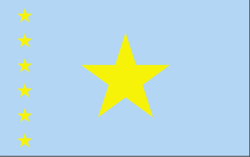 Congolese or Congo national flag (Flag of Congo (Kinshasa))
 Congo (Kinshasa) country profile
 Travel advice for Congo (Kinshasa)
As for the Congolese or Congo climate; tropical; hot and humid in equatorial river basin; cooler and drier in southern highlands; cooler and wetter in eastern highlands; north of Equator - wet season (April to October), dry season (December to February); south of Equator - wet season (November to March), dry season (April to October).
Congolese (singular and plural) speak French (official), Lingala (a lingua franca trade language), Kingwana (a dialect of Kiswahili or Swahili), Kikongo, Tshiluba.
Places of note in Congo (Kinshasa)
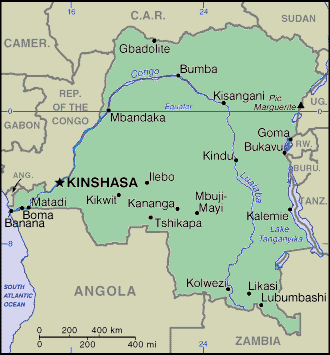 Congolese or Congo map
Regions of Congo (Kinshasa)
Established as a Belgian colony in 1908, the Republic of the Congo gained its independence in 1960, but its early years were marred by political and social instability. Col. Joseph MOBUTU seized power and declared himself president in a November 1965 coup. He subsequently changed his name - to MOBUTU Sese Seko - as well as that of the country - to Zaire. MOBUTU retained his position for 32 years through several subsequent sham elections, as well as through the use of brutal force. Ethnic strife and civil war, touched off by a massive inflow of refugees in 1994 from fighting in Rwanda and Burundi, led in May 1997 to the toppling of the MOBUTU regime by a rebellion led by Laurent KABILA. He renamed the country the Democratic Republic of the Congo (DRC), but in August 1998 his regime was itself challenged by an insurrection backed by Rwanda and Uganda. Troops from Angola, Chad, Namibia, Sudan, and Zimbabwe intervened to support the Kinshasa regime. A cease-fire was signed in July 1999 by the DRC, Congolese armed rebel groups, Angola, Namibia, Rwanda, Uganda, and Zimbabwe but sporadic fighting continued. Laurent KABILA was assassinated in January 2001 and his son, Joseph KABILA, was named head of state. In October 2002, the new president was successful in negotiating the withdrawal of Rwandan forces occupying eastern Congo; two months later, the Pretoria Accord was signed by all remaining warring parties to end the fighting and establish a government of national unity. A transitional government was set up in July 2003; Joseph KABILA remains as president and is joined by four vice presidents representing the former government, former rebel groups, and the political opposition. The transitional government held a successful constitutional referendum in December 2005, and plans to hold a series of elections in 2006 to determine the presidency and National Assembly seats.
The economy of the Democratic Republic of the Congo - a nation endowed with vast potential wealth - has declined drastically since the mid-1980s. The war, which began in August 1998, dramatically reduced national output and government revenue, increased external debt, and resulted in the deaths of perhaps 3.5 million people from violence, famine, and disease. Foreign businesses curtailed operations due to uncertainty about the outcome of the conflict, lack of infrastructure, and the difficult operating environment. Conditions improved in late 2002 with the withdrawal of a large portion of the invading foreign troops. The transitional government has reopened relations with international financial institutions and international donors, and President KABILA has begun implementing reforms. Much economic activity lies outside the GDP data. Economic stability improved in 2003-05, although an uncertain legal framework, corruption, and a lack of openness in government policy continues to hamper growth. In 2005, renewed activity in the mining sector, the source of most exports, boosted Kinshasa's fiscal position and GDP growth. Business and economic prospects are expected to improve once a new government is installed after elections.
Congolese or Congo natural resources include cobalt, copper, niobium, tantalum, petroleum, industrial and gem diamonds, gold, silver, zinc, manganese, tin, uranium, coal, hydropower, timber
straddles equator; has very narrow strip of land that controls the lower Congo River and is only outlet to South Atlantic Ocean; dense tropical rain forest in central river basin and eastern highlands
Congolese or Congo religion is Roman Catholic 50%, Protestant 20%, Kimbanguist 10%, Muslim 10%, other syncretic sects and indigenous beliefs 10%.
Natural hazards in Democratic Republic of the Congo include periodic droughts in south; Congo River floods (seasonal); in the east, in the Great Rift Valley, there are active volcanoes.
Travel Advice for Congo (Kinshasa)
CongoSUMMARY
- We advise against all but essential travel outside the main cities of Brazzaville and Pointe Noire, as there is some instability and risk of rebel activity in the countryside.
- If resident in or visiting the Republic of Congo, you should register with the British Embassy in Kinshasa at: Consular Online Registration.
- The threat from terrorism is low.
- The main type of incident for which British nationals require consular assistance in the Republic of Congo is for medical emergencies.
- We strongly recommend that you obtain comprehensive travel and medical insurance before travelling. You should check any exclusions, and that your policy covers you for the activities you want to undertake. Please see: Travel Insurance.
SAFETY AND SECURITY
The incidence of street crime, armed robbery or vehicle hi-jacking is low in Brazzaville and Pointe Noire, although there are frequent police checkpoints. Take sensible security precautions i.e. do not walk in the streets after dark, or carry large amounts of money or valuables.
Political Situation
Congo (Rep of) Country Profile
If in Brazzaville, you should keep yourself updated locally on the security situation. In the event of trouble in the capital you should remain indoors and follow local advice from the British Honorary Consul; the main town centre hotels tend to be relatively safe.
Local Travel
You should avoid travelling at night throughout the whole country.
Following an armed attack on 30 June 2006 on police in Matadi in the Democratic Republic of Congo by the 'Bundu dia Kongo', (Congolese armed group) in which twelve died, the border between the Republic of Congo and Angola (Cabinda) was temporarily closed
The risk of rebel attacks on the coastal town of Pointe Noire itself is considered very low. But travel between Brazzaville and Pointe Noire should be by air as armed criminal gangs frequently prey on those travelling by road and rail. Road travel in the Pool region requires a permit from the Congolese army.
Road Safety
Road conditions are generally poor and deteriorate during the wet season, which lasts from November to May. Overland travel off the main roads requires a four-wheel drive vehicle.
The EU has published a list of air carriers that are subject to an operating ban or restrictions within the community. You should check the following link to see whether this will affect your travel: http://europa.eu.int/comm/transport/air/safety/flywell_en.htm
ENTRY REQUIREMENTS
HEALTH
You should not eat 'bush meat'.
Water-borne diseases, HIV/AIDS and malaria are prevalent. More than three-quarters of British travellers who contracted malaria in 2005 did not take preventive measures, such as malaria prevention tablets. However, malaria can occur despite appropriate prevention, and therefore you should promptly seek medical care in the event of a fever or flu-like illness in the first year following your return from travelling to a malaria risk country. Before travelling you should seek medical advice about the malaria risk in the Republic of Congo.
You should seek medical advice before travelling and ensure that all appropriate vaccinations are up to date. For further information on health, check the Department of Health’s website at http://www.dh.gov.uk/PolicyAndGuidance/HealthAdviceToTravellers/fs/en or contact your own GP for up to date information.
GENERAL