World index ... Africa ... Rwanda
Travelers word index

Rwanda

Continents
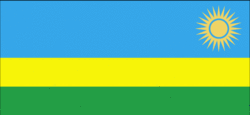
Rwandan flag

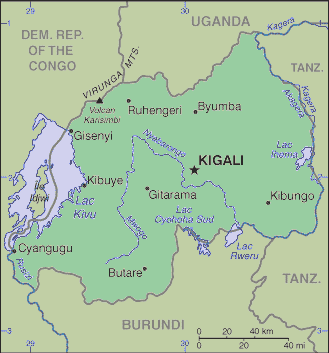
Rwanda is located in Central Africa, east of Democratic Republic of the Congo.

Rwanda has borders with Burundi for 290km, Congo (Kinshasa) for 217km, Tanzania for 217km and Uganda for 169km.
Land in Rwanda is mostly grassy uplands and hills; relief is mountainous with altitude declining from west to east.

Rwandan land covers an area of 26338 square kilometers which is slightly smaller than Maryland

As for the Rwandan climate; temperate; two rainy seasons (February to April, November to January); mild in mountains with frost and snow possible.

Rwandan(s) speak Kinyarwanda (official) universal Bantu vernacular, French (official), English (official), Kiswahili (Swahili) used in commercial centers.

Rwanda country profile, Travel advice for Rwanda

Rwandan Map
Places of note in Rwanda
Kigali
Butare
Gitarama
Ruhengeri
Gisenyi
Byumba
Cyangugu
Rwamagana
Kibuye
Kibungo
Nzega
Regions of Rwanda
Butare
Byumba
Cyangugu
Gikongoro
Gisenyi
Gitarama
Kibungo
Kibuye
Kigali
Ruhengeri
Rwanda (general)

In 1959, three years before independence from Belgium, the majority ethnic group, the Hutus, overthrew the ruling Tutsi king. Over the next several years, thousands of Tutsis were killed, and some 150,000 driven into exile in neighboring countries. The children of these exiles later formed a rebel group, the Rwandan Patriotic Front (RPF), and began a civil war in 1990. The war, along with several political and economic upheavals, exacerbated ethnic tensions, culminating in April 1994 in the genocide of roughly 800,000 Tutsis and moderate Hutus. The Tutsi rebels defeated the Hutu regime and ended the killing in July 1994, but approximately 2 million Hutu refugees - many fearing Tutsi retribution - fled to neighboring Burundi, Tanzania, Uganda, and the former Zaire. Since then, most of the refugees have returned to Rwanda, but about 10,000 remain in neighboring Democratic Republic of the Congo and have formed an extremist insurgency bent on retaking Rwanda, much as the RPF tried in 1990. Despite substantial international assistance and political reforms - including Rwanda's first local elections in March 1999 and its first post-genocide presidential and legislative elections in August and September 2003 - the country continues to struggle to boost investment and agricultural output, and ethnic reconciliation is complicated by the real and perceived Tutsi political dominance. Kigali's increasing centralization and intolerance of dissent, the nagging Hutu extremist insurgency across the border, and Rwandan involvement in two wars in recent years in the neighboring Democratic Republic of the Congo continue to hinder Rwanda's efforts to escape its bloody legacy.

Country profile: Rwanda

Map of RwandaRwanda experienced Africa's worst genocide in modern times, but the country's recovery was marred by its intervention in the conflict in neighbouring Democratic Republic of Congo.

The country has been beset by ethnic tension associated with the traditionally unequal relationship between the dominant Tutsi minority and the majority Hutus.

Although after 1959 the ethnic relationship was reversed, when civil war prompted around 200,000 Tutsis to flee to Burundi, lingering resentment led to periodic massacres of Tutsis.

The most notorious of these began in April 1994. The shooting down of the plane carrying President Juvenal Habyarimana, and his Burundian counterpart, near Kigali triggered what appeared to be a coordinated attempt by Hutus to eliminate the Tutsi population.

AT-A-GLANCE


In response, the Tutsi-led Rwandan Patriotic Front (RPF) launched a military campaign to control the country. It achieved this by July, by which time at least 800,000 Tutsis and moderate Hutus had been brutally massacred.

Some two million Hutus fled to Zaire, now the DR Congo. They included some of those responsible for the massacres, and some joined Zairean forces to attack local Tutsis. Rwanda responded by invading refugee camps dominated by Hutu militiamen.

Meanwhile, Laurent Kabila, who seized control of Zaire and renamed it the DR Congo, failed to banish the Hutu extremists, prompting Rwanda to support the rebels trying to overthrow him.

Rwanda withdrew its forces from DR Congo in late 2002 after signing a peace deal with Kinshasa. But tensions simmer, with Rwanda accusing the Congolese army of aiding Hutu rebels in eastern DR Congo.

Rwanda has used traditional "gacaca" community courts to try those suspected of taking part in the 1994 genocide. But key individuals - particularly those accused of orchestrating the slaughter - appear before an International Criminal Tribunal in northern Tanzania.

The country is striving to rebuild its economy, with coffee and tea production being among its main sources of foreign exchange. Nearly two thirds of the population live below the poverty line.

President: Paul Kagame

In August 2003 Paul Kagame - who had been selected by MPs as president in 2000 - claimed a landslide victory in the first presidential elections since the 1994 genocide.

Rwandan president

Rwanda has been relatively stable under Mr Kagame and the Rwandan Patriotic Front (RPF), but the Crisis Group - a conflict-prevention agency - reported in 2002 that the RPF tolerated no criticism or challenge to its authority.

Born in western Rwanda in 1957, Mr Kagame grew up in Uganda, where his parents fled to escape Hutu violence.

He joined Yoweri Museveni - Uganda's future president - in the fight to topple Milton Obote, rising to become Mr Museveni's intelligence chief.

He was instrumental in establishing the RPF, becoming its military commander. His rebel force ended the 1994 genocide.

Mr Kagame has rejected the conclusions of a French report which said he ordered the 1994 rocket attack on a plane carrying the then-president, which sparked the genocide.

Known to his colleagues as an incorruptible teetotaller, Mr Kagame downplays any ethnic agenda, presenting himself as a Rwandan and not a Tutsi. His government has redrawn Rwanda's political boundaries in an attempt to blur the distinction between ethnic Hutu and Tutsi areas.

  • Prime minister: Bernard Makuza
  • Foreign minister: Charles Muligande
  • Finance minister: James Musoni

    Many of Rwanda's broadcasters are government-controlled. A private radio station, the first to open since the 1994 genocide, launched in 2004. It has been joined by a cluster of competitors.

    Newspapers often exercise self-censorship. In 2006 media rights organisation Reporters Without Borders said officials intimidated journalists who criticised the government.

    Radio had its own role in the 1994 genocide. The notorious, privately-run "hate radio" station Radio Tele Libre Mille Collines (RTLM) was a vehicle for virulent anti-Tutsi propaganda.

    In late 2003 a leading light at the station was sentenced to life imprisonment by the international criminal tribunal for Rwanda for his part in the genocide. His colleague was sentenced to 35 years in jail.

    The BBC can be heard across Rwanda via FM transmitters in Kigali, Karongi and Butare. The Voice of America and Deutsche Welle broadcast on FM in Kigali.

    The press

  • The New Times - private, pro-government, English-language
  • Rwanda Herald - private, English-language
  • Rwanda Newsline - owned by Rwanda Independent Media Group, English-language
  • Umeseso - sister paper to Rwanda Newsline, Kinyarwanda-language

    Television

  • Television Rwandaise (TVR) - state-owned

    Radio

  • Radio Rwanda - state-owned, broadcasts in English, French, Kinyarwanda and Swahili
  • Radio 10 - private
  • Flash FM - private
  • Contact FM - private
  • City Radio - private
  • Radio Izuba - private
  • Radio Maria - religious

    News agencies

  • Rwanda News Agency (RNA)
  • Orinfor - government information

    Rwanda is a poor rural country with about 90% of the population engaged in (mainly subsistence) agriculture. It is the most densely populated country in Africa and is landlocked with few natural resources and minimal industry. Primary foreign exchange earners are coffee and tea. The 1994 genocide decimated Rwanda's fragile economic base, severely impoverished the population, particularly women, and eroded the country's ability to attract private and external investment. However, Rwanda has made substantial progress in stabilizing and rehabilitating its economy to pre-1994 levels, although poverty levels are higher now. GDP has rebounded and inflation has been curbed. Despite Rwanda's fertile ecosystem, food production often does not keep pace with population growth, requiring food imports. Rwanda continues to receive substantial aid money and obtained IMF-World Bank Heavily Indebted Poor Country (HIPC) initiative debt relief in 2005. Kigali's high defense expenditures have caused tension between the government and international donors and lending agencies. An energy shortage and instability in neighboring states may slow growth in 2006, while the lack of adequate transportation linkages to other countries continues to handicap export growth.

    Rwandan natural resources include gold, cassiterite (tin ore), wolframite (tungsten ore), methane, hydropower, arable land

    landlocked; most of the country is savanna grassland with the population predominantly rural

    Rwandan religion is Roman Catholic 56.5%, Protestant 26%, Adventist 11.1%, Muslim 4.6%, indigenous beliefs 0.1%, none 1.7% (2001).

    Natural hazards in Rwanda include periodic droughts; the volcanic Virunga mountains are in the northwest along the border with Democratic Republic of the Congo.

    Travel Advice on Rwanda

    Rwanda

    This advice has been reviewed and reissued with amendments to Summary, Crime section (bag snatching), Local Travel and Road Safety sections, Local Laws and Customs section (ban on import of poultry) and Health section (yellow fever vaccination certificate). The overall level of the advice has not changed.

    SUMMARY

    • We advise against all but essential travel to the rural border areas with Burundi and Democratic Republic of the Congo (DRC), except to the towns of Gisenyi, Kibuye and Cyangugu.  This is because of the risk of cross-border incursions by armed guerrillas operating from both countries.  Please see the Local Travel section of this travel advice for more details.

    • You should be aware of the global risk of indiscriminate terrorist attacks, which could be against civilian targets, including places frequented by foreigners.

    • The main type of incident for which British nationals require consular assistance in Rwanda is for medical emergencies.

    • We strongly recommend that you obtain comprehensive travel and medical insurance before travelling.  You should check any exclusions, and that your policy covers you for the activities you want to undertake.  Please see: Travel Insurance


    SAFETY AND SECURITY

    Crime
    Levels of crime are relatively low but you should take sensible precautions i.e. do not walk in the streets after dark, do not carry large amounts of money and do not leave cars unsupervised in the town centre.  There have been a number of incidents of bag and mobile phone snatching targeting expatriates and tourists over the Christmas and New Year period in December 2006 and January 2007.
    Political Situation
    Rwanda Country Profile
    Local travel
    We advise against all but essential travel to the rural border areas with Burundi and the Democratic Republic of Congo (DRC), except to the towns of Gisenyi, Kibuye and Cyangugu. There remains a residual risk of incursions by armed groups operating from both countries.  We currently advise against all travel to those areas of Burundi and the DRC that border Rwanda.  Please see the Burundi and DRC travel advice for more details.
    You are strongly advised to seek local advice if you intend to travel close to these border areas and you should exercise caution at all times.  If you are travelling to the Parc National des Volcans (also known as Volcanoes Park or the Virunga National Park) you should go as part of an organised tour.
    Road Safety
    UK and international driving licences are acceptable for three months, after which you should apply for a Rwandan licence.
    The road infrastructure from Kigali to all major towns is good.  There can be landslides on some of the major roads during the annual rains in late spring and autumn. Road travel after dark should be avoided as roads are unlit and driving standards are poor.  Shared taxis (mini-vans) and motorbike taxis are the most common form of public transport within towns and around the country.  However, they are also the most vulnerable to accidents, and incidents.
    Air Safety
    The EU has published a list of air carriers that are subject to an operating ban or restrictions within the community.  You should check the following link to see whether this will affect your travel http://europa.eu.int/comm/transport/air/safety/flywell_en.htm
    Five carriers fly in and out of Rwanda: SN Brussels, Kenya Airways, Rwandair, Ethiopian Airlines and Air Burundi.  Air Burundi is not ICAO/IATA approved.  British Government employees have been advised that there are safety concerns about Air Burundi.


    LOCAL LAWS AND CUSTOMS

    Photography of government buildings is prohibited. Due to environmental reasons, plastic bags have been banned. Visible plastic bags will be confiscated on arrival at the airport.
    There is currently a ban on the importation of poultry.


    ENTRY REQUIREMENTS

    British nationals do not need a visa to enter Rwanda for up to three months.  If you intend to travel to Rwanda more frequently or you are working there you should contact the Rwandan Immigration Department for a longer duration visa.  Further information is available from their website at:  www.migration.gov.rw or the Rwandan Embassy in London’s website at:  www.ambarwanda.org.uk.
    Please note that if you are planning to apply for resident/business or missionary multiple entry visas upon entry to Rwanda you will need to obtain UK police clearance.  We strongly advise you to obtain police clearance before travelling as this takes a minimum of 40 working days to process.


    HEALTH

    We strongly recommend that you obtain comprehensive travel and medical insurance before travelling.  You should check any exclusions, and that your policy covers you for the activities you want to undertake.  Please see: Travel Insurance
    Only limited medical facilities are available.  In the event of serious accident or illness an evacuation by air ambulance to Kenya or South Africa may be required
    HIV/AIDS and malaria are prevalent in Rwanda.  The Rwandan Government considers chloroquine ineffective against malaria. More than three-quarters of British travellers who contracted malaria in 2005 did not take preventive measures, such as malaria prevention tablets. However, malaria can occur despite appropriate prevention, and therefore you should promptly seek medical care in the event of a fever or flu-like illness in the first year following your return from travelling to a malaria risk country.  Before travelling you should seek medical advice about the malaria risk in Rwanda.
    You may be asked for your yellow fever vaccination certificate on arrival at Kigali International Airport, especially if you are entering Rwanda where yellow fever is present.
    You should seek medical advice before travelling and ensure that all appropriate vaccinations are up to date.  For further information on health, check the Department of Health’s website at: www.dh.gov.uk.
    NATURAL DISASTERS
    The Nyiragongo and Nyamulagira volcanoes in the northeast of the DRC, some 20 kms away from the border with Rwanda are showing signs of renewed volcanic activity.  A UN vulcanologist warned on 9 May 2006 that one of these volcanoes, Nyamulagira, may erupt in the near future.


    GENERAL

    If things go wrong when overseas, please see: What We Can Do To Help
    You should be aware that the British Embassy in Kigali offers only an Emergency Passport service. All British nationals should register at the British Embassy on arrival.


  • What is this world index all about?