
 Search
Traveling Luck for Burundi. Burundi, Africa
Burundi is located in Central Africa, east of Democratic Republic of the Congo.
Land in Burundi is hilly and mountainous, dropping to a plateau in east, some plains.
Burundian land covers an area of 27830 square kilometers which is slightly smaller than Maryland
Burundi has borders with Congo (Kinshasa) for 233km, Rwanda for 290km and Tanzania for 451km.
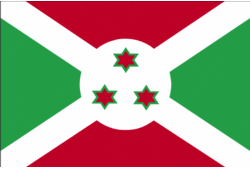 Burundian national flag (Flag of Burundi)
 Burundi country profile
 Travel advice for Burundi
As for the Burundian climate; equatorial; high plateau with considerable altitude variation (772 m to 2,670 m above sea level); average annual temperature varies with altitude from 23 to 17 degrees centigrade but is generally moderate as the average altitude is about 1,700 m; average annual rainfall is about 150 cm; two wet seasons (February to May and September to November), and two dry seasons (June to August and December to January).
Burundian(s) speak Kirundi (official), French (official), Swahili (along Lake Tanganyika and in the Bujumbura area).
Places of note in Burundi
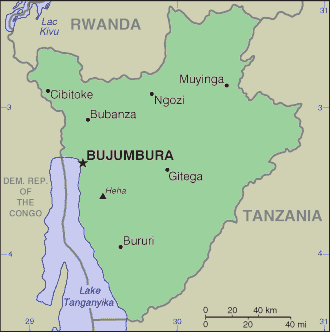 Burundian map
Regions of Burundi
Burundi's first democratically elected president was assassinated in October 1993 after only 100 days in office, triggering widespread ethnic violence between Hutu and Tutsi factions. Over 200,000 Burundians perished during the conflict that spanned almost a dozen years. Hundreds of thousands of Burundians were internally displaced or became refugees in neighboring countries. An internationally brokered power-sharing agreement between the Tutsi-dominated government and the Hutu rebels in 2003 paved the way for a transition process that led to an integrated defense force, established a new constitution in 2005, and elected a majority Hutu government in 2005. The new government, led by President Pierre NKURUNZIZA, faces many challenges, particularly from the country's last rebel group who remains outside of the peace process and continue attacks in the western provinces of Burundi.
Burundi is a landlocked, resource-poor country with an underdeveloped manufacturing sector. The economy is predominantly agricultural with more than 90% of the population dependent on subsistence agriculture. Economic growth depends on coffee and tea exports, which account for 90% of foreign exchange earnings. The ability to pay for imports, therefore, rests primarily on weather conditions and international coffee and tea prices. The Tutsi minority, 14% of the population, dominates the government and the coffee trade at the expense of the Hutu majority, 85% of the population. An ethnic-based war that lasted for over a decade resulted in more than 200,000 deaths, forced more than 48,000 refugees into Tanzania, and displaced 140,000 others internally. Only one in two children go to school, and approximately one in 10 adults has HIV/AIDS. Food, medicine, and electricity remain in short supply. Political stability and the end of the civil war have improved aid flows and economic activity has increased, but underlying weaknesses - a high poverty rate, poor education rates, a weak legal system, and low administrative capacity - risk undermining planned economic reforms.
Burundian natural resources include nickel, uranium, rare earth oxides, peat, cobalt, copper, platinum, vanadium, arable land, hydropower, niobium, tantalum, gold, tin, tungsten, kaolin, limestone
landlocked; straddles crest of the Nile-Congo watershed; the Kagera, which drains into Lake Victoria, is the most remote headstream of the White Nile
Burundian religion is Christian 67% (Roman Catholic 62%, Protestant 5%), indigenous beliefs 23%, Muslim 10%.
Natural hazards in Burundi include flooding, landslides, drought.
Travel Advice for Burundi
BurundiSUMMARY
- We advise against all but essential travel to Bujumbura and against all travel to other parts of Burundi unless with an organised UN mission, but even then your safety cannot be guaranteed.
- A number of senior political figures, arrested in connection with an alleged “coup” plot, are still in detention. This has raised tensions in Bujumbura.
- The threat from indiscriminate attacks by rebel groups is high, particularly in Bujumbura Rural province.
- You should be aware of the global risk of indiscriminate terrorist attacks, which could be against civilian targets, including places frequented by foreigners.
- If you must travel, we strongly recommend that you obtain comprehensive travel and medical insurance before travelling. You should check any exclusions, and that your policy covers you for the activities you want to undertake. Please see: Travel Insurance
SAFETY AND SECURITY
You should be aware of the global risk of indiscriminate terrorist attacks, which could be against civilian targets, including places frequented by foreigners. Please read: Security and General Tips and Risk of Terrorism when Travelling Overseas pages on the FCO website for further information and advice.
Crime
There is a high risk of street crime in Bujumbura. Muggings at gunpoint, purse snatching, pick-pocketing, burglary, car break-ins, and car hijackings have all been reported. Take sensible precautions i.e. do not walk in the streets after dark and do not carry large amounts of money. Safeguard valuables and cash. Deposit them in hotel safes, where practical. Keep copies of important documents, including passports separately. You should not drive alone after dark.
We advise against travelling outside Bujumbura after dark.
In April 2006, the long-standing night time curfew was lifted. Despite this we advise you to exercise caution when travelling between the hours of 23:00 to 06:00. Roadblocks are still in place on some routes after dark.
Political Situation
After 12 years of ethnic conflict, Burundi held elections between June and September 2005. The CNDD-FDD party won convincingly and Pierre Nkurunziza was sworn as President on 26 August 2005.
The UN peacekeeping force (ONUB), deployed in Burundi in June 2004 to oversee the political transition, completed its mandate and withdrew in December 2006. The new integrated office (BINUB), part of the UN Peacebuilding Commission, opened on 1 January 2007. BINUB will focus on reconstruction, institution-building and sustainable development for post-conflict recovery. After years of rebel activity and attacks on the rural population, the Forces Nationales de Libération (FNL) rebel group has finally agreed to join the Burundi peace process. FNL leaders signed a cease-fire agreement with the government on 7 September 2006. Work is underway to implement this agreement.
Although the security situation has stabilised in much of the country, the risk of outbreaks of armed violence, acts of banditry or cross-border incursion by rebel groups remains. Recent arrests of senior political figures, linked to an alleged coup plot have raised tensions in Bujumbura. Crime in rural areas is on the increase, particularly in Bujumbura Rural, Bubanza and Cibitoke. This is likely to continue, given the amount of arms circulating freely. Security of the border with the Democratic Republic of Congo (DRC) remains a matter of concern.
We therefore continue to advise against all travel outside Bujumbura except with an official UN escort, which will have assessed the security situation prior to giving authorisation. We continue to advise against using the Bujumbura to Butare (Rwanda) road, on which there are still occasional ambushes, again unless as part of an official UN convoy.
If you must enter Burundi despite this advice, you should exercise extreme caution. You should regularly review the situation and consider whether your presence is essential. All British nationals in Burundi should register at the Belgian Embassy (tel: +257 22 32 66) and seek their advice on the latest situation.
Road Safety
You may drive in Burundi on a full UK driving licence for the first six months, after which, you are required to obtain a Burundi driving licence.
Air Safety
Five carriers fly in and out of Burundi: Rwandair, Ethiopian Airlines, Kenyan Airways, TMK (DRC registered) and Air Burundi. Neither TMK nor Air Burundi are ICAO/IATA approved. British Government employees have been advised that there are safety concerns about Air Burundi and TMK. For advice about DRC carriers, please see DRC travel advice.
The EU has published a list of air carriers that are subject to an operating ban or restrictions within the community. You should check the following link to see whether this will affect your travel: http://europa.eu.int/comm/transport/air/safety/flywell_en.htm
ENTRY REQUIREMENTS
HEALTH
Only very limited medical facilities are available. In the event of serious accident or illness an evacuation by air ambulance may be required.
HIV/AIDS and Malaria are prevalent in Burundi. More than three-quarters of British travellers who contracted malaria in 2005 did not take preventive measures, such as malaria prevention tablets. However, malaria can occur despite appropriate prevention, and therefore you should promptly seek medical care in the event of a fever or flu-like illness in the first year following your return from travelling to a malaria risk country. Before travelling you should seek medical advice about the malaria risk in Burundi.
You should seek medical advice before travelling and ensure that all appropriate vaccinations are up-to-date. For further information on health, check the Department of Health’s website at www.dh.gov.uk.
NATURAL DISASTERS
An earthquake struck the Lake Tanganyika region (on the border of DRC and Tanzania) on 5 December 2005. Tremors were felt in Burundi and as far away as Kampala and Nairobi. There were no reports of casualties in Burundi.
GENERAL