
 Search
Traveling Luck for Algeria. Algeria, Africa
Algeria is located in Northern Africa, bordering the Mediterranean Sea, between Morocco and Tunisia.
Land in Algeria is mostly high plateau and desert; some mountains; narrow, discontinuous coastal plain.
Algerian land covers an area of 2381740 square kilometers which is slightly less than 3.5 times the size of Texas
Algeria has borders with Western Sahara for 42km, Libya for 982km, Morocco for 1559km, Mali for 1376km, Mauritania for 463km, Niger for 956km and Tunisia for 965km.
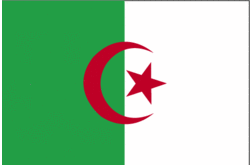 Algerian national flag (Flag of Algeria)
 Algeria country profile
 Travel advice for Algeria
As for the Algerian climate; arid to semiarid; mild, wet winters with hot, dry summers along coast; drier with cold winters and hot summers on high plateau; sirocco is a hot, dust/sand-laden wind especially common in summer.
Algerian(s) speak Arabic (official), French, Berber dialects.
Places of note in Algeria
- Algiers
- Oran
- Constantine
- Batna
- Bab Ezzouar
- Annaba
- Sidi Bel Abbès
- Ech Chettia
- Bejaïa
- Skikda
- El Achir
- Médéa
- Béchar
- El Eulma
- Saïda
- Guelma
- Bordj el Kiffan
- Aïn Oussera
- Laghouat
- Aïn Beïda
- Baraki
- Oum el Bouaghi
- Messaad
- Barika
- Beni Mered
- Aflou
- El Khroub
- Rouissat
- Berrouaghia
- Ksar el Boukhari
- Khemis Miliana
- Azzaba
- Tamanrasset
- Aïn Touta
- Cheria
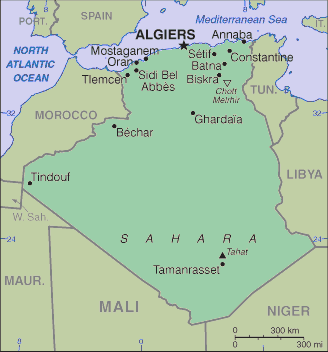 Algerian map
Regions of Algeria
- Adrar
- Aïn Defla
- Aïn Temouchent
- Alger
- Algeria (general)
- Annaba
- Batna
- Béchar
- Bejaïa
- Biskra
- Blida
- Bordj Bou Arréridj
- Bouira
- Boumerdes
- Chlef
- Constantine
- Djelfa
- El Bayadh
- El Oued
- El Tarf
- Ghardaïa
- Guelma
- Illizi
- Jijel
- Khenchela
- Laghouat
- Mascara
- Médéa
- Mila
- Mostaganem
- Mʼsila
- Naama
- Oran
- Ouargla
- Oum el Bouaghi
- Relizane
- Saïda
- Sétif
- Sidi Bel Abbès
- Skikda
- Souk Ahras
- Tamanghasset
- Tébessa
- Tiaret
- Tindouf
- Tipaza
- Tissemsilt
- Tizi Ouzou
- Tlemcen
After more than a century of rule by France, Algerians fought through much of the 1950s to achieve independence in 1962. Algeria's primary political party, the National Liberation Front (FLN), has dominated politics ever since. Many Algerians in the subsequent generation were not satisfied, however, and moved to counter the FLN's centrality in Algerian politics. The surprising first round success of the Islamic Salvation Front (FIS) in the December 1991 balloting spurred the Algerian army to intervene and postpone the second round of elections to prevent what the secular elite feared would be an extremist-led government from assuming power. The army began a crack down on the FIS that spurred FIS supporters to begin attacking government targets. The government later allowed elections featuring pro-government and moderate religious-based parties, but did not appease the activists who progressively widened their attacks. The fighting escalated into an insurgency, which saw intense fighting between 1992-98 and which resulted in over 100,000 deaths - many attributed to indiscriminate massacres of villagers by extremists. The government gained the upper hand by the late-1990s and FIS's armed wing, the Islamic Salvation Army, disbanded in January 2000. However, small numbers of armed militants persist in confronting government forces and conducting ambushes and occasional attacks on villages. The army placed Abdelaziz BOUTEFLIKA in the presidency in 1999 in a fraudulent election but claimed neutrality in his 2004 landslide reelection victory. Longstanding problems continue to face BOUTEFLIKA in his second term, including the ethnic minority Berbers' ongoing autonomy campaign, large-scale unemployment, a shortage of housing, unreliable electrical and water supplies, government inefficiencies and corruption, and the continuing - although significantly degraded - activities of extremist militants. Algeria must also diversify its petroleum-based economy, which has yielded a large cash reserve but which has not been used to redress Algeria's many social and infrastructure problems.
The hydrocarbons sector is the backbone of the economy, accounting for roughly 60% of budget revenues, 30% of GDP, and over 95% of export earnings. Algeria has the seventh-largest reserves of natural gas in the world and is the second-largest gas exporter; it ranks 14th in oil reserves. Sustained high oil prices in recent years, along with macroeconomic policy reforms supported by the IMF, have helped improve Algeria's financial and macroeconomic indicators. Algeria is running substantial trade surpluses and building up record foreign exchange reserves. Real GDP has risen due to higher oil output and increased government spending. The government's continued efforts to diversify the economy by attracting foreign and domestic investment outside the energy sector, however, has had little success in reducing high unemployment and improving living standards. The population is becoming increasingly restive due to the lack of jobs and housing and frequently stages protests, which have resulted in arrests and injuries, including some deaths as government forces intervened to restore order. Structural reform within the economy, such as development of the banking sector and the construction of infrastructure, moves ahead slowly hampered by corruption and bureaucratic resistance.
Algerian natural resources include petroleum, natural gas, iron ore, phosphates, uranium, lead, zinc
second-largest country in Africa (after Sudan)
Algerian religion is Sunni Muslim (state religion) 99%, Christian and Jewish 1%.
Natural hazards in Algeria include mountainous areas subject to severe earthquakes; mudslides and floods in rainy season.
Travel Advice for Algeria
AlgeriaSUMMARY
- There is a continuing threat from terrorism in Algeria.
- On 10 December 2006 two minibuses carrying expatriate workers were targeted in a bomb and gun attack at Bouchaoui, in the western suburbs of Algiers. One Algerian and one Lebanese national were killed. Six foreigners, including three British citizens, were injured. The GSPC terrorist group has claimed responsibility. On 29 October 2006, two bomb attacks targeted police stations at Reghaia and Dergana (20kms east of Algiers). Since May 2006, there have been a series of bomb attacks in Algeria (see the Terrorism section of this travel advice for more information).
- You are at risk of being caught up in attacks by terrorist groups if you travel by road in certain parts of northern Algeria.
- You should exercise particular care in Haute Kabylie, especially the area in and around Boumerdès; the area to the west of the Massif de Ouarsensis, especially around the cities of Relizane and Mascara; the area to the south of Blida, especially around the city of Medea; and in the area around the city of Tebessa near the border with Tunisia.
- Overland travel between major cities should be avoided at night. Sustained small-scale attacks, including bombings, illegal roadblocks, kidnapping and murder, occur in rural and remote sections of the country.
- The GSPC terrorist group issued an explicit threat to target non-Muslims in June 2004.
- If you are planning to travel to Algeria, you should be very careful about your personal security arrangements throughout your visit. We recommend that long-term visitors vary their daily travel routines, changing the timings and routes of regular journeys where possible. Developments in the region could affect the security situation. You should check the FCO website regularly for updated advice.
- Crimes against individuals, such as assaults and muggings, are on the increase in urban areas. You should avoid carrying large amounts of money or valuable property.
- We strongly recommend that comprehensive travel and medical insurance is obtained before travelling. You should check any exclusions, and that your policy covers you for the activities you want to undertake. Please see Travel Insurance.
SAFETY AND SECURITY
Most visits to Algeria are crime-free. In certain areas of larger cities there are incidents of robbery (muggings), bag snatching, pick-pocketing and thefts of and from motor vehicles. There have been reports of car-jackings and robberies and thefts by criminals posing as police officers outside the main cities. You should avoid areas that you do not know, especially after dark. Do not carry large amounts of money or valuables around with you.
Political Situation
Demonstrations, sometimes violent, over issues such as water, increases in the price of fuel and public transport, shortage of housing and jobs have been reported in many parts of Algeria over the past year. While this unrest is not directed against foreigners, you should take care not to become caught up in a demonstration that may lead to violence.
Algeria Country Profile
Local Travel
If you are travelling to Algeria you should seek the advice of your hosts about appropriate security measures. You should arrange to be met on arrival and in Algiers and should stay at one of the main hotels that take proper security precautions.
LOCAL LAWS AND CUSTOMS
Algeria is a predominantly Muslim country. The weekend is Thursday and Friday. There are, however, no restrictions on alcohol in restaurants, or in urban areas generally. In rural areas, women would be expected to dress conservatively.
ENTRY REQUIREMENTS
HEALTH
NATURAL DISASTERS
Over the years, parts of Algiers and the surrounding region have, on occasion, suffered severe flood damage. Northern Algeria is also within an earthquake zone. During the evening of 21 May 2003, a severe earthquake struck the Algiers area. There were over 2,200 dead and more than 10,000 injured.
GENERAL