
 Search
Traveling Luck for Tunisia. Tunisia, Africa
Tunisia is located in Northern Africa, bordering the Mediterranean Sea, between Algeria and Libya.
Land in Tunisia is mountains in north; hot, dry central plain; semiarid south merges into the Sahara.
Tunisian land covers an area of 163610 square kilometers which is slightly larger than Georgia
Tunisia has borders with Algeria for 965km and Libya for 459km.
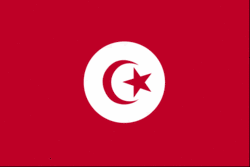 Tunisian national flag (Flag of Tunisia)
 Tunisia country profile
 Travel advice for Tunisia
As for the Tunisian climate; temperate in north with mild, rainy winters and hot, dry summers; desert in south.
Tunisian(s) speak Arabic (official and one of the languages of commerce), French (commerce).
Places of note in Tunisia
- Tunis
- Sfax
- Sousse
- Kairouan
- Bizerte
- Gabès
- Kasserine
- Gafsa
- La Goulette
- Zarzis
- La Mohammedia
- Al Marsá
- Masākin
- Şaqānis
- Houmt Souk
- Tataouine
- Douane
- Béja
- Al Ḩammāmāt
- Jendouba
- El Kef
- Hammam-Lif
- Oued Lill
- Menzel Bourguiba
- Zouila
- Radès
- Sidi Bouzid
- Al Metlaoui
- Jammāl
- Qaşr Hallāl
- El Hamma
- Tozeur
- Dar Chabanne
- Hammam Sousse
- Al Qarmadah
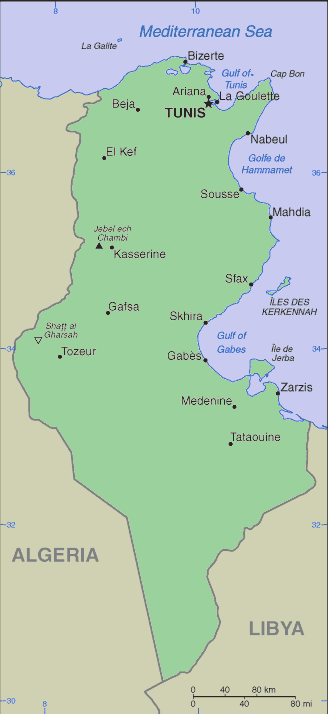 Tunisian map
Regions of Tunisia
Following independence from France in 1956, President Habib BOURGUIBA established a strict one-party state. He dominated the country for 31 years, repressing Islamic fundamentalism and establishing rights for women unmatched by any other Arab nation. Tunisia has long taken a moderate, non-aligned stance in its foreign relations. Domestically, it has sought to defuse rising pressure for a more open political society.
Tunisia has a diverse economy, with important agricultural, mining, energy, tourism, and manufacturing sectors. Governmental control of economic affairs while still heavy has gradually lessened over the past decade with increasing privatization, simplification of the tax structure, and a prudent approach to debt. Progressive social policies also have helped raise living conditions in Tunisia relative to the region. Real growth slowed to a 15-year low of 1.9% in 2002 because of agricultural drought and lackluster tourism. Better rains in 2003 through 2005, however, helped push GDP growth to about 5% for these years. Tourism also recovered after the end of combat operations in Iraq. Tunisia is gradually removing barriers to trade with the EU. Broader privatization, further liberalization of the investment code to increase foreign investment, improvements in government efficiency, and reduction of the trade deficit are among the challenges ahead.
Tunisian natural resources include petroleum, phosphates, iron ore, lead, zinc, salt
strategic location in central Mediterranean; Malta and Tunisia are discussing the commercial exploitation of the continental shelf between their countries, particularly for oil exploration
Tunisian religion is Muslim 98%, Christian 1%, Jewish and other 1%.
Natural hazards in Tunisia include NA.
Travel Advice for Tunisia
TunisiaSUMMARY
- You should be aware of the threat from terrorism in Tunisia.
- Following police action against an armed terrorist group on 3 January 2007 the Tunisian authorities announced that 12 of the group had been killed and 15 arrested. It is believed the group were planning attacks against Western interests, including Embassies. There are continuing police roadblocks at major intersections. You are advised to maintain a high level of vigilance with regard to your personal security whilst you are in Tunisia.
- You are strongly advised not to attempt to cross the border into Algeria if travelling independently. We advise caution if you intend to travel to the south eastern Algerian provinces of Tamanrasset, Djanet and Illizi and recommend that you travel with a reputable tour company or an approved local guide.
- Around 350,000 British nationals visit Tunisia each year. Most visits are trouble-free. The main types of incident for which British nationals require consular assistance in Tunisia are for deaths, mostly from natural causes, hospitalisations (for physical injury and psychiatric illness) and replacing lost and stolen passports. You should watch out for petty criminals such as pickpockets, and bag snatchers, particularly in crowded market places.
- We strongly recommend that you obtain comprehensive travel and medical insurance before travelling. You should check any exclusions, and that your policy covers you for the activities you want to undertake. Please see: Travel Insurance.
SAFETY AND SECURITY
There is little violent crime but you should watch out for petty criminals such as pickpockets, particularly in crowded market places.
There has also been a noticeable increase in incidents of bag snatching in tourist areas and you are strongly advised to ensure that, when carrying bags etc they are kept close to your person at all times. Where possible, you should avoid carrying all your important documents, money etc in the same bag. You should take similar precautions to protect yourself and your belongings, as you would do at home.
Political Situation
Tunisia Country Profile
You should be aware of the impact that the situation in Iraq, as well as the violence between the Israelis and Palestinians, has across the Arab world and the risk of public disturbance in response.
You should follow news reports and be alert to developments, which might trigger public disturbances. You should take sensible precautions for your personal safety and avoid political gatherings and demonstrations.
Local Travel
You should seek specific advice from tour operators or the British Embassy when travelling independently to the desert areas in the south.
You are strongly advised not to attempt to cross the border into Algeria if travelling independently. We advise caution if you intend to travel to the south eastern Algerian provinces of Tamanrasset, Djanet and Illizi and recommend that you travel with a reputable tour company or an approved local guide.
Road Safety
Driving in Tunisia can be erratic and sometimes dangerous. There is little lane discipline and pedestrian crossings are ignored. You should take particular care when crossing roads, even where there is a signal allowing you to do so. Driving tends to be fast, even in towns.
Roads are of a reasonable standard although large pot-holes can appear quickly following heavy rain. There are only three motorways in Tunisia, running from Tunis to Bizerte in the north, to Sousse in the south and to Beja to the West. These roads are in good condition and well maintained. Motorway driving can be fast, usually exceeding the 110kmph (68mph) speed limit. Further motorway expansion is planned.
Air Safety
Internal air travel is safe and airports provide a reasonably high level of security to passengers and aircraft.
Rail Safety
Rail travel is also safe, but you should ensure that you remain vigilant against petty criminals at all times.
LOCAL LAWS AND CUSTOMS
You must not become involved in drugs. The possession of even a small amount of 'soft' drugs could result in a prison term.
If you have any concerns about taking medication with you to Tunisia, you should contact the Tunisian Representation in the UK, for further information. Additionally in the case of prescription medication, we recommend that you carry a note from your GP confirming that the medication has been prescribed for an existing condition.
You should also be aware that it is not permitted to remove antiquities from Tunisia without first obtaining permission from Customs authorities. Failure to do so could result in lengthy delays on departure, fines and/or imprisonment.
In the coastal holiday resorts and main cities, the dress code is very much like any European city or tourist areas. If visiting religious sites or more remote areas of Tunisia, you should dress more modestly and avoid any articles of clothing which may cause offence.
Only married couples are permitted to cohabit in Tunisia. Homosexuality is illegal.
You should avoid taking any photographs near sensitive political or military sites.
Tunisian family law is very different from UK law and particular caution is needed when, for example, child custody becomes an issue. Please see child abduction.
ENTRY REQUIREMENTS
Single parents or other adults travelling alone with children should be aware that some countries require documentary evidence of parental responsibility before allowing lone parents to enter the country or, in some cases, before permitting the children to leave the country. For further information on exactly what will be required at immigration please contact the Tunisian Representation in the UK.
HEALTH
There is no provision for free medical attention for non-Tunisians. All doctors' fees, medication and hospitalisation in private (as opposed to state run) clinics have to be paid for on the spot. These costs can be quite high.
You should seek medical advice before travelling and ensure that all appropriate vaccinations are up to date. For further information on health, check the Department of Health’s website at: www.dh.gov.uk.
GENERAL
Tunisian regulations require you to declare on entry any large amounts of money being brought in. You will also be asked to declare if you expect to have more than £500 on you when you leave. The export of Tunisian dinars is expressly prohibited. You could be required to show the currency declaration on departure.
ATMs are widely available in Tunisia. Almost all ATMs will accept Visa cards, and many (most notably Bank of Tunisia and BIAT) will also accept Maestro (Switch) cards for cash withdrawals. Visa and Mastercard are widely acceptable for payment in shops, restaurants and hotels although there are frequent problems in obtaining authorisation for Mastercard purchases.
The Consular Section at the British Embassy in Tunisia offers a full passport issuing service. If you lose your passport while on holiday, you should immediately report the loss first to the nearest police station, and then to the Consular Section, who will advise on the arrangements for a replacement passport to be issued.
You should carry a copy of your passport for identity and leave the passport itself in a safe place such as a deposit box at your hotel.
There have been numerous instances recently where British nationals wishing to buy property in Tunisia have been advised to do so through a Tunisian "friend" on the pretence that it is illegal for foreign nationals to purchase property in Tunisia. If you are considering purchasing property in Tunisia, you should immediately consult a local lawyer who will be best placed to offer advice. Do not make private arrangements, which in themselves may be illegal and may result in large financial loss.