
 Search
Traveling Luck for Libya. Libya, Africa
Libya is located in Northern Africa, bordering the Mediterranean Sea, between Egypt and Tunisia.
Land in Libya is mostly barren, flat to undulating plains, plateaus, depressions.
Libyan land covers an area of 1759540 square kilometers which is slightly larger than Alaska
Libya has borders with Algeria for 982km, Egypt for 1115km, Niger for 354km, Sudan for 383km, Chad for 1055km and Tunisia for 459km.
 Libyan national flag (Flag of Libya)
 Libya country profile
 Travel advice for Libya
As for the Libyan climate; Mediterranean along coast; dry, extreme desert interior.
Libyan(s) speak Arabic, Italian, English, all are widely understood in the major cities.
Places of note in Libya
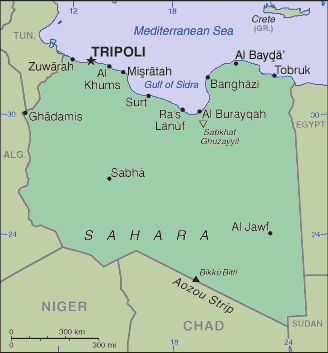 Libyan map
Regions of Libya
- Ajdābiyā
- Al ‘Azīzīyah
- Al Fātiḩ
- Al Jabal al Akhḑar
- Al Jufrah
- Al Khums
- Al Kufrah
- An Nuqāţ al Khams
- Ash Shāţiʼ
- Awbārī
- Az Zāwiyah
- Banghāzī
- Darnah
- Ghadāmis
- Gharyān
- Libya (general)
- (LY02)
- (LY04)
- (LY06)
- (LY09)
- (LY10)
- (LY11)
- (LY12)
- (LY15)
- (LY18)
- (LY19)
- (LY23)
- (LY24)
- (LY25)
- (LY26)
- (LY27)
- (LY29)
- (LY31)
- (LY32)
- (LY33)
- (LY35)
- (LY36)
- (LY37)
- (LY39)
- (LY43)
- (LY46)
- Mişrātah
- Murzuq
- Sabhā
- Sawfajjīn
- Surt
- Ţarābulus
- Tarhūnah
- Ţubruq
- Yafran
- Zlīţan
From the earliest days of his rule following the 1969 military coup, Col. Muammar Abu Minyar al-QADHAFI has espoused his own political system, the Third Universal Theory. The system is a combination of socialism and Islam derived in part from tribal practices and is supposed to be implemented by the Libyan people themselves in a unique form of "direct democracy." QADHAFI has always seen himself as a revolutionary and visionary leader. He used oil funds during the 1970s and 1980s to promote his ideology outside Libya, supporting subversives and terrorists abroad to hasten the end of Marxism and capitalism. In addition, beginning in 1973, he engaged in military operations in northern Chad's Aozou Strip - to gain access to minerals and to use as a base of influence in Chadian politics - but was forced to retreat in 1987. UN sanctions in 1992 isolated QADHAFI politically following the downing of Pan AM Flight 103 over Lockerbie, Scotland. Libyan support for terrorism appeared to have decreased after the imposition of sanctions. During the 1990s, QADHAFI also began to rebuild his relationships with Europe. UN sanctions were suspended in April 1999 and finally lifted in September 2003 after Libya resolved the Lockerbie case. In December 2003, Libya announced that it had agreed to reveal and end its programs to develop weapons of mass destruction, and QADHAFI has made significant strides in normalizing relations with western nations since then. He has received various Western European leaders as well as many working-level and commercial delegations, and made his first trip to Western Europe in 15 years when he traveled to Brussels in April 2004. QADHAFI also finally resolved in 2004 several outstanding cases against his government for terrorist activities in the 1980s by compensating the families of victims of the UTA and La Belle disco bombings.
The Libyan economy depends primarily upon revenues from the oil sector, which contribute about 95% of export earnings, about one-quarter of GDP, and 60% of public sector wages. Substantial revenues from the energy sector coupled with a small population give Libya one of the highest per capita GDPs in Africa, but little of this income flows down to the lower orders of society. Libyan officials in the past four years have made progress on economic reforms as part of a broader campaign to reintegrate the country into the international fold. This effort picked up steam after UN sanctions were lifted in September 2003 and as Libya announced that it would abandon programs to build weapons of mass destruction in December 2003. Almost all US unilateral sanctions against Libya were removed in April 2004, helping Libya attract more foreign direct investment, mostly in the energy sector. Libya faces a long road ahead in liberalizing the socialist-oriented economy, but initial steps - including applying for WTO membership, reducing some subsidies, and announcing plans for privatization - are laying the groundwork for a transition to a more market-based economy. The non-oil manufacturing and construction sectors, which account for about 20% of GDP, have expanded from processing mostly agricultural products to include the production of petrochemicals, iron, steel, and aluminum. Climatic conditions and poor soils severely limit agricultural output, and Libya imports about 75% of its food.
Libyan natural resources include petroleum, natural gas, gypsum
more than 90% of the country is desert or semidesert
Libyan religion is Sunni Muslim 97%.
Natural hazards in Libya include hot, dry, dust-laden ghibli is a southern wind lasting one to four days in spring and fall; dust storms, sandstorms.
Travel Advice for Libya
LibyaSUMMARY
- We advise against all but essential travel to all areas bordering Chad and Sudan, because of instability in the region. With the exception of the official land border crossings to Tunisia and Egypt, visitors and residents are not permitted to travel in the interior or to border areas without an officially sanctioned guide or specific permission from the Libyan authorities.
- Libya shares with the rest of the North African region a threat from terrorism. Attacks could be indiscriminate and against civilian targets, including places frequented by foreigners.
- British nationals visiting Libya for short periods may wish to register with the British Embassy so that contact details are available in case of emergency. British nationals remaining for longer periods should register as soon as possible. The email address for registration is: Consular.Registration.Tripoli@fco.gov.uk.
- You should take sensible precautions for your personal safety and avoid political gatherings and demonstrations. You should follow news reports and be alert to developments in Libya and the Middle East that might trigger public disturbances.
- You require prior permission (a desert pass) from the Libyan authorities if you intend to travel to the desert regions. Your tour operator will usually be able to do this for you. If you obtain a desert pass you should avoid those desert areas where oil extraction is in operation. Oil companies will provide passes for their employees.
- Libya is a cash society. You must be in possession of a minimum of foreign currency equivalent to 500 Libyan Dinars on arrival. Hard currency should be declared to the immigration officer on arrival at the airport. Credit cards are not widely used and there are few reliable ATMs in Tripoli.
- Around 2,000 British nationals visit Libya every year. Most visits are trouble-free. The main type of incident for which British nationals require consular assistance in Libya is for replacing lost or stolen passports or from becoming involved in road accidents.
- We strongly recommend that comprehensive travel and medical insurance is obtained before travelling. You should check any exclusions, and that your policy covers you for the activities you want to undertake. Please see: Travel Insurance.
SAFETY AND SECURITY
Local Travel.
LOCAL LAWS AND CUSTOMS
You should respect Libyan laws and regulations. Sale and consumption of alcohol is against the law. Stern penalties are imposed for the possession or use of alcohol. You should on no account attempt to bring alcohol into the country.
Drugs laws are severe. Those found in the possession of any illegal drug may receive a prison sentence.
Severe penalties are imposed for criticising the country, its leadership or religion. Libya is a Muslim country and you should dress accordingly, covering arms, shoulders and legs. Avoid shorts, tight fitting or revealing clothes in public.
Homosexuality is considered a criminal offence in Libya. Sexual relations outside marriage are also punishable by law.
You are advised not to use cameras close to military or official sites.
ENTRY REQUIREMENTS
There are a number of exceptions to this Libyan regulation. They are for visitors:
- who obtained a visa for an official mission;
- who obtained a visa for study on a government course;
- who are in possession of an official government invitation;
- who are joining a Libyan resident, provided the resident undertakes to bear cost of the visitor’s stay and medical treatment; and
- who are travelling in tourist groups arranged by tour operator or travel agency where expenses have been covered before arrival.
HEALTH
Health care in Libya is on the whole, below the standard available in the UK. There are, however, a couple of private clinics in Tripoli. If you require treatment local hospitals and private clinics should be able to stabilise you, but you would normally be medically evacuated to Malta or mainland Europe for further treatment. You should ensure that your insurance covers you for such an event.
GENERAL
You are advised to carry some form of identification with you at all times and should take out adequate comprehensive insurance including full cover for medical treatment and accidents before travelling.
British nationals visiting Libya for short periods may wish to register with the British Embassy so that contact details are available in case of emergency. British nationals remaining for longer periods should register as soon as possible.
The Consular Section at the British Embassy in Libya offers a full passport issuing service. If you lose your passport while on holiday, you should immediately report the loss first to the nearest Police Station, and then to the Consular Section, who will advise on the arrangements for a replacement passport to be issued.
Money
Libya is a cash society. Visitors to Libya should be in possession of foreign currency equivalent to 500 Libyan Dinars (see the paragraph on Entry Requirements).
Credit cards are not widely used Although VISA and MASTERCARD are starting to be accepted in some outlets. and there are few reliable ATMs in Tripoli. There is a branch of Western Union situated at Tripoli International Airport. Money transfers can also be arranged through some banks.
Consular Assistance
In recent years Libya has received more visitors and tourists to the region; approximately 2,000 visitors in 2005. All British Citizens require a visa, which must be supported by an invitation, either from a company or local tour operator. Borders are still not open to independent travellers wishing to travel across country without a local guide.