World index ... Africa ... Egypt
Travelers word index

Egypt

Continents
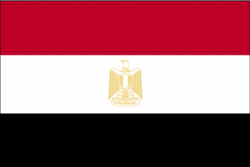
Egyptian flag

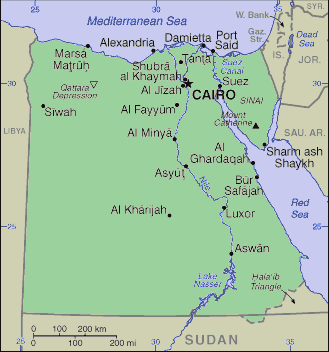
Egypt is located in Northern Africa, bordering the Mediterranean Sea, between Libya and the Gaza Strip, and the Red Sea north of Sudan, and includes the Asian Sinai Peninsula.

Egypt has borders with Israel for 266km, Libya for 1115km and Sudan for 1273km.
Land in Egypt is vast desert plateau interrupted by Nile valley and delta.

Egyptian land covers an area of 1001450 square kilometers which is slightly more than three times the size of New Mexico

As for the Egyptian climate; desert; hot, dry summers with moderate winters.

Egyptian(s) speak Arabic (official), English and French widely understood by educated classes.

Egypt country profile, Travel advice for Egypt

Egyptian Map
Places of note in Egypt
Cairo
Alexandria
Al Jīzah
Port Said
Suez
Al Maḩallah al Kubrá
Luxor
Asyūţ
Al Manşūrah
Ţanţā
Al Fayyūm
Az Zaqāzīq
Ismailia
Kafr ad Dawwār
Aswān
Qinā
Damanhûr
Al Minyā
Sūhāj
Banī Suwayf
Banhā
Idfu
Ṭalkha
Kafr ash Shaykh
Mallawī
Dikirnis
Bilbays
Al `Arīsh
Jirjā
Al Ḩawāmidīyah
Idkū
Bilqās Qism Awwal
Disūq
Abū Kabīr
Qalyūb
Regions of Egypt
Ad Daqahlīyah
Al Baḩr al Aḩmar
Al Buḩayrah
Al Fayyūm
Al Gharbīyah
Al Iskandarīyah
Al Ismā‘īlīyah
Al Jīzah
Al Minūfīyah
Al Minyā
Al Qāhirah
Al Qalyūbīyah
Al Wādī al Jadīd
Ash Sharqīyah
As Suways
Aswān
Asyūţ
Banī Suwayf
Būr Sa‘īd
Dumyāţ
Egypt (general)
Janūb Sīnāʼ
Kafr ash Shaykh
Maţrūḩ
Qinā
Shamāl Sīnāʼ
Sūhāj

The regularity and richness of the annual Nile River flood, coupled with semi-isolation provided by deserts to the east and west, allowed for the development of one of the world's great civilizations. A unified kingdom arose circa 3200 B.C., and a series of dynasties ruled in Egypt for the next three millennia. The last native dynasty fell to the Persians in 341 B.C., who in turn were replaced by the Greeks, Romans, and Byzantines. It was the Arabs who introduced Islam and the Arabic language in the 7th century and who ruled for the next six centuries. A local military caste, the Mamluks took control about 1250 and continued to govern after the conquest of Egypt by the Ottoman Turks in 1517. Following the completion of the Suez Canal in 1869, Egypt became an important world transportation hub, but also fell heavily into debt. Ostensibly to protect its investments, Britain seized control of Egypt's government in 1882, but nominal allegiance to the Ottoman Empire continued until 1914. Partially independent from the UK in 1922, Egypt acquired full sovereignty following World War II. The completion of the Aswan High Dam in 1971 and the resultant Lake Nasser have altered the time-honored place of the Nile River in the agriculture and ecology of Egypt. A rapidly growing population (the largest in the Arab world), limited arable land, and dependence on the Nile all continue to overtax resources and stress society. The government has struggled to ready the economy for the new millennium through economic reform and massive investment in communications and physical infrastructure.

Country profile: Egypt

Map of Egypt

While best known for its pyramids and ancient civilisations, Egypt has played a central role in Middle East politics in modern times.

Its three wars with Israel in 1948, 1967 and 1973, then its eventual peace with its adversary in 1979, have seen Egypt move from being a warring nation to become a key representative in the peace process.

But the historic step taken by President Anwar Sadat in the Camp David agreement with Israel saw the expulsion of Egypt from the Arab League until 1989, and in 1981 Mr Sadat was assassinated by Islamic extremists angry at his moves to clamp down on their activities.

AT-A-GLANCE


Al-Azhar mosque, Cairo Since then, President Hosni Mubarak has taken a more moderate line, but Islamic groups have continued their campaigns sporadically, being responsible for deadly attacks that have often targeted tourists and resort areas.

Campaigners for political reform have become more vocal in recent times and have taken to the streets in defiance of an emergency law, in force since 1981. Activists say the law restricts political expression.

Although Egypt has changed its constitution to allow the opposition to contest presidential polls, potential candidates must meet strict criteria for participation. A ban remains on religious political parties.

Egypt's ancient past and the fact that it was one of the first Middle Eastern countries to open up to the West following Napoleon's invasion means that it is seen by many as the intellectual and cultural leader in the region. The head of Cairo's Al-Azhar Mosque is one of the highest authorities in Sunni Islam.

Egypt's teeming cities - and almost all agricultural activity - are concentrated along the banks of the Nile, and on the river's delta. Deserts occupy most of the country.

President: Muhammad Hosni Mubarak

Hosni Mubarak is Egypt's longest-serving ruler since Muhammad Ali in the early 19th century and one of the longest-serving leaders in the Arab world.

Egyptian president Aged 77, he gained a fifth consecutive term in presidential elections in September 2005. The poll was the the first under a new system which allows multiple candidates to stand. In previous elections Egyptians voted yes or no for a single candidate appointed by parliament.

However, the only opposition organisation which has broad public support, the Muslim Brotherhood, is banned from open political activity and could not field a candidate.

Mr Mubarak succeeded Anwar Sadat, who was assassinated in 1981. He is a great survivor, having escaped no fewer than six assassination attempts.

The president is an economic liberal and his government has promised economic reforms. But Egypt remains plagued by high unemployment and low standards of living.

Mr Mubarak has pursued friendly relations with the West. He broke the isolation imposed on Egypt by Arab countries opposed to peace with Israel.

As a military man he modernised the air force after Egypt's defeat in the six-day war with Israel in 1967. He helped to plan the 1973 Yom Kippur War - an Egyptian-Syrian attack on Israeli forces on the Suez Canal and in the Golan Heights.

The succession has been hotly debated. Reports that Mr Mubarak's younger son Gamal is being groomed for office have angered the opposition and have been denied by the president.

Since 1952, when army officers led by Gamal Abdel Nasser overthrew the monarchy, Egyptian leaders have been drawn from the military.

Hosni Mubarak was born in 1928. He and his wife Suzanne, who is part Welsh and part Egyptian, have two sons, Ala and Gamal.

  • Prime minister: Ahmed Nazif
  • Foreign minister: Ahmad Ali Abu-al-Ghayt
  • Finance minister: Yusuf Butrus Ghali

    Egypt is a major regional media player. Its press is one of the most influential and widely-read in the region, and its TV and film industry supplies much of the Arab-speaking world with shows from its Media Production City, an enterprise which was set up to create the "Hollywood of the East".

    Media criticism of the government is commonplace, but press laws which allow prison sentences for libelling the president, state institutions and foreign heads of state remain in place.

    There are two state-run national TV channels and six regional channels, but many viewers turn to pan-Arab channels for their news. Egypt is a big force in satellite TV; its Space Channels are popular across the Arabic-speaking world. Broadcasters can tap into a major programme-making industry and have access to a large film archive.

    Egypt was the first Arab nation to have its own satellite, Nilesat 101. Private satellite TV stations include Dream 1, Dream 2 and Al-Mihwar TV. The state's radio monopoly was broken with the arrival of private, commercial music stations in 2003.

    The press

  • Al-Ahram - state-owned daily, the oldest newspaper in the Arab world
  • Al-Ahram Weekly - English-language
  • Al-Jumhuriyah - state-owned daily
  • Al-Akhbar - semi state-owned daily
  • Al-Ahali - opposition
  • Al-Wafd - opposition
  • Al-Messa - pro-government
  • Middle East Times - English-language weekly

    Television

  • Egypt Radio Television Union (ERTU) - state-run, operates domestic and satellite networks, including Nile TV International
  • Dream TV - privately-owned satellite network, operates Dream 1 targeting young viewers and Dream 2, an entertainment channel

    Radio

  • Egypt Radio Television Union (ERTU) - state-run, operates eight national networks and external services Radio Cairo and Voice of the Arabs
  • Nile FM - private, Western pop
  • Nogoum FM - private, Arabic pop

    News agency

  • Middle East News Agency (MENA) - state-run

    Occupying the northeast corner of the African continent, Egypt is bisected by the highly fertile Nile valley, where most economic activity takes place. In the last 30 years, the government has reformed the highly centralized economy it inherited from President NASSER. In 2005, Prime Minister Ahmed NAZIF reduced personal and corporate tax rates, reduced energy subsidies, and privatized several enterprises. The stock market boomed, and GDP grew nearly 5%. Despite these achievements, the government has failed to raise living standards for the average Egyptian, and has had to continue providing subsidies for basic necessities. The subsidies have contributed to a growing budget deficit - more than 8% of GDP in 2005 - and represent a significant drain on the economy. Foreign direct investment remains low. To achieve higher GDP growth the NAZIF government will need to continue its aggressive pursuit of reform, especially in the energy sector. Egypt's export sectors - particularly natural gas - have bright prospects.

    Egyptian natural resources include petroleum, natural gas, iron ore, phosphates, manganese, limestone, gypsum, talc, asbestos, lead, zinc

    controls Sinai Peninsula, only land bridge between Africa and remainder of Eastern Hemisphere; controls Suez Canal, a sea link between Indian Ocean and Mediterranean Sea; size, and juxtaposition to Israel, establish its major role in Middle Eastern geopolitics; dependence on upstream neighbors; dominance of Nile basin issues; prone to influxes of refugees

    Egyptian religion is Muslim (mostly Sunni) 90%, Coptic 9%, other Christian 1%.

    Natural hazards in Egypt include periodic droughts; frequent earthquakes, flash floods, landslides; hot, driving windstorm called khamsin occurs in spring; dust storms, sandstorms.

    Travel Advice on Egypt

    Egypt

    This advice has been reviewed and reissued with amendments to the Summary (photographic ID), removal of Local Travel section, River & Sea Safety, addition of Mines section, Local Laws & Customs, Health and General sections.  The overall level of the advice has not changed.

    SUMMARY

    • There is a high threat from terrorism in Egypt.  Attacks can be indiscriminate and against civilian targets, including places frequented by foreigners.

    • Since October 2004 there have been three separate bomb attacks in the Sinai Peninsula.  These attacks have killed and injured a number of British nationals.  The most recent incident was on 24 April 2006 when there were explosions at three separate locations in the resort town of Dahab, in which 23 people were killed and more than 60 injured.  You should see the Terrorism Section of this travel advice for more information.

    • Developments in the region may trigger public unrest.  You should take care to avoid demonstrations, which can turn hostile, and be particularly vigilant in public places.

    • Outbreaks of Avian Influenza (Bird Flu) in Egypt have resulted in twelve human fatalities.  As a precaution, you should avoid live animal markets, poultry farms and other places where you may come into contact with domestic, caged or wild birds; and ensure poultry and egg dishes are thoroughly cooked.  For further information see Avian Influenza section below and also read the FCO’s Avian and Pandemic Influenza Factsheet.

    • Approximately 1,033,000 British nationals visited Egypt in 2006.  Most visits are trouble-free.  The main types of incident for which British nationals require consular assistance in Egypt are for hospital cases, especially in relation to psychiatric illness; and death, mostly from natural causes and drowning.  The majority of consular cases occur in Cairo, Luxor and Sharm el-Sheikh, where most tourists stay.  The crime rate in Egypt is low but you should safeguard valuables including your passport and money.

    • Egyptian society is conservative and women should dress modestly.

    • You should carry some form of photographic ID at all times. A copy of your passport is sufficient.

    • We strongly recommend that you obtain comprehensive travel and medical insurance before travelling.  You should check any exclusions, and that your policy covers you for the activities you want to undertake.  Please see Travel Insurance.


    SAFETY AND SECURITY

    Crime

    The crime rate in Egypt is low but you should take sensible precautions.  Take care of your passport and valuables, use hotel safes and be aware of pickpockets and bag snatchers.  If you are travelling alone or in small groups, you are advised to take extra caution, as there have been reports of harassment, the majority targeting women, especially on the streets of busy cities or at the beach resorts.  If you are the victim of any crime you must report it to the Tourist Police immediately.  Failure to report crimes before you leave Egypt will make it impossible to seek a prosecution at a later date.

    Taxis and minibuses often overcharge tourists for airport transfers.  You should ensure that you agree with the driver a charge for the ride before taking it.

    Political Situation

    Egypt Country Profile

    Opposition in Egypt to Western and British policy in the Middle East is widespread.  The conflict in Iraq triggered demonstrations across the country and the conflict between Israel and the Palestinians continues to provoke public anger and demonstrations.

    You should follow news reports and be alert to developments in the Middle East that might trigger public disturbance.  You should avoid political gatherings and demonstrations, and respect any advice or instruction from the local security authorities.

    Road and Rail Safety

    Local driving conditions and poor vehicle maintenance make road travel outside the main cities hazardous.  Avoid driving on country roads at night and observe the local speed limit.  Make sure you obtain third party insurance.  In the event of an accident emergency medical facilities are limited.

    There have been two serious bus crashes since 1 January 2006, in which 46 people were killed.

    By law, seatbelts must be worn when travelling in the front of a vehicle.  Where available, seatbelts should be worn at all times.  Child car seats are available locally.

    Foreign residents must apply for an Egyptian driving licence.  Visitors need an international driving licence.

    Only certain categories of foreign residents may import vehicles.  Vehicles of visitors should be temporarily imported with a valid “carnet de passage” available from the Automobile Association.

    Pavement and pedestrian crossings are not always present and drivers do not give right of way to pedestrians.

    If travelling off road, a qualified guide should be employed.

    Egypt's extensive rail network has experienced a number of accidents in recent years.  The most serious took place in February 2002, when a fire developed in a train in southern Egypt and led to 361 fatalities.  Most recently 58 people died and 114 were injured when two passenger trains collided in northern Cairo on 21 August 2006.  There were no foreigners among those killed or injured.

    River and Sea Safety

    There have been a number of accidents involving Nile cruisers during the last couple of years.  An Egyptian ferry sank in the Red Sea between Duba, Saudi Arabia and Safaga, Egypt in February 2006.
    Piracy is a problem that affects all countries that border the Red Sea. There have been attacks by armed pirates against ships.  There have also been two incidents in 2006 in which robbers have threatened smaller boats and stolen equipment.  Travellers in small boats should move in convoy and obtain detailed advice from Maritime Agencies before travelling through the area.

    If you are considering diving or snorkelling in any of the Red Sea resorts you should be aware that safety standards of diving operators can vary considerably.  Where possible you should make any bookings through your tour representative, and ensure that your travel insurance covers you fully before you dive.

    Mines
    There remains a small risk from unexploded mines in certain desert areas in the north west of Egypt near to Alamein, and on some limited stretches of the Mediterranean coast near Marsa Matrouh and on the Red Sea coast south of Suez. Danger areas are usually well marked with signs and barbed wire fencing. You should exercise caution and follow local advice, especially if planning trips off marked roads.


    LOCAL LAWS AND CUSTOMS

    Egypt is a conservative society.  You should dress modestly, especially when visiting traditional areas like mosques and souqs (markets).  Women's clothes should cover their legs and upper arms.  Public displays of affection are frowned upon.

    You should be aware that during Ramadan (which in 2007 falls between mid September and mid October) eating, drinking or smoking between sunrise and sunset is forbidden for Muslims (though not for children under the age of eight).  Although alcohol will be available in some hotels and restaurants, drinking alcohol elsewhere may cause offence.  As a courtesy you may wish to avoid drinking, eating and smoking in public places during Ramadan.

    Possession, use or trafficking in illegal drugs is a serious offence and can, even for possession of small amounts, lead to long prison sentences (25 years) or the death penalty.

    Photography of or near military official installations is strictly prohibited.  Don’t photograph officials without their consent.

    Egypt is an Islamic country.  The government does not interfere with the practice of Christianity, but conversion to the Christian faith is frowned upon and encouraging conversion is illegal.

    Although homosexuality is not in itself illegal under Egyptian law, homosexual acts in public are illegal and homosexuals have been convicted for breaching laws on public decency.

    Women are advised to take extra caution when travelling alone as there have been isolated incidents of harassment and sexual assault, including rape.

    Egyptian family law is very different from UK law and particular caution is needed when, for example, child custody becomes an issue.  Please see the child abduction page on the FCO website.


    ENTRY REQUIREMENTS

    British visitors need a visa.  These can be obtained from an Egyptian Consulate outside Egypt or on arrival by payment in Sterling or USD, for stays of up to a month.  Passports should be valid for at least six months.  Applications for visa extensions should be made at Egyptian Passport and Immigration Offices.
    You may have difficulties leaving Egypt with an out of date visa.  You will not normally be allowed to leave if the visa is out of date by more than 14 days.  For visas and further information on entry requirements, check with the Egyptian Embassy in your country of residence.  (Egyptian Representation in the UK.)
    Evidence of an AIDS test is required if you are applying for a work permit.
    5,000 Egyptian pounds is the maximum amount of local currency you are allowed to bring in or take out of Egypt.   There is no limit to the amount of hard currency that you may bring in, but sums that exceed USD 10,000 should be declared on arrival.   Egyptian currency should not be sent through the post.
    Certain valuables such as electrical equipment, video camera etc must be declared on arrival.   Electrical items noted in passports must be produced on exit from the country.   Failure to do so will result in payment of high rates of customs duty.   It is advisable to contact the Egyptian embassy in your country of residence for specific information regarding customs requirements.


    HEALTH

    You are strongly recommended to obtain comprehensive travel and medical insurance before travelling. Make sure it covers the cost of local hospitalisation and medical repatriation to your country of residence. You should check any exclusions, and that your policy covers you for the activities you want to undertake.  You should contact your insurer if you have had a previous health condition, including mental illness, as this may not be covered if it recurs. Please see:  Travel Insurance
    Medical facilities outside Cairo can be basic and in case of emergency you are advised to seek treatment in Cairo.
    Come prepared for the heat.  Use a high factor sun block and drink plenty of water to guard against exposure and dehydration, which can result in serious health problems.
    In general tap water is not safe to drink.  Bottled water is cheap and readily available.
    You should seek medical advice before travelling and ensure that all appropriate vaccinations are up to date.  For further information on health, check the Department of Health’s website at:  www.dh.gov.uk.
    Avian Influenza (Bird Flu)
    The first cases of bird flu in Egypt were confirmed on 17 February 2006. Since then, bird flu has been confirmed in 20 governorates. This has led to a small number of cases of human infection, including twelve fatalities, believed to have arisen from close contact with infected poultry. Since the end of 2003, a number of human deaths have also occurred in Azerbaijan, Iraq, Vietnam, Thailand, Nigeria, Indonesia, Cambodia, Turkey and China.
    The risk to humans from Avian Influenza is believed to be very low. However, as a precaution you should avoid visiting live animal markets, poultry farms and other places where you may come into close contact with domestic, caged or wild birds; and ensure poultry and egg dishes are thoroughly cooked.
    The World Health Organisation (WHO) has warned of the possibility that the Avian Influenza outbreaks could lead at some point to a human flu pandemic, if the virus mutates to a form which is easily transmissible between people.
    British nationals living longer term in an Avian-Influenza affected region should take personal responsibility for their own safety in the event of a future pandemic, including considering their access to adequate healthcare and ensuring travel documents are up to date.
    You should read this advice in conjunction with the FCO’s Avian and Pandemic Influenza Factsheet.
    NATURAL DISASTERS
    Egypt is susceptible to occasional earthquakes; the last major one was in 1992.


    GENERAL

    If things go wrong when overseas, please see:  What We Can Do To Help
    British nationals visiting and resident in Egypt should register at the British Embassy.  This can be done in person or on-line at:  Egypt: British Embassy Cairo
    Visitors and residents should carry photographic ID at all times.  Your passport must contain a valid visas.
    All flights, domestic and international, should be reconfirmed within 72 hours of travel.
    The hiring of quad bikes can be dangerous.  In 2006, there were three serious quad bike accidents involving British nationals in Sharm el Sheikh.  You should take the same safety precautions as you would in the UK as safety standards can vary considerably.  You should always wear a crash helmet and you should ensure that your travel insurance policy covers you fully before you hire a quad bike.
    Money
    Cash machines are quite common in Egypt, especially in the main tourist areas. Scottish and Northern Irish bank notes are not exchangeable in Egypt.
    Major hotels and medical facilities will usually accept payment by credit card, however smaller hotels and medical establishments may expect payment in hard currency.
    Purchase of Property
    British nationals have purchased land in many parts of Egypt. Some have encountered problems. If you intend to purchase a property in Egypt we strongly advise you to engage a local lawyer. A list of English speaking lawyers is available on the British Embassy, Cairo website at: http://www.britishembassy.org.eg. You should deal only with established and reputable lawyers and estate agents or with other contacts whom they know to be reliable and genuine, and you should make all payments within bank premises and/or through banking channels and not in cash.
    In parts of Egypt and increasingly, in the area of the West Bank in Luxor your land tenure rights can be severely curtailed by local legislation. It is important that your lawyer obtains an extract from the local land registry to satisfy you that the property or land in question is formally registered. You should again seek legal advice before entering into any contract. Don't sign anything that you do not understand. A list of translators is available on the British Embassy, Cairo website (see above). You should ensure that your personal details and the full purchase price of the property are reflected on the deeds.


  • What is this world index all about?