
 Search
Traveling Luck for Mauritania. Mauritania, Africa
Mauritania is located in Northern Africa, bordering the North Atlantic Ocean, between Senegal and Western Sahara.
Land in Mauritania is mostly barren, flat plains of the Sahara; some central hills.
Mauritanian land covers an area of 1030700 square kilometers which is slightly larger than three times the size of New Mexico
Mauritania has borders with Algeria for 463km, Western Sahara for 1561km, Mali for 2237km and Senegal for 813km.
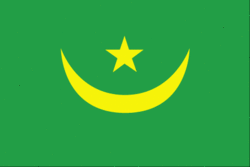 Mauritanian national flag (Flag of Mauritania)
 Mauritania country profile
 Travel advice for Mauritania
As for the Mauritanian climate; desert; constantly hot, dry, dusty.
Mauritanian(s) speak Arabic (official), Pulaar, Soninke, French, Hassaniya, Wolof.
Places of note in Mauritania
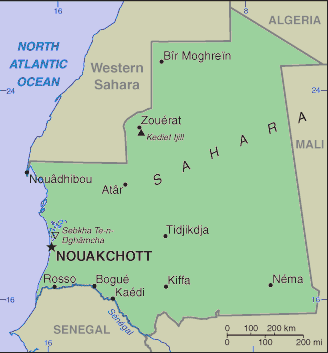 Mauritanian map
Regions of Mauritania
Independent from France in 1960, Mauritania annexed the southern third of the former Spanish Sahara (now Western Sahara) in 1976, but relinquished it after three years of raids by the Polisario guerrilla front seeking independence for the territory. Maaouya Ould Sid Ahmed TAYA seized power in a coup in 1984. Opposition parties were legalized and a new constitution approved in 1991. Two multiparty presidential elections since then were widely seen as flawed, but October 2001 legislative and municipal elections were generally free and open. A bloodless coup in August 2005 deposed President TAYA and ushered in a military council headed by Col. Ely Ould Mohamed VALL, which declared it would remain in power for up to two years while it created conditions for genuine democratic institutions and organized elections. For now, however, Mauritania remains an autocratic state, and the country continues to experience ethnic tensions among its black population and different Moor (Arab-Berber) communities.
Half the population still depends on agriculture and livestock for a livelihood, even though many of the nomads and subsistence farmers were forced into the cities by recurrent droughts in the 1970s and 1980s. Mauritania has extensive deposits of iron ore, which account for nearly 40% of total exports. The decline in world demand for this ore, however, has led to cutbacks in production. The nation's coastal waters are among the richest fishing areas in the world, but overexploitation by foreigners threatens this key source of revenue. The country's first deepwater port opened near Nouakchott in 1986. In the past, drought and economic mismanagement resulted in a buildup of foreign debt which now stands at more than three times the level of annual exports. In February 2000, Mauritania qualified for debt relief under the Heavily Indebted Poor Countries (HIPC) initiative and in December 2001 received strong support from donor and lending countries at a triennial Consultative Group review. A new investment code approved in December 2001 improved the opportunities for direct foreign investment. Ongoing negotiations with the IMF involve problems of economic reforms and fiscal discipline. In 2001, exploratory oil wells in tracts 80 km offshore indicated potential extraction at current world oil prices. Mauritania has an estimated 1 billion barrels of proved reserves. Substantial oil production and exports are scheduled to begin in early 2006 and may average 75,000 barrels per day for that year. Meantime the government emphasizes reduction of poverty, improvement of health and education, and promoting privatization of the economy.
Mauritanian natural resources include iron ore, gypsum, copper, phosphate, diamonds, gold, oil, fish
most of the population concentrated in the cities of Nouakchott and Nouadhibou and along the Senegal River in the southern part of the country
Mauritanian religion is Muslim 100%.
Natural hazards in Mauritania include hot, dry, dust/sand-laden sirocco wind blows primarily in March and April; periodic droughts.
Travel Advice for Mauritania
MauritaniaSUMMARY
- We advise against all but essential travel to the area near Mauritania’s border with Algeria, and the area near Mauritania’s northern border with Mali east of Nema, because of the risk of banditry, and the activities of armed smugglers and extremist groups.
- There is no British diplomatic presence in Mauritania and you should register your presence with the British Honorary Consul in Nouakchott. You should inform the Honorary Consul if you intend to travel to areas outside the main cities of Nouakchott and Nouadhibou.
- Developments in the region may trigger public unrest, especially after Friday prayers. You should avoid large gatherings of people and demonstrations, which can turn hostile. Be particularly alert in public places.
- Mauritania shares with the rest of the region a threat from international terrorism to visibly western and British interests. We believe that terrorist groups may be planning attacks against civilian targets, particularly those frequented by foreigners.
- Travel in Mauritania can be difficult and conditions are poor for overland travel. Domestic flights operate between the main towns.
- The main types of incident for which British nationals require consular assistance in Mauritania are for replacing lost and stolen passports. Only 5 British nationals have sought consular assistance from the Honorary Consul over the last 12 months.
- You should carry a copy of your passport with you at all times for identification purposes.
- We strongly recommend that you obtain comprehensive travel and medical insurance before travelling. You should check any exclusions, and that your policy covers you for the activities you want to undertake. Please see: Travel Insurance
SAFETY AND SECURITY
We advise against all but essential travel to the area near Mauritania’s border with Algeria, and the area near Mauritania’s northern border with Mali east of Nema, because of the risk of banditry, and the activities of armed smugglers and extremist groups. A terrorist group, which attached a Mauritanian army unit in June 2005, and was accused of kidnapping tourists in Algeria in 2003, remains active in the region and continues to pose a security threat.
Unexploded landmines remain a danger along Mauritania’s border with Western Sahara. Travellers should exercise caution, particularly if travelling off road.
Crime
The level of crime in Mauritania is very low, though petty theft is on the increase. You should avoid the unlit and isolated beach at Nouakchott and ‘Le Cinquième’ district after dark.
Political Situation
Mauritania Country Profile.
A coup took place in Mauritania in August 2005. The Military Council for Justice and Democracy has appointed a government to oversee the transition to democracy. Legislative elections in November and December 2006 passed off peacefully. Presidential elections are scheduled for March 2007.
Mauritania is calm but further instability cannot be ruled out. You should remain vigilant and exercise particular caution. You should be prepared to adjust travel plans at short notice in light of developments.
You should take sensible precautions for your personal safety and avoid political gatherings and demonstrations.
Local Travel
You should inform the Honorary Consul in Nouakchott if you intend to travel to areas outside the main cities of Nouakchott and Nouadhibou.
Should you experience any difficulties, you should seek advice from the British Honorary Consul. Contact details are:
Mr Sid’ Ahmed Ould Abeidna
Tel: +222 525 8331
Road Safety
There is a reasonably good tarmac/asphalt single carriageway between Nouakchott and Nouadhibou. The drive takes 4-5 hours and is about 470km with no petrol stations or services, so take water, food and petrol. There are basic huts/shacks with water and dried snacks. Do not drive at night as many cars have one or no lights. Also beware at all times of small dunes of sand in the road, resulting from sand storms.
Of the other paved roads, conditions are generally poor, and overland travel is difficult. You are advised to use four wheel drive vehicles, check the tide times, travel in convoy and ensure you bring adequate supplies of water and fuel. Nouakchott and Nouadhibou have several tour companies, which are well equipped and will organise desert trips.
Rail Safety
The national mining company, SNIM, runs a train service for both people and vehicles between Nouadhibou and Atar (80km from Choum). It is essential to book in advance.
Air Safety
Air Mauritanie runs flights linking Nouakchott to Nouadhibou (daily), Zouerate, Atar, Kaedi, Kiffa, Tidjikja, Aioun and Nema.
Significant deficiencies have been identified in the level of safety oversight that Mauritania gives to aircraft on its register and to the airlines that it certifies. Evidence also suggests that there may be safety deficiencies in Air Mauritanie’s operations. As a consequence, the Department for Transport is refusing to issue a permit for Air Mauritanie to operate commercial services to the UK.
Sea Safety
Sailing in the port at Nouadhibou can be dangerous because of the number of shallow shipwrecks.
LOCAL LAWS AND CUSTOMS
You should respect Mauritanian laws and regulations. It is considerate to dress modestly. Sale and consumption of alcohol is against the law, although some restaurants do serve it. Police sometimes object to photography without prior permission.
Homosexuality remains a punishable offence in Mauritania.
Drugs laws are severe. Those found in the possession of any illegal drug may receive a prison sentence.
ENTRY REQUIREMENTS
Single parents or other adults travelling alone with children should be aware that some countries require documentary evidence of parental responsibility before allowing lone parents to enter the country or, in some cases, before permitting the children to leave the country. For further information on exactly what will be required at immigration please contact the Mauritania Embassy.
HEALTH
Medical facilities are extremely limited, particularly outside Nouakchott and Nouadhibou, where lack of communications makes dealing with an emergency very difficult. Clinics in Nouakchott and Nouadhibou charge for medical care (sometimes in Euros or US dollars), and may not accept foreign insurance cards.
The weather can be very hot and dry. Fluid intake should be kept high, making sure enough salts are included.
You should seek medical advice before travelling and ensure that all appropriate vaccinations are up to date. For further information on health, check the Department of Health’s website at www.dh.gov.uk.
GENERAL
It is highly advisable to carry ID, especially when travelling outside Nouakchott (where you may encounter many police road checks). You are also advised to comply promptly with directions from the police and other Mauritanian security forces, and to carry copies of your personal identity papers (passport) with you at all times.
There is no British Embassy in Mauritania. The British Ambassador in Rabat, Morocco is accredited to Mauritania. There is a British Honorary Consul in Nouakchott, Mr Sid'Ahmed Ould Abeidna. If you decide to travel to Mauritania, you should endeavour to register with the Honorary Consul.
Contact details of the British Honorary Consulate are as follows:
Since the start of 2006, the Honorary Consul has been authorised to issue emergency passports in Mauritania.
Local currency (Ouguiya) is not convertible and may not be exported. US Dollars or (preferably) Euros can be changed for Ouguiyas at banks, some hotels and official Bureaux de Change. The rate for pounds Sterling is very poor. Credit cards can be used at a few hotels in Nouakchott and Nouadhibou. There are no ATMs.