World index ... Africa ... Senegal
Travelers word index

Senegal

Continents
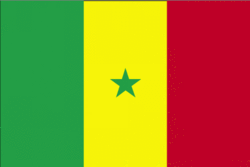
Senegalese flag

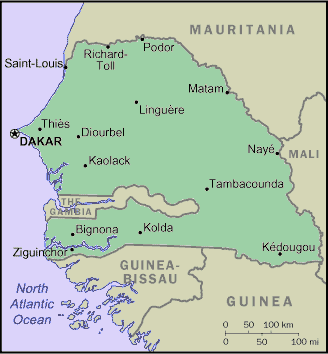
Senegal is located in Western Africa, bordering the North Atlantic Ocean, between Guinea-Bissau and Mauritania.

Senegal has borders with Gambia for 740km, Guinea for 330km, Guinea-Bissau for 338km, Mali for 419km and Mauritania for 813km.
Land in Senegal is generally low, rolling, plains rising to foothills in southeast.

Senegalese land covers an area of 196190 square kilometers which is slightly smaller than South Dakota

As for the Senegalese climate; tropical; hot, humid; rainy season (May to November) has strong southeast winds; dry season (December to April) dominated by hot, dry, harmattan wind.

Senegalese (singular and plural) speak French (official), Wolof, Pulaar, Jola, Mandinka.

Senegal country profile, Travel advice for Senegal

Senegalese Map
Places of note in Senegal
Dakar
Grand Dakar
Thiès Nones
Ziguinchor
Tiébo
Kolda
Richard Toll
Joal-Fadiout
Ndibène Dahra
Bignona
Pourham
Vélingara
Nioro du Rip
Sédhiou
Mékhé
Kédougou
Nguékokh
Pout
Kayar
Guinguinéo
Ouro Sogui
Koungheul
Ndioum
Khombole
Sokone
Tiadiaye
Kanel
Ndofane
Rosso
Gandiaye
Ouaoundé
Diofior
Tionk Essil
Diawara
Marsassoum
Regions of Senegal
Dakar
Diourbel
Fatick
Kaolack
Kolda
Louga
Matam
Saint-Louis
Senegal (general)
(SG04)
(SG08)
Tambacounda
Thiès
Ziguinchor

Independent from France in 1960, Senegal was ruled by the Socialist Party for forty years until current President Abdoulaye WADE was elected in 2000. Senegal joined with The Gambia to form the nominal confederation of Senegambia in 1982, but the envisaged integration of the two countries was never carried out, and the union was dissolved in 1989. A southern separatist group sporadically has clashed with government forces since 1982, but Senegal remains one of the most stable democracies in Africa. Senegal has a long history of participating in international peacekeeping.

Country profile: Senegal

Map of SenegalSenegal has been held up as one of Africa's model democracies. It has an established multi-party system and a tradition of civilian rule.

Although poverty is widespread and unemployment is high, the country has one of the region's more stable economies.

For the Senegalese, political participation and peaceful leadership changes are not new. Even as a colony Senegal had representatives in the French parliament. And the promoter of African culture, Leopold Senghor, who became president at independence in 1960, voluntarily handed over power to Abdou Diouf in 1980.

AT-A-GLANCE


The 40-year rule of Senegal's Socialist Party came to a peaceful end in elections in 2000, which were hailed as a rare democratic power transfer on a continent plagued by coups, conflict and election fraud.

Senegal is on the western-most part of the bulge of Africa and includes desert in the north and a moist, tropical south. Slaves, ivory and gold were exported from the coast during the 17th and 18th centuries and now the economy is based mainly on agriculture. The money sent home by Senegalese living abroad is a key source of revenue.

A long-running, low-level separatist war in the southern Casamance region has claimed hundreds of lives. The conflict broke out over claims by the region's people that they were being marginalised by the Wolof, Senegal's main ethnic group.

The government and rebels signed a peace pact at the end of 2004, raising hopes for reconciliation.

On the world stage, Senegal has sent peacekeeping troops to DR Congo, Liberia and Kosovo.

President: Abdoulaye Wade

Abdoulaye Wade, the founder of the Senegalese Democratic Party, won presidential elections at the fifth attempt, defeating Abdou Diouf's Socialist Party in March 2000. He was 73 at the time.

President Wade He found himself in a political impasse: The presidential poll did not coincide with parliamentary elections and he was left heading a minority coalition.

But elections in April 2001 consolidated his power base. His supporters gained control of the national assembly, with his party winning 89 of the 120 seats.

An advocate of democratisation, Mr Wade helped to launch the New Partnership for Africa's Development, or Nepad. The plan aims to foster economic recovery through African-led reforms and good governance. He has sought to strengthen ties with the US.

Abdoulaye Wade was born in northern Senegal in 1927. He studied in France and has a French wife.

The country has a lively political scene, with parties competing across ethnic, religious and ideological lines. General elections are expected in February 2007.

  • Prime minister: Cherif Macky Sall
  • Foreign minister: Cheikh Tidiane Gadio
  • Finance minister: Abdoulaye Diop

    Senegal has traditionally enjoyed one of the most unrestricted media climates in the region. However the Paris-based media rights body Reporters Without Borders noted in 2004 that developments in Senegal had taken a "disturbing turn".

    It cited the expulsion from the country of a Radio France Internationale correspondent over her coverage of the Casamance issue. Several other journalists had been physically attacked or threatened, it added. In 2005 a leading private radio station, Sud FM, was taken off the air temporarily after it aired an interview with a Casamance separatist leader.

    The constitution guarantees media freedom. The government does not practise censorship, but self-censorship arises from laws which prohibit reports that discredit the state, incite disorder or disseminate "false news". Nevertheless, the private media frequently criticise the government.

    Radio is an influential medium. Commercial and community stations have mushroomed since the 1990s.

    There are nearly 20 daily newspapers. Foreign publications circulate freely and multichannel pay-TV is readily available. BBC World Service and Radio France Internationale are available on FM in Dakar.

    The press

  • Le Soleil - state-owned daily
  • Sud Quotidien - private daily
  • Le Quotidien - private daily
  • L'Observateur - private daily
  • Wal Fadjri L'Aurore - private daily

    Television

  • Radiodiffusion Television Senegalaise (RTS) - state-run national broadcaster, operates RTS1 and RTS2 channels

    Radio

  • Radiodiffusion Television Senegalaise (RTS) - state-run national broadcaster, operates Chaine Nationale and Chaine Internationale networks, the capital's Dakar FM, and several regional services
  • Sud FM - private, available in Dakar and other cities
  • Radio Nostalgie - Dakar-based private station
  • Sept FM - private, Dakar station operated by Groupe Com 7
  • Walf FM - private, operated by Groupe Wal Fadjri
  • Radio Dunyaa - private
  • Radio Future Medias (RFM) - private

    News agency

  • Agence de Presse Senegalaise - state-run

    In January 1994, Senegal undertook a bold and ambitious economic reform program with the support of the international donor community. This reform began with a 50% devaluation of Senegal's currency, the CFA franc, which was linked at a fixed rate to the French franc. Government price controls and subsidies have been steadily dismantled. After seeing its economy contract by 2.1% in 1993, Senegal made an important turnaround, thanks to the reform program, with real growth in GDP averaging over 5% annually during 1995-2004. Annual inflation had been pushed down to the low single digits. As a member of the West African Economic and Monetary Union (WAEMU), Senegal is working toward greater regional integration with a unified external tariff and a more stable monetary policy. However, Senegal still relies heavily upon outside donor assistance. Under the IMF's Highly Indebted Poor Countries (HIPC) debt relief program, Senegal will benefit from eradication of two-thirds of its bilateral, multilateral, and private-sector debt.

    Senegalese natural resources include fish, phosphates, iron ore

    westernmost country on the African continent; The Gambia is almost an enclave within Senegal

    Senegalese religion is Muslim 94%, Christian 5% (mostly Roman Catholic), indigenous beliefs 1%.

    Natural hazards in Senegal include lowlands seasonally flooded; periodic droughts.

    Travel Advice on Senegal

    Senegal

    This advice has been reviewed and reissued with an amendment to the Political Situation section.  The overall level of the advice has not changed.

    SUMMARY

    • Most visits to Senegal are trouble-free.  The main type of incident for which British nationals require consular assistance in Senegal are varied, but have included illness and problems with passports.

    • Pick pocketing and street crime is common in parts of Dakar.  You should take sensible precautions and avoid carrying valuables in public.

    • The Casamance region in south-western Senegal remains affected by  incidents involving separatist rebel groups.  You should avoid travel by road in the western Casamance because of the recent increase in conflict and isolated incidents of banditry.

    • You should be aware of the global risk of indiscriminate terrorist attacks, which could be against civilian targets, including places frequented by foreigners.

    • We strongly advise that you obtain comprehensive travel and medical insurance before travelling.  You should check any exclusions, and that your policy covers you for the activities you want to undertake.  Please see:  Travel Insurance.


    SAFETY AND SECURITY

    Political Situation
    Presidential elections will take place on 25 February 2007.  Legislative elections will be held on 3 June 2007.  The campaign period for the presidential election formally started on 4 February 2007.
    There is no reason to doubt that these elections will be conducted peacefully.  However, there can be no guarantee that they will go off without incident.  The use of tear gas to disperse an unauthorised march on 27 January 2007 and some stone throwing on 4 February 2007 illustrate risks that could lead to personal injury to personal bystanders.
    For the moment, we advise British citizens living in or visiting Senegal to steer clear of any political demonstration or marches during the election period.
    The Embassy will keep the situation under regular review, and will qualify this advice as appropriate.
    Senegal Country Profile.
    Local Travel
    The Casamance region of south-western Senegal remains affected by insecurity involving separatist rebel groups.  There were clashes in May 2006 involving separatist groups and the armed forces of Guinea-Bissau.  In August 2006 the Senegalese government sent in troops in a military action.  Clashes between the Army and presumed separatist rebels took place in December 2006 to the north of Bignona.  On 30 December 2006 presumed separatist rebels murdered the President of the Zinguinchor Conseil Régional at his home in Sindian.  Due to these events and their possible consequences, and to other isolated incidents of banditry we advise against road travel in the Casamance region wet of Kolda.
    Road Safety
    While some main roads are of good quality, other roads can be poor especially during the rainy season (July-October).  Driving standards are unpredictable.  Traffic in the Dakar area is heavy and you need to take particular care and attention to avoid accidents.  Driving after dark carries added hazards because of poor lighting both of streets and other vehicles.  If you do have an accident you must wait for the police to arrive at the scene.
    Air Safety

    The EU has published a list of air carriers that are subject to an operating ban or restrictions within the community.  You should check the following link to see whether this will affect your travel:  http://europa.eu.int/comm/transport/air/safety/flywell_en.htm


    LOCAL LAWS AND CUSTOMS

    Most Senegalese are Muslims, although they are tolerant of other customs and religions.  However, it is a generally conservative society.  You are advised to dress and behave modestly in public outside the main tourist areas.  Bars and restaurants usually serve alcoholic drinks but drunkenness is considered offensive.  Some Muslims do not shake hands with members of the opposite sex but no rebuff is intended by this.  Kissing as a greeting is acceptable but kissing romantically is not.  Homosexual acts are illegal in Senegal and there is no gay scene.


    ENTRY REQUIREMENTS

    UK passport holders do not need a visa to enter Senegal but passports with less than six months’ validity should ideally be renewed before travel, see also “General” below.

    Single parents or other adults travelling alone with children should be aware that some countries require documentary evidence of parental responsibility before allowing lone parents to enter the country or, in some cases, before permitting the children to leave the country.  For further information on exactly what will be required at immigration please contact:  http://www.senegalembassy.co.uk.


    HEALTH

    We strongly recommend that you obtain comprehensive medical and travel insurance before travelling.  This should include cover for medical treatment and evacuation, accidents, cancelled flights and stolen cash, credit cards, passport and luggage.  You should check any exclusions, and that your policy covers you for the activities you want to undertake.  Please see:  Travel Insurance.

    Health facilities in Dakar are reasonable but are limited in the rest of Senegal.
    Malaria and other tropical diseases are prevalent, especially during the rainy season (July-October).  More than three-quarters of British travellers who contracted malaria in 2005 did not take preventive measures, such as malaria prevention tablets.  However, malaria can occur despite appropriate prevention, and therefore you should promptly seek medical care in the event of a fever or flu-like illness in the first year following your return from travelling to a malaria risk country.  Before travelling you should seek medical advice about the malaria risk in Senegal.
    Water is sometimes unsafe.  You are advised to drink bottled water and avoid ice cubes.  There are occasional outbreaks of cholera but if you take sensible hygiene precautions you are unlikely to be affected.  If you do suffer diarrhoea during a visit to Dakar you should consult a doctor immediately.
    You should seek medical advice before travelling and ensure that all appropriate vaccinations are up-to-date.  For further information on health, check the Department of Health’s website at:  DoH: Health Advice To Travellers.


    GENERAL

    If things go wrong when overseas, please see:  What We Can Do To Help
    The British Embassy in Dakar does not issue passports and before setting off, you should ensure that your passport has sufficient validity and a plentiful supply of unused pages.  Applications for new passports are accepted in Dakar for forwarding to the British High Commission in Banjul for processing, but this may take up to five weeks.  If a courier is used, the cost will have to be borne by the applicant.
    Senegal has imposed a temporary ban on the import of poultry and poultry products.   This is a precautionary measure against Avian Flu.  No cases of Avian Flu have been reported.  
    Money
    Credit cards are accepted in larger establishments that cater for tourists.  You should be aware that a commission is added for their use.  There are ATM facilities in Dakar, but banking facilities are sporadic in the rest of the country.


  • What is this world index all about?