World index ... Africa ... Gambia
Travelers word index

Gambia

Continents
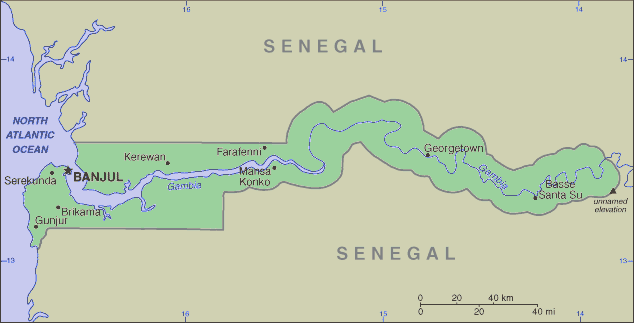
Gambian flag

The Gambia is located in Western Africa, bordering the North Atlantic Ocean and Senegal.

Gambia has borders with Senegal for 740km.
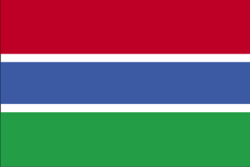
Land in The Gambia is flood plain of the Gambia River flanked by some low hills.

Gambian land covers an area of 11300 square kilometers which is slightly less than twice the size of Delaware

As for the Gambian climate; tropical; hot, rainy season (June to November); cooler, dry season (November to May).

Gambian(s) speak English (official), Mandinka, Wolof, Fula, other indigenous vernaculars.

Gambia country profile, Travel advice for Gambia

Gambian Map
Places of note in Gambia
Brikama
Bakau
Banjul
Farafenni
Lamin
Sukuta
Basse Santa Su
Gunjur
Soma
Sabi
Bansang
Gambissara
Abuko
Essau
Barra
Demba Kunda
Koina
Diabugu
Georgetown
Sami
Kerewan
Jarreng
Sutukoba
Somita
Kuntaur
Nyamanari
Baro Kunda
Bakadagy
Saba
Saruja
No Kunda
Galleh Manda
Sankwia
Kaiaf
Jakhaly
Regions of Gambia
Banjul
Central River
Gambia, The (general)
Lower River
North Bank
Upper River
Western

The Gambia gained its independence from the UK in 1965; it formed a short-lived federation of Senegambia with Senegal between 1982 and 1989. In 1991 the two nations signed a friendship and cooperation treaty. A military coup in 1994 overthrew the president and banned political activity, but a 1996 constitution and presidential elections, followed by parliamentary balloting in 1997, completed a nominal return to civilian rule. The country undertook another round of presidential and legislative elections in late 2001 and early 2002. Yahya A. J. J. JAMMEH, the leader of the coup, has been elected president in all subsequent elections.

Country profile: The Gambia

Map of The GambiaThe Gambia is one of Africa's smallest countries and unlike many of its West African neighbours it has enjoyed long spells of stability since independence.

This stability has not translated into prosperity. Despite the presence of the Gambia river, which runs through the middle of the country, only one-sixth of the land is arable and poor soil quality has led to the predominance of one crop - peanuts.

This has made The Gambia heavily dependent on peanut exports - and a hostage to fluctuations in the production and world prices of the crop.

AT-A-GLANCE


Voters in Gambia's 2006 polls Consequently, the country relies on foreign aid to fill gaps in its balance of payments.

President Jammeh wants to turn The Gambia into an oil-producing state. He says this could usher in a "new future". However, the country has yet to strike crude oil.

Tourism is an important source of foreign exchange, as is the money sent home by Gambians living abroad. Most visitors are drawn to the resorts that occupy a stretch of the Atlantic coast.

In 1994 The Gambia's elected government was toppled in a military coup. The country returned to constitutional rule two years later when its military leader ran as a civilian and won a presidential election. But the credibility of the poll was questioned by a group of Commonwealth ministers.

President: Yahya Jammeh

Yahya Jammeh seized power in 1994 as a young army lieutenant and has won three widely criticised multi-party elections since then.

Gambian president He won his third five-year term in September 2006 with more than two-thirds of the votes cast. His main rival, Oussainou Darboe, rejected the result, saying there had been widespread intimidation by local chiefs, governors and members of the security forces.

Commonwealth observers said overt support for Jammeh from public officials during the run-up to the vote may have given him an unfair advantage.

Jammeh's government has been criticised by international rights groups for its attitude to civil liberties, especially freedom of the press.

Reporters Without Borders (RSF) has described press freedom in Gambia as "catastrophic", with death threats, surveillance and arbitrary night-time arrests the daily lot of journalists "who do not sing the government's praises".

Many Gambians privately disapprove of the iron-fisted nature of his rule, which has seen political opponents and journalists imprisoned without charge, but say he has done much to improve schools, hospitals and roads.

Born in 1965, Yahya Jammeh joined the army in 1984 upon leaving school. He came to power in 1994 when a bloodless military coup ousted the elected president, Dawda Jawara, who had led the country since independence.

Upon taking power he set up bodies to investigate corruption and recover pilfered public funds.

  • Foreign minister: Maba Jobe
  • Finance minister: Musa Gibril Bala Gaye

    Gambia's private media face severe restrictions, with radio stations and newspapers having to pay large licence fees.

    A commission with wide-ranging powers, from issuing licences to jailing journalists, was set up under a 2002 media law. It was seen by critics as a threat to press freedom.

    Further legislation introduced in late 2004 provided jail terms for journalists found guilty of libel or sedition. Deyda Hydara, one of the press law's leading critics and the editor of private newspaper The Point, was shot dead days after the law was passed.

    In 2006 media rights organisation Reporters Without Borders described the press freedom situation as "catastrophic".

    State-run Radio Gambia broadcasts tightly-controlled news, which is also relayed by private radio stations. Radio France Internationale is available via an FM relay.

    The government operates the only national television station.

    The press

  • Observer - private daily
  • The Independent - private, bi-weekly
  • Foroyaa - private, bi-weekly
  • The Point - private, thrice-weekly

    Television

  • Gambia Television - state-run, single-channel national service
  • Premium TV Network - private satellite channel

    Radio

  • Radio Gambia - national broadcaster, programmes in English and vernacular languages
  • Radio 1 FM - private, music-based
  • West Coast Radio - private
  • Sud FM - private
  • City Limits Radio - private

    The Gambia has no significant mineral or natural resource deposits and has a limited agricultural base. About 75% of the population depends on crops and livestock for its livelihood. Small-scale manufacturing activity features the processing of peanuts, fish, and hides. Reexport trade normally constitutes a major segment of economic activity, but a 1999 government-imposed preshipment inspection plan, and instability of the Gambian dalasi (currency) have drawn some of the reexport trade away from The Gambia. The government's 1998 seizure of the private peanut firm Alimenta eliminated the largest purchaser of Gambian groundnuts. Despite an announced program to begin privatizing key parastatals, no plans have been made public that would indicate that the government intends to follow through on its promises. Unemployment and underemployment rates remain extremely high; short-run economic progress depends on sustained bilateral and multilateral aid, on responsible government economic management, on continued technical assistance from the IMF and bilateral donors, and on expected growth in the construction sector.

    Gambian natural resources include fish, titanium (rutile and ilmenite), tin, zircon, silica sand, clay, petroleum

    almost an enclave of Senegal; smallest country on the continent of Africa

    Gambian religion is Muslim 90%, Christian 9%, indigenous beliefs 1%.

    Natural hazards in The Gambia include drought (rainfall has dropped by 30% in the last 30 years).

    Travel Advice on Gambia

    Gambia, The

    This advice has been reviewed and reissued with an amendment to the Political Situation section.  The overall level of the advice has not changed.

    SUMMARY

    • You should not travel by road from The Gambia to Casamance in southern Senegal because of an increase in fighting between rebel factions involving the Senegalese armed forces.

    • Care should be taken when driving or walking on roads, particularly at night, due to unpredictable driving standards and lack of street lighting.

    • Malaria is prevalent in The Gambia.  You should seek medical advice about taking anti-malarial medication before, during and after your visit.  In addition, you should take precautions to avoid being bitten by mosquitoes.  Please see the Health Section of this travel advice for more details.

    • The threat from terrorism is low, but you should be aware of the global risk of indiscriminate terrorist attacks, which could be against civilian targets, including places frequented by foreigners.

    • Around 50,000 British nationals visit The Gambia each year.  Most visits are trouble-free.  The main types of incident for which British nationals require consular assistance in The Gambia are for replacing lost and stolen passports and financial assistance.  Crime against tourists is increasing and you should take sensible precautions and remain vigilant in public places.

    • We strongly recommend that you obtain comprehensive medical and travel insurance before travelling.  You should check any exclusions, and that your policy covers you for the activities you want to undertake.  Please see:  Travel Insurance.


    SAFETY AND SECURITY

    Political Situation

    The Gambia Country Profile.
    The Gambia is a multi-party state and elections are held every five years.  The last elections took place in September 2006 and passed off peacefully so.

    National Assembly elections took place on 25 January 2007 and passed off peacefully.

    You are advised to avoid political gatherings and demonstrations.
    Local Travel
    The Casamance region of south western Senegal (the area of Senegal due south of The Gambia) remains affected by insecurity involving separatist rebel groups. Since August 2006, there has been an upsurge in fighting on the Senegalese side of the border.

    You should not stay or travel in the Casamance region west of Kolda.  This includes travel by road into the region from The Gambia.  For further details please see the travel advice for Senegal.
    Travel to other areas in The Gambia is reasonably safe as long as sensible precautions are taken to safeguard your baggage and personal possessions.
    Road Safety

    You can drive on a UK driving licence for up to three months.
    Driving standards are unpredictable and some local taxis are not roadworthy.  Driving after dark carries added hazards because of poor road and vehicle lighting.  For this reason, you should exercise particular caution when walking along roads at night.  In the event of an accident, emergency medical facilities are very limited.
    During the rainy season (June to October) potholes on roads are common and you should take care when driving.  Poor roads up-country make travel outside of the Greater Banjul area difficult year round.
    Security checkpoints are common on all major routes in The Gambia.  They are not always well sign-posted and care should be taken when approaching them, especially at night.
    Air Safety

    The EU has published a list of air carriers that are subject to an operating ban or restrictions within the community.  You should check the following link to see whether this will affect your travel:  http://europa.eu.int/comm/transport/air/safety/flywell_en.htm


    LOCAL LAWS AND CUSTOMS

    Local laws reflect the fact that The Gambia is a Muslim country.  You should respect local customs and sensitivities at all times, especially away from the tourist areas and during the Holy month of Ramadan.  During Ramadan, eating, drinking and smoking between sunrise and sunset is forbidden for Muslims (though children under the age of puberty are not required to fast).

    The Gambian authorities will take strong action against anyone importing, exporting or found in possession of drugs or contraband.  You should not accept packages on behalf of anyone without knowing the contents.
    New laws were introduced in 2003 to tackle the problems associated with travelling child sex offenders.  In particular, there are heavy penalties for any form of sexual offence against a child.
    Homosexuality is illegal in The Gambia although generally tolerated if couples are discreet.
    Photography of military and official installations is prohibited.


    ENTRY REQUIREMENTS

    There are no entry requirements for British citizens visiting for up to 28 days, but the Gambian authorities require that passports have a minimum of three months validity.  For visits in excess of 28 days, permission has to be obtained from the Gambian Immigration Department at their offices in Banjul.  Extensions cost D250 for each additional month.
    You should check with Gambian High Commission in London for further details.
    Single parents or other adults travelling alone with children should be aware that some countries require documentary evidence of parental responsibility before allowing lone parents to enter the country.  For further information on exactly what will be required at immigration, please contact the Gambian High Commission (address above).


    HEALTH

    We strongly recommend that you take out comprehensive medical and travel insurance before travelling.  This should include cover for medical treatment and evacuation, accidents, cancelled flights and stolen cash, credit cards, passport and luggage.  You should check any exclusions, and that your policy covers you for the activities you want to undertake.  Please see:  Travel Insurance.
    Medical facilities in The Gambia are very limited and the cost of medical evacuation can be very high.  Private clinics will only treat fee-paying patients.
    Water borne diseases and malaria are prevalent throughout the year.  You should carry any vaccination certificates with you.  The risk of malaria is greater during the months of June to November.  Two British nationals died from malaria in November 2005, after travelling to The Gambia.  More than three-quarters of British travellers who contracted malaria in 2005 did not take preventive measures, such as malaria prevention tablets.  However, malaria can occur despite appropriate prevention, and therefore you should promptly seek medical care in the event of a fever or flu-like illness in the first year following your return from travelling to a malaria risk country.  Before travelling you should seek medical advice about the malaria risk The Gambia.
    You should seek medical advice before travelling and ensure that all appropriate vaccinations are up-to-date.  For further information on health, check the Department of Health’s website at www.dh.gov.uk.
    NATURAL DISASTERS
    Floods are common during the rainy season (June‑October), but do not normally impact on tourists.


    GENERAL

    If things go wrong when overseas, please see:  What We Can Do To Help
    ID is only needed when driving a car (passport and driving licence).
    If you are a long-stay visitor you should register at the British High Commission in Banjul.

    Money

    You are advised to bring traveller’s cheques or cash to The Gambia because only a few places accept credit cards.  Bureaux de Change and local banks do not.


  • What is this world index all about?