World index ... Africa ... Morocco
Travelers word index

Morocco

Continents
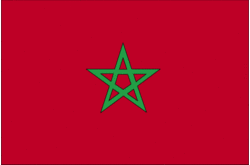
Moroccan flag

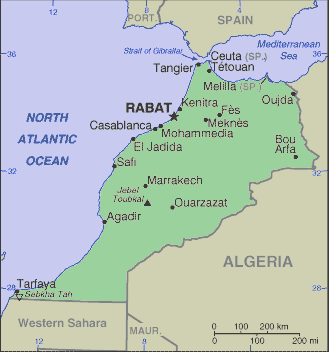
Morocco is located in Northern Africa, bordering the North Atlantic Ocean and the Mediterranean Sea, between Algeria and Western Sahara.

Morocco has borders with Algeria for 1559km, Western Sahara for 443km and Spain for 15.9km.
Land in Morocco is northern coast and interior are mountainous with large areas of bordering plateaus, intermontane valleys, and rich coastal plains.

Moroccan land covers an area of 446550 square kilometers which is slightly larger than California

As for the Moroccan climate; Mediterranean, becoming more extreme in the interior.

Moroccan(s) speak Arabic (official), Berber dialects, French often the language of business, government, and diplomacy.

Morocco country profile, Travel advice for Morocco

Moroccan Map
Places of note in Morocco
Casablanca
Rabat
Fès
Marrakech
Agadir
Tangier
Meknès
Oujda
Kenitra
Tétouan
Safi
Khouribga
Beni Mellal
El Jadida
Taza
Nador
Settat
Larache
Ksar el Kebir
Khemisset
Guelmim
Berrechid
Oued Zem
Fkih Ben Salah
Taourirt
Berkane
Sidi Slimane
Sidi Qacem
Khenifra
Taroudannt
Tiflet
Oulad Teïma
Sefrou
Youssoufia
Tan-Tan
Regions of Morocco
Chaouia-Ouardigha
Doukkala-Abda
Fès-Boulemane
Gharb-Chrarda-Beni Hssen
Grand Casablanca
Guelmim-Es Smara
Marrakech-Tensift-Al Haouz
Meknès-Tafilalet
(MO01)
(MO02)
(MO03)
(MO04)
(MO05)
(MO06)
(MO07)
(MO08)
(MO09)
(MO10)
(MO11)
(MO12)
(MO13)
(MO14)
(MO15)
(MO16)
(MO17)
(MO18)
(MO19)
(MO20)
(MO21)
(MO22)
(MO23)
(MO24)
(MO25)
(MO26)
(MO27)
(MO29)
(MO30)
(MO32)
(MO33)
(MO34)
(MO35)
(MO36)
(MO37)
(MO38)
(MO39)
(MO40)
(MO41)
(MO42)
(MO43)
(MO44)
Morocco (general)
Oriental
Rabat-Salé-Zemmour-Zaër
Souss-Massa-Drâa
Tadla-Azilal
Tanger-Tétouan
Taza-Al Hoceima-Taounate

In 788, about a century after the Arab conquest of North Africa, successive Moorish dynasties began to rule in Morocco. In the 16th century, the Sa'adi monarchy, particularly under Ahmad AL-MANSUR (1578-1603), repelled foreign invaders and inaugurated a golden age. In 1860, Spain occupied northern Morocco and ushered in a half century of trade rivalry among European powers that saw Morocco's sovereignty steadily erode; in 1912, the French imposed a protectorate over the country. A protracted independence struggle with France ended successfully in 1956. The internationalized city of Tangier and most Spanish possessions were turned over to the new country that same year. Morocco virtually annexed Western Sahara during the late 1970s, but final resolution on the status of the territory remains unresolved. Gradual political reforms in the 1990s resulted in the establishment of a bicameral legislature, which first met in 1997. Parliamentary elections were held for the second time in September 2002 and municipal elections were held in September 2003.

Country profile: Morocco

Map of MoroccoThe Kingdom of Morocco is the most westerly of the North African countries known as the Maghreb.

Strategically situated with both Atlantic and Mediterranean coastlines, but with a rugged mountainous interior, it stayed independent for centuries while developing a rich culture blended from Arab, Berber, European and African influences.

Morocco was a French protectorate from 1912 to 1956, when Sultan Mohammed became king. He was succeeded in 1961 by his son, Hassan II, who ruled for 38 years. He played a prominent role in the search for peace in the Middle East, given the large number of Israelis of Moroccan origin, but was criticised for suppressing domestic opposition.

Old town, Marrakesh A truth commission set up to investigate human rights violations during Hassan's reign has confirmed nearly 10,000 cases, ranging from death in detention to forced exile.

After his death in 1999 Hassan was succeeded by his son, who became King Mohammed VI and was seen as a moderniser. There has been some economic and social liberalisation, but the monarch has retained sweeping powers.

Morocco is bidding for membership of the European Union, its main trade partner, but there appears to be little enthusiasm for this within the bloc.

To the south, the status of Western Sahara remains unresolved. Morocco annexed the territory in 1975 and a guerrilla war with Algerian-backed pro-independence forces ended in 1991. UN efforts have failed to break the political deadlock.

To the north, a dispute with Spain in 2002 over the tiny island of Perejil revived the issue of the sovereignty of Melilla and Ceuta. The small enclaves on the Mediterranean coast are surrounded by Morocco and have been administered by Madrid for centuries.

Morocco has been given the status of non-Nato ally by Washington, which has praised its support for the US-led war on terror. After deadly suicide bombings in Casablanca in 2003, Morocco launched a crackdown on suspected Islamic militants.

King: King Mohammed VI

Groomed for "kingship", as his late father King Hassan II referred to his upbringing, Mohammed VI became monarch in 1999.

Moroccan king

He initiated political and economic changes and an investigation into human rights abuses during his father's rule.

The king says the fight against poverty is a priority, earning him the name "guardian of the poor". Economic liberalisation has attracted foreign investment and officials point to better basic services in shanty towns and rural areas. But some non-government groups say little has changed, with poverty still widespread and unemployment remaining high.

A key reform has been the Mudawana, a law which grants more rights to women. The king has said it is in line with Koranic principles, but religious conservatives have opposed it.

Bomb attacks in Casablanca in 2003 prompted the enactment of new anti-terrorism laws and a reinvigorated campaign against extremists. But some rights groups say the measures have eroded human rights.

King Mohammed married computer engineer Salma Bennani in 2002. They have a son, Crown Prince Moulay Hassan, born in 2003.

Under the constitution, the king can dissolve parliament and dismiss or appoint the prime minister.

  • Prime minister: Driss Jetou
  • Foreign minister: Mohamed Benaissa
  • Finance minister: Fathallah Oulalou

    Morocco's private press is free to cover many previously-taboo issues, including social problems.

    Satellite dishes on Moroccan houses

    But this freedom is not unbounded. Paris-based Reporters Without Borders, while noting "positive changes", has called for an overhaul of press laws. US-based Human Rights Watch says the press code "provides an arsenal of repressive tools". Western Sahara, the monarchy and corruption are all sensitive topics and self-censorship is commonplace.

    Newspaper readership is limited by low literacy levels, and competition for advertising is intense.

    The government owns, or has a stake in, RTM and 2M, Morocco's main TV networks. An expansion of private TV and radio services is under way. Broadcasters are tamer in their coverage of sensitive topics than the print media.

    Satellite dishes are widely used, giving access to a range of foreign TV stations.

    The press

  • Al-Anbaa - government-owned daily
  • Le Matin - semi-official daily
  • Assabah - private, daily
  • Liberation - private, daily
  • L'Economiste - business daily
  • Le Journal - private, weekly
  • Morocco Times - English-language news site

    Television

  • Radio-Television Marocaine (RTM) - operates state-run Television Marocaine (TVM)
  • 2M - partly state-owned
  • Al Maghribiya - satellite channel operated by RTM and 2M, aimed at Moroccans living abroad
  • Medi 1 Sat - Tangier-based satellite channel, privately-owned by Moroccan and French concerns

    Radio

  • Radio-Television Marocaine (RTM) - state-run, regional and national services
  • Medi 1 - Tangier-based, privately-owned by Moroccan and French concerns, programmes in Arabic and French

    WESTERN SAHARA:

  • National Radio of the Saharan Arab Democratic Republic - broadcasts in Arabic and Spanish; launched in the 1970s, the station supports the Polisario Front

    News agency

  • Maghreb Arab Presse (MAP) - state-run

    Moroccan economic policies brought macroeconomic stability to the country in the early 1990s but have not spurred growth sufficient to reduce unemployment that nears 20% in urban areas. Poverty has actually increased due to the volatile nature of GDP, Morocco's continued dependence on foreign energy, and its inability to promote the growth of small and medium size enterprises. Despite structural adjustment programs supported by the IMF, the World Bank, and the Paris Club, the dirham is only fully convertible for current account transactions and Morocco's financial sector is rudimentary. Moroccan authorities understand that reducing poverty and providing jobs is key to domestic security and development. In 2004, Moroccan authorities instituted measures to boost foreign direct investment and trade by signing a free trade agreement with the US and selling government shares in the state telecommunications company and in the largest state-owned bank. The Free Trade agreement went into effect in January 2006. In 2005, GDP growth slipped to 1.2% and the budget deficit rose sharply - to 7.5% of GDP - because of substantial increases in wages and oil subsidies. Long-term challenges include preparing the economy for freer trade with the US and European Union, improving education and job prospects for Morocco's youth, and raising living standards, which the government hopes to achieve by increasing tourist arrivals and boosting competitiveness in textiles.

    Moroccan natural resources include phosphates, iron ore, manganese, lead, zinc, fish, salt

    strategic location along Strait of Gibraltar

    Moroccan religion is Muslim 98.7%, Christian 1.1%, Jewish 0.2%.

    Natural hazards in Morocco include northern mountains geologically unstable and subject to earthquakes; periodic droughts.

    Travel Advice on Morocco

    Morocco

    This advice has been reviewed and reissued with amendments to the Crime section (increase in crime & aggressive begging).  The overall level of the advice has not changed.

    SUMMARY

    • There is a high threat from terrorism in Morocco.  A series of terrorist attacks took place on 16 May 2003 in Casablanca.

    • Morocco has a poor road safety record.  Accidents are frequent, especially on busy major routes.  The main road from Agadir to Marrakesh via Imi’n Tanoute and Chichaoua has been reported as particularly hazardous.

    • If you are travelling to Western Sahara, please see our separate Travel Advice covering this disputed territory.

    • Around 200,000 British nationals visit Morocco each year.  Most visits are trouble-free.  The main types of incident for which British nationals require consular assistance in Morocco are for replacing lost and stolen passports.  There are occasional incidents involving theft at knifepoint in the major cities and along beaches, violent crime, though not a major problem in Morocco, is growing.

    • We strongly recommend that you obtain comprehensive travel and medical insurance before travelling.  You should check any exclusions, and that your policy covers you for the activities you want to undertake.  Please see: Travel Insurance.


    SAFETY AND SECURITY

    Crime
    Violent crime is not a major problem in Morocco, but it is growing.  There are occasional incidents involving theft at knifepoint in the major cities and along beaches.  There has also been an increase in reports of other violent attacks, including some shootings.  Two European residents were killed in their home in Rabat during the night of 17/18 September 2006, apparently during a break-in (though the background remains unclear). 
    Petty crime, such as pickpocketing and bag snatching, continues to increase.  Crime and aggressive begging near ATM machines are increasing.  Credit card fraud and scams such as substituting inferior goods for those that were actually purchased are common.  Intimidation is sometimes used to force customers to purchase goods.  You should remain vigilant and alert to potential confidence tricks.
    You should avoid run down areas and badly lit streets in areas such as the medina.  If offered the services of a guide, you should ensure that the guide is authorised by or operating with the agreement of the local tourist authorities, and displays an official badge. Harassment of tourists by men posing as official tourist guides is common.
    Political Situation
    Travellers to Morocco should be aware of the impact that the situation in Iraq, as well as the violence between Israelis and Palestinians, has had across the Arab world and the risk of public disturbance in response.  You should follow news reports and be alert to developments in the Middle East that might trigger public disturbances.  You should take sensible precautions for your personal safety and avoid public gatherings and demonstrations.  Any increase in regional tension might affect Travel Advice. 
    Road Safety
    Morocco has a poor road safety record.  Accidents are frequent, especially on busy major routes but also on narrower secondary roads.  All drivers should take extra care when overtaking, particularly where there are no hard shoulders.  You are advised to leave plenty of time to reach your destination and to stay well within speed limits.
    If you are involved in a road accident resulting a fatality and the Moroccan authorities consider you responsible, you may be detained pending a trial hearing.
    If your are involved in a minor accident, you should complete a 'Constat Amiable' form, to be signed by both parties.  The blank forms are available upon arrival at the Tangier port from the insurance company booths, or can be purchased from tobacconists in all cities.


    LOCAL LAWS AND CUSTOMS

    Local laws reflect the fact that Morocco is a Muslim country.  You should respect local customs and sensitivities at all times, especially during the holy month of Ramadan or if you intend to visit religious areas.
    Women, especially when travelling alone, will attract attention.  To minimise hassle, you should dress inconspicuously and avoid wearing clothes that could be regarded as provocative (eg short skirts and low-necked strappy tops), except on the beach.
    Homosexuality is considered a criminal offence in Morocco.  Sexual relations outside marriage are also punishable by law.
    British nationals travelling to Morocco with a view to marrying a Moroccan should, before they travel, contact either the British Consulate in Tangier or the Consular Section of the British Embassy in Rabat to enquire about the documentation they will need to provide.
    The penalties for possession of even small amounts of drugs are severe:  up to 10 years’ imprisonment, with no remission for good behaviour, heavy fines and confiscation of your vehicle/vessel.  If you travel through the Rif Mountains, a major cannabis growing area, you may be harassed by drug dealers.
    It is against the law to carry bibles in Arabic, to attempt to distribute any non-Muslim/evangelical literature or be involved in any such activity.


    ENTRY REQUIREMENTS

    British nationals do not require entry visas to Morocco for the purpose of tourism.  If intending to enter for any other purpose, you are advised to check with the Moroccan Representation in the UK.
    If you intend to travel to the disputed territories to the South of Morocco, you should consult our separate Travel Advice for Western Sahara.
    You should also be aware that the border between Algeria and Morocco is closed, and no attempt should be made to cross it at any point.
    Your passport will need to be valid for at least six months after your entry into Morocco.  When entering the country, particularly during the busy summer months, you should ensure that your passports are stamped.  You will then be able to stay in Morocco for up to three months.  Some tourists have experienced difficulties leaving the country because their passports bear no entry stamp.
    Single parents or other adults travelling alone with children should be aware that some countries require documentary evidence of parental responsibility before allowing lone parents to enter the country or, in some cases, before permitting the children to leave the country.  For further information on exactly what will be required at immigration please contact the Moroccan Embassy in London.
    When arriving by private boat, you must enter the country by a recognised port of entry.  Entry through other ports will be considered illegal.  For specific details, contact the Moroccan Representation in the UK before travel.


    HEALTH

    We strongly recommend that you obtain comprehensive travel and medical insurance before travelling.  You should check any exclusions, and that your policy covers you for the activities you want to undertake.  Please see:  Travel Insurance.
    You should seek medical advice before travelling and ensure that all appropriate vaccinations are up to date.  For further information on health, check the Department of Health’s website at:  DoH: Health Advice To Travellers.
    NATURAL DISASTERS
    Morocco is in an earthquake zone and earthquakes, usually minor ones, occur occasionally.  But a strong earthquake hit northern Morocco around the port town of Al Hoceima on 24 February 2004, killing more than 600 people.  You should familiarise yourself with general safety procedures in the event of an earthquake and take note of any earthquake-related instructions, eg in hotel rooms.


    GENERAL

    If things go wrong when overseas, please see:  What We Can Do To Help.

    When insuring your vehicle, it is advisable to choose a company with a local representative.
    Money
    You should bring sufficient funds for the visit in cash, travellers' cheques or credit cards.  There is no limit on the amount you can import.  Most major credit cards are accepted in the larger urban centres throughout Morocco.  However, it is not possible to change Scottish or Irish bank notes.  The Moroccan Dirham is non-convertible and its export is prohibited.  ATMs are widely available in cities and most main towns.  If you enter Morocco with a vehicle, the registration number will be entered in the immigration computer.  If you are not in possession of the same vehicle when leaving Morocco, you will be refused exit and detained.


    OTHER

    Morocco Country Profile


  • What is this world index all about?