
 Search
Traveling Luck for Spain. Spain, Europe
Spain is located in Southwestern Europe, bordering the Bay of Biscay, Mediterranean Sea, North Atlantic Ocean, and Pyrenees Mountains, southwest of France.
Land in Spain is large, flat to dissected plateau surrounded by rugged hills; Pyrenees in north.
Spanish land covers an area of 504782 square kilometers which is slightly more than twice the size of Oregon
Spain has borders with Andorra for 63.700000000000003km, France for 623km, Gibraltar for 1.2km, Morocco for 15.9km and Portugal for 1214km.
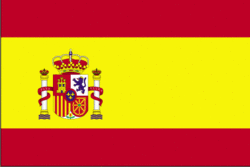 Spanish national flag (Flag of Spain)
 Spain country profile
 Travel advice for Spain
As for the Spanish climate; temperate; clear, hot summers in interior, more moderate and cloudy along coast; cloudy, cold winters in interior, partly cloudy and cool along coast.
Spaniard(s) speak Castilian Spanish 74%, Catalan 17%, Galician 7%, Basque 2%; note - Castilian is the official language nationwide; the other languages are official regionally.
Places of note in Spain
- Madrid
- Barcelona
- Valencia
- Sevilla
- Zaragoza
- Málaga
- Murcia
- Las Palmas de Gran Canaria
- Palma de Mallorca
- Bilbao
- Valladolid
- Córdoba
- Alacant
- Vigo
- Gijón
- l'Hospitalet de Llobregat
- A Coruña
- Granada
- Vitoria-Gasteiz
- Santa Cruz de Tenerife
- Badalona
- Elche
- Oviedo
- Móstoles
- Cartagena
- Fuenlabrada
- Sabadell
- Alcalá de Henares
- Jerez de la Frontera
- Pamplona
- Donostia-San Sebastián
- Santander
- Leganés
- Almería
- Burgos
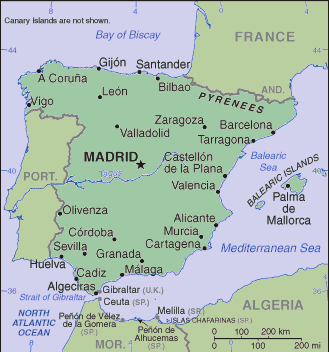 Spanish map
Regions of Spain
Spain's powerful world empire of the 16th and 17th centuries ultimately yielded command of the seas to England. Subsequent failure to embrace the mercantile and industrial revolutions caused the country to fall behind Britain, France, and Germany in economic and political power. Spain remained neutral in World Wars I and II, but suffered through a devastating civil war (1936-39). A peaceful transition to democracy following the death of dictator Francisco FRANCO in 1975, and rapid economic modernization (Spain joined the EU in 1986), have given Spain one of the most dynamic economies in Europe and made it a global champion of freedom. Continuing challenges include Basque Fatherland and Liberty (ETA) terrorism and relatively high unemployment.
The Spanish economy boomed from 1986 to 1990, averaging five percent annual growth. After a European-wide recession in the early 1990s, the Spanish economy resumed moderate growth starting in 1994. Spain's mixed capitalist economy supports a GDP that on a per capita basis is 80% that of the four leading West European economies. The center-right government of former President AZNAR successfully worked to gain admission to the first group of countries launching the European single currency (the euro) on 1 January 1999. The AZNAR administration continued to advocate liberalization, privatization, and deregulation of the economy and introduced some tax reforms to that end. Unemployment fell steadily under the AZNAR administration but remains high at 10.1%. Growth of 2.5% in 2003, 2.6% in 2004, and 3.4% in 2005 was satisfactory given the background of a faltering European economy. The socialist president, RODRIGUEZ ZAPATERO, has initiated economic and social reforms that are generally popular among the masses of people, but that are anathema to religious and other conservative elements. Adjusting to the monetary and other economic policies of an integrated Europe, reducing unemployment, and absorbing widespread social changes will pose challenges to Spain over the next few years.
Spanish natural resources include coal, lignite, iron ore, copper, lead, zinc, uranium, tungsten, mercury, pyrites, magnesite, fluorspar, gypsum, sepiolite, kaolin, potash, hydropower, arable land
strategic location along approaches to Strait of Gibraltar
Spanish religion is Roman Catholic 94%, other 6%.
Natural hazards in Spain include periodic droughts.
Travel Advice for Spain
SpainSUMMARY
- On 30 December 2006, at 0900 local time a large car bomb exploded in the multi-storey car park at Terminal 4 of Barajas International Airport, Madrid. The Spanish Ministry of Interior said that the attack bore the hallmarks of ETA. No British nationals were involved. Flights to and from Terminal 4 - are now running as normal although there is a reduced number of parking places at Terminal 4.
- You should remain aware of the global risk of indiscriminate terrorist attacks, which could be against civilian targets, including places frequented by foreigners.
- In late January 2007, Acciona Transmediterránea unexpectedly discontinued its ferry service between Bilbao and Portsmouth till late April 2007.
- In March 2004, 192 people died and over 1400 were injured following bomb attacks on three trains in Madrid. A group purporting to represent Al Qa’ida claimed responsibility on 13 March.
- Around 17 million British nationals visit Spain each year. The main types of incident for which British nationals require consular assistance in Spain are theft and pickpocketing. You should also be alert to the existence of street crime.
- We strongly recommend that comprehensive travel and medical insurance is obtained before travelling. You should check any exclusions, and that your policy covers you for the activities you want to undertake. Please see: Travel Insurance.
SAFETY AND SECURITY
Street crime is occasionally accompanied by violence. Remain alert at all times. Guard valuable personal items and do not keep them all together.
The incidence of rape and other sexual offences is statistically low. Nevertheless attacks occur.
You should also be alert to the availability and possible use of "date rape" and other drugs, including "GBH" and liquid ecstasy. You should purchase your own drinks and keep sight of them at all times to make sure they cannot be spiked.
Motorists should be on the look out for "highway pirates" who target foreign registered and hire cars, especially those towing caravans. If you decide to stop to check the condition of your vehicle, you should be extremely wary of anyone offering help.
In Madrid, especially in the centre of town, petty theft or theft by distraction is fairly common. You should take particular care in the Puerta del Sol and surrounding streets including the Plaza Mayor, the Retiro Park and Lavapies. Beware of approaches by strangers offering help even when they may appear to be police officers, there have been cases of bogus policemen reported in the Madrid area. Drivers, especially on the M30 and M40 Madrid ring roads, the A4 and A5 should be wary of approaches by bogus policeman, without a proper uniform, and travelling in unmarked cars. If in any doubt, drivers should converse through the car window and telephone the Spanish Police on the 112 emergency number.
In Barcelona, you should be especially vigilant in the Plaza Catalunya, Ramblas and surrounding streets of the old city and be aware of the possibility of violent muggings in the Monjuic area.
At Malaga Airport robbers are particularly targeting rental vehicles on the exit road and nearby highways by indicating that there is a problem with the vehicle's tyres. When the vehicle stops the robbers will offer assistance and take advantage of distractions to steal bags, etc from the interior of the vehicle.
Lottery Scams
There have been complaints about lottery scams, in which a person receives what appears to be official notification from the Spanish Inland Revenue office (Hacienda) that they have won the Spanish lottery and are required to deposit an amount of money in a bank account to secure their substantial winnings. It is likely to be a scam if you have not entered a lottery, are asked to pay anything up-front or if the contact telephone number is for a mobile phone.
Spain Country Profile.
Ferries
In late January 2007, Acciona Transmediterránea unexpectedly and without prior notice discontinued its ferry service between Bilbao and Portsmouth till late April 2007. Passenger ticket holders due to sail with the company before this date should avoid travelling to the Port of Bilbao and seek information about the situation on telephone 902 454 645 (0900-1700) or Portsmouth 0780 139 7746.
Rail Safety
On 21 August 2006, there was a serious train accident at a small town called Villada between Leon and Palencia causing six fatalities and 36 injured.
LOCAL LAWS AND CUSTOMS
You should be aware that each airline has its own policy regarding unaccompanied minors, and may require prior notification before arranging for them to travel. It is therefore essential to consult the airline before travelling.
ENTRY REQUIREMENTS
HEALTH
The Form E111 is no longer valid. You should obtain a European Health Insurance Card (EHIC) before leaving the UK. The EHIC is not a substitute for medical and travel insurance, but entitles you to emergency medical treatment on the same terms as Spanish nationals. You will not be covered for medical repatriation, on-going medical treatment or treatment of a non-urgent nature. For more information about how to obtain the EHIC please see: Europe and the EHIC
If you intend to visit Andorra you should be aware that is not an EU member and the EHIC card is not accepted there. You should see the Travel Advice for Andorra for more details.
You should seek country-specific medical advice before travelling. For further information on health, check the Department of Health's website at: www.dh.gov.uk
Avian Influenza (Bird Flu)
The risk to humans from Avian Influenza is believed to be very low. No human infections or deaths have been reported. But as a precaution you should avoid places where you may come into close contact with domestic, caged or wild birds; and ensure poultry and egg dishes are thoroughly cooked.
You should read this advice in conjunction with the Avian and Pandemic Influenza Factsheet which gives more detailed advice and information.
GENERAL