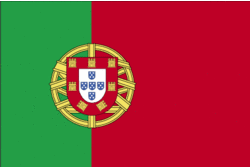
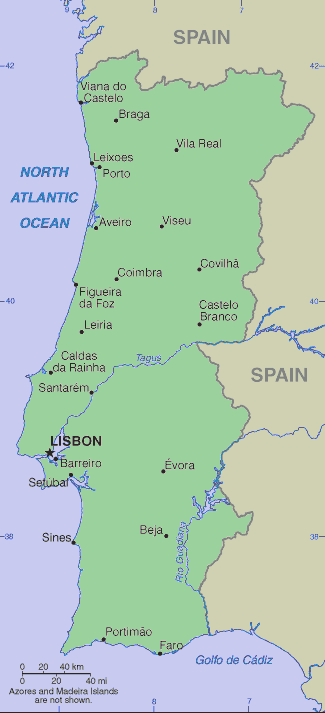
Portugal is located in Southwestern Europe, bordering the North Atlantic Ocean, west of Spain.
Land in Portugal is mountainous north of the Tagus River, rolling plains in south.
Portuguese land covers an area of 92391 square kilometers which is slightly smaller than Indiana
As for the Portuguese climate; maritime temperate; cool and rainy in north, warmer and drier in south.
Portuguese (singular and plural) speak Portuguese (official), Mirandese (official - but locally used).
Following its heyday as a world power during the 15th and 16th centuries, Portugal lost much of its wealth and status with the destruction of Lisbon in a 1755 earthquake, occupation during the Napoleonic Wars, and the independence in 1822 of Brazil as a colony. A 1910 revolution deposed the monarchy; for most of the next six decades, repressive governments ran the country. In 1974, a left-wing military coup installed broad democratic reforms. The following year, Portugal granted independence to all of its African colonies. Portugal is a founding member of NATO and entered the EC (now the EU) in 1986.
Country profile: Portugal
Portugal, a country with a rich history of seafaring and discovery, looks out from the Iberian peninsula into the Atlantic Ocean.
When it handed over its last overseas territory, Macau, to Chinese administration in 1999, it brought to an end a long and sometimes turbulent era as a colonial power.
The roots of that era stretch back to the 15th century when Portuguese explorers such as Vasco da Gama put to sea in search of a passage to India. By the 16th century these sailors had helped build a huge empire embracing Brazil as well as swathes of Africa and Asia. There are still some 200 million Portuguese speakers around the world today.

Portugal's history has had a lasting impact on the culture of the country with Moorish and Oriental influences in architecture and the arts. Traditional folk dance and music, particularly the melancholy fado, remain vibrant.
For almost half of the 20th century Portugal was a dictatorship in which for decades Antonio de Oliveira Salazar was the key figure. The dictatorship's stubborn refusal to relinquish its grip on the former colonies as demands for independence gained momentum there resulted in expensive wars in Africa.
This period was brought to an end in 1974 in a bloodless coup, picturesquely known as the Revolution of the Carnations, which ushered in a new democracy.
By the end of 1975 all of Portugal's former colonies in Africa were independent of Lisbon.
- Full name: Portuguese Republic
- Population: 10.5 million (Statistics Institute, 2005)
- Capital: Lisbon
- Area: 92,345 sq km (35,655 sq miles)
- Major language: Portuguese
- Major religion: Christianity
- Life expectancy: 73 years (men), 80 years (women) (UN)
- Monetary unit: 1 euro = 100 cents
- Main exports: Textiles and clothing, wood products, electrical equipment
- GNI per capita: US $16,170 (World Bank, 2006)
- Internet domain: .pt
- International dialling code: +351
President: Anibal Cavaco Silva
Anibal Cavaco Silva won the January 2006 presidential poll, becoming the first centre-right president since the coup of 1974. He defeated two Socialist candidates to win a first round election victory.
The president's role is mainly ceremonial, but incumbents can appoint prime ministers, dissolve parliament and call elections.
Prime minister: Jose Socrates
Victory in February 2005 elections went to the Socialist Party led by Jose Socrates. The Socialists gained their first absolute majority in parliament since democracy returned to Portugal in 1974.

On taking office, Mr Socrates said his priority would be to encourage economic growth and stem rising unemployment. He promised to invest in training and technology. His government faces the major task of bringing the budget deficit - the widest within the eurozone - under control.
His government aims to slim down the civil service, and to overhaul the social security and education systems.
Mr Socrates was 47 when the elections took place. He served as environment minister in the last Socialist government and became the party's leader in 2004.
President Sampaio had called the elections early amidst growing discontent over the failure of the previous centre-right government led by Pedro Santana Lopes to tackle the country's mounting economic problems.
Foreign minister: Luis Filipe Marques Amado
Finance minister: Fernando Teixeira dos Santos
Portugal's commercial TV stations command a lion's share of the viewing audience, and provide tough competition for the cash-strapped public broadcaster.
Public TV services are operated by RTP, which enjoyed a monopoly on the airwaves until the launch of commercial channel SIC in 1992.
The future of public broadcasting has generated heated political debate. The second public TV channel and a public radio network survived closure threats in 2002.
Multichannel TV - via cable and satellite - reaches more than two million homes and offers a wide range of domestic and foreign channels.
Public radio networks are operated by RDP. The Roman Catholic Church owns the widely-listened-to Radio Renascenca. There are some 300 local and regional commercial radio stations.
The press
Diario de Noticias - daily
Publico - daily
Correio da Manha - daily
Jornal de Noticias - daily
Expresso - weekly
The Portugal News - English-language weekly
Television
RTP - public, operates two domestic channels and external services RTP Africa and RTP Internacional
SIC - commercial, channels include cable news station SIC Noticias
TVI - commercial
TV Cabo - main pay-TV operator
Radio
RDP - public, operates three national networks, regional and external services
Radio Comercial - national, commercial
TSF - national, commercial
Radio Clube Portugues - commercial network
Radio Renascenca - church-run
News agency
Lusa News Agency
Portugal has become a diversified and increasingly service-based economy since joining the European Community in 1986. Over the past decade, successive governments have privatized many state-controlled firms and liberalized key areas of the economy, including the financial and telecommunications sectors. The country qualified for the European Monetary Union (EMU) in 1998 and began circulating the euro on 1 January 2002 along with 11 other EU member economies. Economic growth had been above the EU average for much of the past decade, but fell back in 2001-05. GDP per capita stands at two-thirds that of the Big Four EU economies. A poor educational system, in particular, has been an obstacle to greater productivity and growth. Portugal has been increasingly overshadowed by lower-cost producers in Central Europe and Asia as a target for foreign direct investment. The government faces tough choices in its attempts to boost Portugal's economic competitiveness while keeping the budget deficit within the eurozone's 3%-of-GDP ceiling.
Portuguese natural resources include fish, forests (cork), iron ore, copper, zinc, tin, tungsten, silver, gold, uranium, marble, clay, gypsum, salt, arable land, hydropower
Azores and Madeira Islands occupy strategic locations along western sea approaches to Strait of Gibraltar
Portuguese religion is Roman Catholic 94%, Protestant (1995).
Natural hazards in Portugal include Azores subject to severe earthquakes.
Portugal
This advice has been reviewed and reissued with an amendment to the General section. The overall level of the advice has not changed.
SUMMARY
- Portugal shares with the rest of Europe a threat from international terrorism. Attacks could be indiscriminate and against civilian targets.
- Around three million British tourists visit Portugal every. Most visits are trouble-free. The main incidents for which British nationals require consular assistance are hospitalisation, especially relating to road traffic accidents, death, mainly from natural causes, and the replacement of their passport due to theft or loss. You should be alert to the risk of petty theft.
- We strongly recommend that you obtain comprehensive travel and medical insurance before travelling. You should check any exclusions, and that your policy covers you for the activities you want to undertake. Please see: Travel Insurance.
SAFETY AND SECURITY
Portugal shares with the rest of Europe a threat from international terrorism. Attacks could be indiscriminate and against civilian targets.
Please read Security and General Tips, and Risk of Terrorism when Travelling Overseas pages on the FCO website.
Crime
Crime remains comparatively low in Portugal but pickpocketing, handbag snatching and theft from cars are increasingly common in major tourist areas. Passports, credit cards, travel tickets and money should not be carried together in handbags or pockets. Leave spare cash and valuables in a safe place. Do not leave any valuables in an unattended car.
Portuguese police recommend car windows and doors are closed and locked while driving at night in urban centres. Pedestrians are advised not to wear valuable jewellery or watches in public areas.
Road Safety
If hiring a car, you should ensure that the vehicle insurance is fully comprehensive and covers you and your passengers for all eventualities.
As a holidaymaker, you can bring your own vehicle to Portugal for a maximum of 180 days in any 12-month period. You must not use your vehicle for any other purpose or loan it to anyone else during that time. If you intend to stay longer, you must apply to the Portuguese Customs authority to have the car legally imported. You will be fined if you leave the country without your car.
The minimum age for driving is 18. You must possess a UK driving licence or an International Driving Permit. In addition to your licence, you must also carry your vehicle logbook or rental contract, proof of insurance and MOT certificate (if appropriate) together with all other relevant documentation. There are heavy on-the-spot fines for those who fail to do so.
You must carry a red warning triangle to place behind the vehicle in case of accident or breakdown and a reflective vest for use if you have to get out of your car. The wearing of seatbelts is compulsory in the front and rear of vehicles. Children under 12 must not travel in the front passenger seat. You must not carry spare petrol cans in the vehicle.
Fines for traffic offences are substantial in Portugal. Such infringements as speeding, driving under the influence of drink or drugs, the use of mobile phones whilst driving and illegal parking are heavily penalised. Special emphasis is also placed on the use of child safety seats and seat belts in the rear of the vehicle. The police have the authority to fine on-the-spot and most of their vehicles are now equipped with portable ATM machines to facilitate immediate payment. The Portuguese Highway Code can be found (in Portuguese) at: http://www.dgv.pt
As in many other European countries, there is a toll system in operation on Portuguese motorways. Heavy fines are imposed for those who do not or cannot pay toll fees. You should take care not to use the green lanes reserved for motorists who subscribe to the automatic pay system.
Driving regulations and customs are different from those in the UK and the accident rate is higher. Visitors are advised to take extra care when crossing busy roads, especially late at night. This includes crossing at zebra crossings which are often badly lit and poorly marked. UK organisations such as the AA or RAC should be able to provide detailed advice.
Beaches & Swimming
Death by drowning occurs every year on Portuguese beaches. In an effort to address the problem, the Portuguese Government has approved a new law, which came into effect on 7 June 2006, and which allows the Maritime Police to fine bathers who disobey the lifeguard's warning flags.
Warning flags on beaches should be taken seriously. The red flag indicates danger. Never enter the water when the red flag is flying. If the yellow flag is up, you may paddle at the water's edge, but you may not swim. The green flag indicates that it is safe to swim, and the chequered flag means that the beach is temporarily unmanned.
Do not swim at fluvial beaches or beaches without lifeguards. Do not dive into unknown bodies of water, because hidden rocks or shallow depths can cause serious injury or death. Always exercise caution when swimming in the sea or in swimming pools.
LOCAL LAWS AND CUSTOMS
Under Portuguese drug legislation, if you are caught consuming or in possession of drugs for personal use you may be subject to a fine or other sanction (including the seizure of personal belongings). Selling or trafficking of drugs is a criminal offence and subject to severe penalties.
ENTRY REQUIREMENTS
As an EU national, you may remain in Portugal as a tourist for a period not exceeding 180 days. If you intend to settle, you must apply for a residence permit from the nearest office of the Serviço de Estrangeiros e Fronteiras (Portuguese immigration authority).
A minor under the age of 18 travelling to Portugal must either:
-
be accompanied by a parent or guardian,
-
be met at the airport or point of entry by a parent or guardian, or
-
carry a letter of authorisation to travel from a parent or guardian. The letter should name the adult responsible for the minor during his/her stay.
A minor who is living in Portugal may be prevented from leaving the country if he/she is travelling unaccompanied and is not carrying a notarised letter of authority from a parent or guardian. This is particularly important for children returning to school in the UK.
Similarly, a resident minor travelling with just one of his/her parents, must have a notarised letter of authority to leave the country from the parent who is staying behind. A standard form of words covering both of these cases, may be downloaded from the Portuguese immigration service website at http://www.sef.pt/impressos.htm (see: Saída de Menores de Território Nacional).
There is a legal requirement for foreign nationals to be able to show some form of identification if requested by the police or judicial authorities. For UK nationals this means a passport. This requirement is rigorously enforced in the case of those driving cars in Portugal. In other cases, it should be sufficient to carry a photocopy of the data page of your passport, but you should be prepared to produce the original document, if necessary. This may mean being accompanied by the police to collect it from your hotel. All UK visitors are in any case advised to keep a photocopy of the data page separate from the original.
HEALTH
You are strongly advised to take out comprehensive travel and medical insurance before travelling. You should check any exclusions, and that your policy covers you for the activities you want to undertake. Please see: Travel Insurance
You do not need an a European Health Insurance Card (EHIC), which has now replaced the E111 form, for Portugal (see: New E111 form), as there is a reciprocal agreement between Portugal and the UK, which covers free or reduced cost, state-provided, emergency medical treatment in State facilities. However, it gives no entitlement to medical repatriation costs, it cannot be used to settle the bill at a private clinic, and will not cover ongoing illnesses of a non-urgent nature. Private treatment is expensive.
You should seek medical advice before travelling and ensure that all appropriate vaccinations are up to date. For further information on health, check the Department of Health’s website at: www.dh.gov.uk
NATURAL DISASTERS
Forest Fires
Forest fires occur frequently in Portugal during the summer months. There have already been many serious outbreaks, especially in northern and central parts of the country. There is a danger that these will become more frequent whilst the weather remains hot and dry. Please take care when visiting or driving through woodland areas; ensure that cigarette ends are properly extinguished, do not light barbecues and do not leave rubbish or empty bottles behind. If you see the on-set of a forest fire, please call the Emergency services on 112 or 117.
For up-to-date information on the situation, you may wish to consult the Portuguese Fire and Civil Protection Service's website at http://www.snbpc.pt.
During your visit, please use water with care.
GENERAL
If things go wrong when overseas, please see: What We Can Do To Help
The revised EU-wide security measures that came into effect for all passengers departing from UK airports in November 2006 are also being implemented in Portugal. For more details about this please see: DfT - Airline Security Update
The Euro
You are reminded that the currency of Portugal is the Euro.
OTHER
Portugal Country Profile