World index ... Europe ... Romania
Travelers word index

Romania

Continents
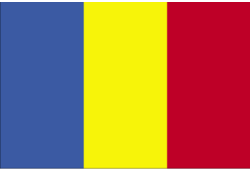
Romanian flag

Romania is located in Southeastern Europe, bordering the Black Sea, between Bulgaria and Ukraine.

Romania has borders with Bulgaria for 608km, Hungary for 443km, Moldova for 450km and Ukraine for 531km.
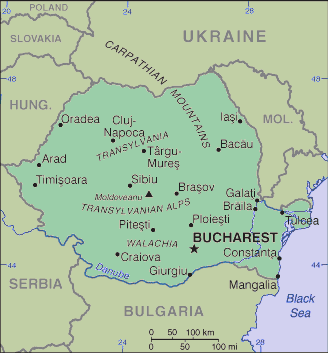
Land in Romania is central Transylvanian Basin is separated from the Plain of Moldavia on the east by the Carpathian Mountains and separated from the Walachian Plain on the south by the Transylvanian Alps.

Romanian land covers an area of 237500 square kilometers which is slightly smaller than Oregon

As for the Romanian climate; temperate; cold, cloudy winters with frequent snow and fog; sunny summers with frequent showers and thunderstorms.

Romanian(s) speak Romanian (official), Hungarian, German.

Romania country profile, Travel advice for Romania

Romanian Map
Places of note in Romania
Bucharest
Iaşi
Cluj-Napoca
Timişoara
Craiova
Constanţa
Galaţi
Braşov
Ploieşti
Brăila
nagyvarad
Bacău
Arad
Piteşti
Sibiu
Târgu-Mureş
Baia Mare
Buzău
Botoşani
Satu Mare
Râmnicu Vâlcea
Suceava
Focşani
Piatra Neamţ
Drobeta-Turnu Severin
Târgu Jiu
Tulcea
Târgovişte
Bistriţa
Reşiţa
Slatina
Vaslui
Călăraşi
Hunedoara
Giurgiu
Regions of Romania
Alba
Arad
Argeş
Bacău
Bihor
Bistriţa-Năsăud
Botoşani
Brăila
Braşov
Bucureşti
Buzău
Călăraşi
Caraş-Severin
Cluj
Constanţa
Covasna
Dâmboviţa
Dolj
Galaţi
Giurgiu
Gorj
Harghita
Hunedoara
Ialomiţa
Iaşi
Ilfov
Maramureş
Mehedinţi
Mureş
Neamţ
Olt
Prahova
Romania (general)
Sălaj
Satu Mare
Sibiu
Suceava
Teleorman
Timiş
Tulcea
Vâlcea
Vaslui
Vrancea

The principalities of Wallachia and Moldavia - for centuries under the suzerainty of the Turkish Ottoman Empire - secured their autonomy in 1856; they united in 1859 and a few years later adopted the new name of Romania. The country gained recognition of its independence in 1878. It joined the Allied Powers in World War I and acquired new territories - most notably Transylvania - following the conflict. In 1940, Romania allied with the Axis powers and participated in the 1941 German invasion of the USSR. Three years later, overrun by the Soviets, Romania signed an armistice. The post-war Soviet occupation led to the formation of a Communist "people's republic" in 1947 and the abdication of the king. The decades-long rule of dictator Nicolae CEAUSESCU, who took power in 1965, and his Securitate police state became increasingly oppressive and draconian through the 1980s. CEAUSESCU was overthrown and executed in late 1989. Former Communists dominated the government until 1996 when they were swept from power. Although Romania completed accession talks with the European Union (EU) in December 2004, it must continue to address rampant corruption - while invigorating lagging economic and democratic reforms - to fulfill the requirements for EU accession, scheduled to take place in 2007 or 2008. Romania joined NATO in March of 2004.

Country profile: Romania

Map of Romania The largest of the Balkan countries, Romania has dramatic mountain scenery and a coastline on the Black Sea.

It has seen numerous empires come and go from the Roman, to the Ottoman, to the Austro-Hungarian.

After World War II the country was under communist rule although the leadership pursued a foreign policy independent of that of the Soviet Union.

Romania, a slower developer than other former communist countries of eastern Europe, took a major step away from its past when it was one of seven countries to join Nato in late March 2004. Its strategic location and Black Sea air and naval bases make it attractive to the alliance.

Worker prepares EU entry celebrations

There have been several complex exchanges of territory over the years, not least when the area formerly known as Bessarabia went to the USSR following a pact between Hitler and Stalin. That region now forms a large part of the Republic of Moldova. Romanian, a Romance language, is essentially the same as Moldovan although the latter has undergone more influence from Russian.

The legacy of communist-era leader Nicolae Ceausescu, who was feared and loathed in approximately equal measure, lingered long after the uprising which brought his execution on Christmas Day 1989.

Former communists dominated politics until 1996 when a centrist government came to power. It became involved in prolonged political feuding which did little or nothing to promote economic reform. The left returned in 2000 when Ion Iliescu was re-elected president.

Failure to push ahead sufficiently with reforms meant that the country was not on the list of new EU members four years later. However, in April 2005 Bucharest signed the EU accession treaty, paving the way for Romania to join the union in January 2007.

President: Traian Basescu

Traian Basescu, the popular centrist mayor of Bucharest, topped the poll in the second round of Romania's presidential election in mid-December 2004, defeating incumbent Prime Minister Adrian Nastase of the leftist Social Democratic party. The result came as a surprise to many.

Traian Basescu

The veteran former president, Ion Iliescu, also of the Social Democrats, had dominated Romanian politics since the fall of Communist dictator Nicolae Ceausescu in 1989. He was barred by the constitution from running for a further term.

Although Mr Iliescu and the Social Democrats had overseen Romania's entry into Nato and brought the country within sight of EU membership, they were regarded by critics as having dragged their feet on reform and as not tough enough against corruption.

Mr Basescu, a former sea captain, has promised to take a harder line against poverty and graft.

Mr Basescu was 53 at the time of his election. He was transport minister between 1996 and 2000.

Prime minister: Calin Tariceanu

Romanian PM Tariceanu

Calin Tariceanu became prime minister following parliamentary elections in November 2004. His government is an alliance of Liberals and Democrats and has members from four reformist parties.

He said his main aim was to achieve EU membership in 2007 and identified the fight against corruption as one of the key challenges.

His government has won praise from EU officials for its efforts to tackle the problem. Numerous criminal investigations have been launched into the activities of senior officials and members of the judiciary.

Mr Tariceanu had a successful business career before entering politics. He was 53 when he became prime minister.

  • Foreign minister: Razvan Ungureanu
  • Economy, trade minister: Codrut Seres

    Romania has one of the most dynamic media markets in southeastern Europe. State-owned Romania 1 and the private commercial stations Pro TV and Antena 1 command the lion's share of viewing.

    There is a large number of smaller, private TV stations, some of them part of local networks. The state broadcaster, TVR, operates a second national network, TVR 2, and a pan-European satellite channel. Pay TV channels have a smaller but significant audience.

    The first private radio stations appeared in 1990; there are now more than 100 of them. State-run Radio Romania operates four national networks and regional and local stations. BBC World Service is available on 88 FM in the capital.

    Most households in Bucharest have cable TV. There are hundreds of cable distributors offering access to Romanian, European and other stations.

    Romania's newspaper market thrived after the 1989 revolution, but many newspapers subsequently closed because of rising costs.

    The 1991 constitution upholds freedom of expression, but prohibits "defamation of the country".

    In 2004 the media rights body Reporters Without Borders said physical attacks on journalists investigating corruption had increased. It added that self-censorship among journalists was prompted by defamation laws.

    The press

  • Adevarul - daily
  • Libertatea - daily
  • Evenimentul Zillei - daily
  • Jurnalul National - daily, English-language pages
  • Romania Libera -daily
  • Capital - business weekly
  • Nine O' Clock - English-language daily

    Television

  • TVR - state-owned, operates Romania 1 and TVR 2 networks
  • Antena 1 - commercial
  • Pro TV - commercial
  • Prima TV - commercial
  • Acasa TV - commercial
  • Realitatea TV - commercial

    Radio

  • Radio Romania - state-owned, operates national and regional networks and Radio Romania International
  • Europa FM - commercial
  • Kiss FM - commercial
  • Pro FM - commercial
  • Radio 21 - commercial

    News agencies

  • Rompres - state-run
  • Mediafax - private, English-language pages

    Romania began the transition from Communism in 1989 with a largely obsolete industrial base and a pattern of output unsuited to the country's needs. The country emerged in 2000 from a punishing three-year recession thanks to strong demand in EU export markets. Despite the global slowdown in 2001-02, strong domestic activity in construction, agriculture, and consumption have kept GDP growth above 4%. An IMF standby agreement, signed in 2001, has been accompanied by slow but palpable gains in privatization, deficit reduction, and the curbing of inflation. The IMF Board approved Romania's completion of the standby agreement in October 2003, the first time Romania has successfully concluded an IMF agreement since the 1989 revolution. In July 2004, the executive board of the IMF approved a 24-month standby agreement for $367 million. IMF concerns about Romania's tax policy and budget deficit led to a breakdown of this agreement in 2005. In the past, the IMF has criticized the government's fiscal, wage, and monetary policies. Meanwhile, macroeconomic gains have only recently started to spur creation of a middle class and address Romania's widespread poverty, while corruption and red tape continue to handicap the business environment. Romanian government confidence in continuing disinflation was underscored by its currency revaluation in 2005, making 10,000 "old" lei equal 1 "new" leu.

    Romanian natural resources include petroleum (reserves declining), timber, natural gas, coal, iron ore, salt, arable land, hydropower

    controls most easily traversable land route between the Balkans, Moldova, and Ukraine

    Romanian religion is Eastern Orthodox (including all sub-denominations) 86.8%, Protestant (various denominations including Reformate and Pentecostal) 7.5%, Roman Catholic 4.7%, other (mostly Muslim) and unspecified 0.9%, none 0.1% (2002 census).

    Natural hazards in Romania include earthquakes, most severe in south and southwest; geologic structure and climate promote landslides.

    Travel Advice on Romania

    Romania

    This advice has been reviewed and reissued with an amendment to the Health section.  The overall level of the advice has not changed.

    SUMMARY

    • Romania shares with the rest of Europe a threat from international terrorism.  Attacks could be indiscriminate and against civilian targets.

    • Around 75,000 British nationals visit Romania every year.  Most consular cases involve petty crime, lost or stolen passports and car theft.  Beware of young pickpockets in city centres especially in crowded areas e.g. buses, trains and busy streets.  Keep valuable belongings in a hotel safe where possible.

    • We strongly recommend that you obtain comprehensive travel and medical insurance before travelling.  You should check any exclusions, and that your policy covers you for the activities you want to undertake.  Please see:  Travel Insurance.


    SAFETY AND SECURITY

    Crime
    You are advised to maintain at least the same level of personal security awareness as in the UK.  You should also be alert to the risk of petty theft in large towns, especially in Bucharest, and for pickpockets and bag snatchers in crowded areas, particularly near exchange shops, hotels, on public transport (especially to the airport), main railway stations and inside airport areas.
    Corruption is widespread.  There have been reports of policemen stopping foreign cars and demanding payment of fines in hard currency for spurious offences.  Bogus policemen may also approach pedestrians and ask to check their documents as a way of stealing cash.  If approached in this way, you should decline to pay any fine or hand over any documents but offer instead to go with them to the nearest police station.
    We are aware of thefts of valuables including passports from hotel rooms.  Items of value, including passports and credit cards should be deposited in hotel safes.  However, you should carry a photocopy of the information pages of your passport as ID.
    You should be aware that there are reports of credit or charge cards being 'copied' when used in some bars and restaurants, resulting in illegal charges being raised against the user account.
    Political Situation
    Romania Country Profile
    Local Travel
    Bucharest has cheap and plentiful public transport provided by underground, bus, and tram.  Yellow taxis are also abundant but make sure prices are listed on the side of the vehicle and that the taxi bears a company name.  There are frequent reports of foreign visitors being overcharged by taxi drivers.  Other cities have fairly good bus services.  Cities and towns are linked by extensive rail services.  If travelling on a domestic air flight, you should have your passport ready for inspection at all times.
    If you are driving to Romania, please note that on entry you are required to pay a road toll to allow you to use the national roads.  Tolls are charged on motorways and main roads out of town, payable in Euros.  Upon payment, ensure you receive and display the windscreen stickers confirming you have paid the toll.  Please note that failure to pay the road toll or to display the sticker may lead to a heavy fine.
    The cost for cars is three Euros for a one-week vignette or six Euros for one month, but prices may change.  Costs are higher for freight vehicles and coaches for eight or more passengers.  Tickets can be purchased at border points on entering the country or at post offices and at most petrol stations throughout Romania.
    Road Safety
    If driving, you need to be alert for horse-drawn carts and livestock especially at night.  The police carry out frequent checks, and it is essential that you observe the speed limit, ensure that your vehicle is roadworthy and have with you all your car documents including evidence of insurance valid in Romania.  Note that there is zero tolerance for drinking and driving.
    In winter, equip your car for extreme conditions.
    Rail Safety
    If travelling by train, you should check with operators on the availability of sleeping compartments and whether bicycles can be taken on board.  This may vary between regions, and there may be additional charges.  Thieves operate on trains, so take particular care that documents and other valuables are safe.


    LOCAL LAWS AND CUSTOMS

    It is illegal to change money on the streets.  Money should be changed in recognised exchange shops, banks and hotels.
    The Romanian authorities treat all drug-related or sex offences very seriously (the age of consent is 18).  Custodial sentences can be expected for any foreigners convicted of such offences.
    Homosexuality is no longer illegal, but attitudes to the subject tend not to be broadminded and the gay community keeps a low profile.
    Most airports and military bases will have signs prohibiting photography.  It is always advisable to ask permission before photographing anything potentially sensitive (eg. official buildings, police cars).


    ENTRY REQUIREMENTS

    You do not need a visa to enter Romania.  From 1 January 2007, British citizens who enter Romania have the right to stay for a period of 3 months from the date of entry. If intending to stay for a longer period than 3 months, British citizens can apply for a registration certificate issued by the Romanian Authority for Aliens.  There are no restrictions on British nationals working in Romania.  If a British citizen has been a legal resident in Romania for a continuous period of at least 5 years then they can apply for a permanent right of residence certificate from the same authorities.  For further information please visit the website of the Romanian representation in the UK.

    All children entering Romania should have their own passport. Children included in parents’ passports will only be allowed entry if the passport also contains their photograph.  For further information on exactly what will be required please contact:  Romanian representation in the UK.


    HEALTH

    We strongly recommend that you obtain comprehensive medical insurance before travelling.  You should check any exclusions, and that your policy covers you for the activities you want to undertake.  Please see:  Travel Insurance.

    The Form E111 is no longer valid.  You should obtain a European Health Insurance Card (EHIC) before leaving the UK.  The EHIC is not a substitute for medical and travel insurance, but entitles you to any medical treatment that becomes necessary on the same terms as Romanian nationals.  You will not be covered for medical repatriation, on-going medical treatment or treatment of a non-urgent nature.  For more information about how to obtain the EHIC please see:  Europe and the EHIC.

    There have been a number of Hepatitis A cases in Romania.  You are advised to seek medical advice about inoculations before travelling.  You should drink only bottled water.

    Rabies is endemic in Romania.  It has largely been confined to the rural areas.  You should be wary of, and try to avoid contact with, the numerous stray dogs.  If bitten, you should seek medical assistance as soon as possible.  If visiting rural areas of Romania, you should consider having a course of rabies inoculations.

    Stray dogs in Romania are also reported to carry the tick-borne African Typhus disease.  Those most at risk are the elderly, the young and the infirm.

    You should seek medical advice before travelling and ensure that all appropriate vaccinations are up to date.  For further information on health, check the Department of Health’s website at: www.dh.gov.uk

     Avian Influenza (Bird Flu)

    There have been confirmed outbreaks of Avian Influenza in the Danube Delta, Transylvania and Bucharest.  The Romanian authorities have taken measures to contain the outbreaks including restricting access to affected areas.  No human infections or deaths have been reported.
    The risk to humans from Avian Influenza is believed to be very low.  As a precaution, you should avoid visiting live animal markets, poultry farms and other places where you may come into close contact with domestic, caged or wild birds; and ensure poultry and egg dishes are thoroughly cooked.
    You should read this advice in conjunction with:  Avian and Pandemic Influenza Factsheet, which gives more detailed advice and information.

    NATURAL DISASTERS

    Earthquakes are not uncommon in southern and southwestern Romania and small tremors are recorded throughout the year without consequences. The last major earthquake occurred in late November 2005 but there were no casualties or significant damage.


    GENERAL

    If things go wrong when overseas, please see: What We Can Do To Help
    Money
    We recommend that you carry Euros in Romania.  Dollars and Sterling are not always easy to exchange for the local currency especially outside of Bucharest.  You may also have difficulties using travellers’ cheques and credit cards.  (And bear in mind the advice on card copying as mentioned in the Crime section).
    Romania is in the middle of a process of redenominating its currency, moving from ROL to RON.  10,000 ROL = 1 RON.  Banknotes and coins of both denominations are in circulation.  Some shops, restaurants and taxis show prices only in RON.  Others show prices in both RON and ROL.  This can be confusing for foreign visitors.  There is a helpful guide on the National Bank website.


  • What is this world index all about?