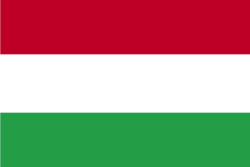
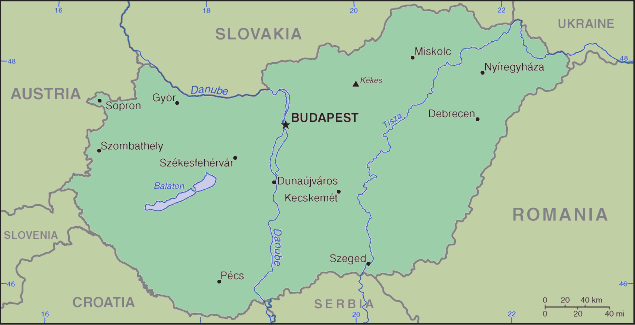
Hungary is located in Central Europe, northwest of Romania.
Land in Hungary is mostly flat to rolling plains; hills and low mountains on the Slovakian border.
Hungarian land covers an area of 93030 square kilometers which is slightly smaller than Indiana
As for the Hungarian climate; temperate; cold, cloudy, humid winters; warm summers.
Hungarian(s) speak Hungarian 93.6%, other or unspecified 6.4% (2001 census).
Hungary was part of the polyglot Austro-Hungarian Empire, which collapsed during World War I. The country fell under Communist rule following World War II. In 1956, a revolt and announced withdrawal from the Warsaw Pact were met with a massive military intervention by Moscow. Under the leadership of Janos KADAR in 1968, Hungary began liberalizing its economy, introducing so-called "Goulash Communism." Hungary held its first multiparty elections in 1990 and initiated a free market economy. It joined NATO in 1999 and the EU in 2004.
Country profile: Hungary
Hungary has a colourful and varied culture reflecting its mix of peoples - the majority Magyars, and Roma, German, Slovak, Croat, Serb and Romanian minorities.It was admitted to Nato in 1999 and joined the EU in May 2004.
A landlocked country, Hungary is home to Lake Balaton, the largest in central Europe, and to a large number of spa towns and hot springs.
It has rich traditions in folk and classical music and was the birthplace of numerous well loved performers and composers, including Franz Liszt, Bela Bartok and Zoltan Kodaly. It also has a long history of wine making.
Once part of the Ottoman and Hapsburg empires, it became a partner in the Austro-Hungarian empire in the mid-19th century. After a period of turmoil following World War I, an independent kingdom of Hungary was established.
Following World War II, the country found itself under communist rule. An uprising against Soviet domination in 1956 was crushed by Red Army forces but Hungary did later become the first Eastern European country to gain some economic freedom. It embraced aspects of the free market while still under communist rule and in 1968 the authorities allowed limited decentralisation of the economy.
This helped to smooth economic transition. Within four years of the collapse of communism nearly half of the country's economic enterprises had been transferred to the private sector, and by 1998 Hungary was attracting nearly half of all foreign direct investment in its region.
Hungary played an important part in accelerating the collapse of communism across Eastern Europe when in 1989 it opened its border with Austria, allowing thousands of East Germans to escape to the West. Just a few months later the Berlin Wall was history.
The redrawing of European borders that took place after World War I left about five million ethnic Hungarians living in neighbouring countries. Their status remains a sensitive issue. Low turnout invalidated a December 2004 referendum on whether or not to offer them citizenship.
- Full name: Republic of Hungary
- Population: 9.8 million (UN, 2005)
- Capital: Budapest
- Area: 93,030 sq km (35,919 sq miles)
- Major language: Hungarian
- Major religion: Christianity
- Life expectancy: 68 years (men), 77 years (women) (UN)
- Monetary unit: Forint
- Main exports: Machinery and transport equipment, foodstuffs, chemicals
- GNI per capita: US $10,030 (World Bank, 2006)
- Internet domain: .hu
- International dialling code: +36
President Laszlo Solyom
Prime minister: Ferenc Gyurcsany
Ferenc Gyurcsany's Socialist-led coalition won a decisive victory in parliamentary elections in April 2006, becoming the first government to win consecutive terms since the restoration of democracy in 1990.
Between them, the Socialists and Free Democrats won 210 of the 386 seats in parliament after campaigning on promises of further reforms.
After his re-election, the prime minister unveiled plans to cut public sector jobs and raise taxes in a bid to boost growth and steer Hungary toward eurozone membership in 2010. He also pledged to reduce the budget deficit.
But he came under intense opposition pressure in September 2006 when a tape recording was made public of him admitting at a party meeting that the government had lied about the state of the economy during the election.
The comments sparked the first violent protests in the capital since the fall of communism. The prime minister said he had been trying to convince his party about the urgent need for reform.
The former sports minister was first formally approved by parliament as prime minister in late September 2004.
He had been chosen by the Socialist Party to succeed Peter Medgyessy who resigned when tensions flared with the Free Democrats, the Socialists' coalition partners, over a cabinet reshuffle. The coalition has been in government since 2002.
Ferenc Gyurcsany was born in 1961 and was a member of the communist youth movement in the 1980s. He went on to become a millionaire from buying state assets in the early years of privatisation. He entered politics in 2002 as a strategic adviser to the former premier.
Finance minister: Janos Veres
Foreign minister: Kinga Goncz
Hungary's private broadcast media compete with state-run radio and TV. The state broadcaster has faced financial struggles, dwindling audiences and allegations of political influence from government circles.
Public radio services operated by Hungarian Radio compete with numerous local radio stations and national commercial services.
Hungary's national and local newspapers are privately-owned, some of them by foreign groups and investors.
The press
Nepszabadsag - daily
Magyar Hirlap - daily
Magyar Nemzet - daily
Nepszava - daily
Heti Vilaggazdasag - political and business weekly
The Budapest Sun - English-language
The Budapest Times - English-language
Television
Magyar Televizio (MTV) public, operates two channels
Duna TV - public, satellite channel geared to Hungarian minorities in neighbouring states
TV2 - private, terrestrial
RTL Klub - private, terrestrial
Hir TV (News TV) - private, news channel
Radio
Hungarian Radio - public, operates Kossuth, Petofi and Bartok networks and external service Radio Budapest
InfoRadio - private, news
Danubius Radio - private
Slager Radio - private
Juventus Radio - private
News agencies
MTI - state-owned, English-language pages
Havaria Press - private
Hungary has made the transition from a centrally planned to a market economy, with a per capita income one-half that of the Big Four European nations. Hungary continues to demonstrate strong economic growth and acceded to the EU in May 2004. The private sector accounts for over 80% of GDP. Foreign ownership of and investment in Hungarian firms are widespread, with cumulative foreign direct investment totaling more than $60 billion since 1989. Hungarian sovereign debt was upgraded in 2000 and together with the Czech Republic holds the highest rating among the Central European transition economies; however, ratings agencies have expressed concerns over Hungary's unsustainable budget and current account deficits. Inflation has declined from 14% in 1998 to 3.7% in 2005. Unemployment has persisted around the 6% level, but Hungary's labor force participation rate of 57% is one of the lowest in the Organization for Economic Cooperation and Development (OECD). Germany is by far Hungary's largest economic partner. Policy challenges include cutting the public sector deficit to 3% of GDP by 2008, from about 6.5% in 2005, and orchestrating an orderly interest rate reduction without sparking capital outflows.
Hungarian natural resources include bauxite, coal, natural gas, fertile soils, arable land
landlocked; strategic location astride main land routes between Western Europe and Balkan Peninsula as well as between Ukraine and Mediterranean basin; the north-south flowing Duna (Danube) and Tisza Rivers divide the country into three large regions
Hungarian religion is Roman Catholic 51.9%, Calvinist 15.9%, Lutheran 3%, Greek Catholic 2.6%, other Christian 1%, other or unspecified 11.1%, unaffiliated 14.5% (2001 census).
Hungary
This advice has been reviewed and reissued with amendments to the Summary, Political Situation and Health section (Avian Influenza). The overall level of the advice has not changed.
SUMMARY
- Hungary shares with the rest of Europe a threat from terrorism. Attacks could be indiscriminate and against civilian targets.
- Around 400,000 British nationals visit Hungary each year. Most visits are trouble free. The main type of incident for which British nationals require consular assistance in Hungary is petty crime, often including the loss of money and/or passports.
- Last autumn, there were a series of political demonstrations in Budapest and elsewhere in the country. Further demonstrations are likely on and immediately after 15 March. There have been some cases where generally peaceful demonstrations ended in violence as a result of the actions of a small minority of protesters. As a precaution you should avoid political demonstrations.
- In January 2007, Hungarian authorities confirmed the existence of the H5N1 (Avian Influenza) virus strain in five dead geese in south-east Hungary. No human deaths or infections have been reported. The Hungarian authorities have announced that strict biosecurity measures are being enforced in accordance with EU legislation. Please see Health section for further information.
- We strongly recommend you obtain comprehensive travel and medical insurance before travelling. You should check any exclusions, and that your policy covers you for the activities you want to undertake. Please see: Travel Insurance.
SAFETY AND SECURITY
Crime
You should take sensible precautions against the sort of risks (such as petty crime) common in Western Europe.
You can be charged exorbitant prices in certain bars, clubs and restaurants in Budapest. This happens in a number of establishments near the large hotels in the business district (V district) of central Pest but problems occur elsewhere in the city as well.
Common scams include adding a 20,000 HUF (£60) surcharge per drink to the final bill or charging up to100,000 HUF (£300) for a meal. Individuals who have been unable to settle their bills have frequently been accompanied by the establishment’s security guards to a cash machine and made to withdraw funds under threats of violence.
Some taxi drivers are accomplices in these frauds. They often recommend certain bars, clubs and restaurants to passengers – they receive a commission to do so, and the money is then recovered by these establishments charging extortionate prices. You should never ask a taxi driver to recommend a bar or club. If a driver offers to take you to one, or you are approached on the street with an invitation to enter a club, you should treat that advice with extreme caution. As a general rule it is better to phone for a taxi from one of the reputable local companies (your hotel can advise). You should also be careful in establishments where menus do not properly display prices. Even when prices appear to be properly displayed, if you have any doubts about a bar, restaurant or club– do not go in.
Bag snatching and pick-pocketing are common in Budapest in particular. Be particularly careful on busy public transport, in train stations, markets and other places frequented by tourists.
If you travel by overnight train you should, if possible, travel accompanied and you should secure your compartment from the inside.
Do not carry large amounts of cash. Do not use street moneychangers.
Political Situation
Hungary Country Profile
Last autumn, there were a series of political demonstrations against the government in Budapest and elsewhere in the country. Further demonstrations are likely on and immediately after March 15. There have been some cases (e.g. in Budapest on 18 and 19 September, and 23 October 2006) where generally peaceful demonstrations ended in violence as a result of the actions of a small minority of protesters. As a precaution you should avoid political demonstrations.
Road Safety
Theft of, and from, vehicles is common. Be wary of contrived incidents, particularly on the Vienna-Budapest motorway, designed to stop motorists and expose them to robbery.
It is illegal to drive having consumed any alcohol.
The use of headlights is compulsory on roads outside towns even in daytime.
Vehicles using the Hungarian motorways M1, M3, M5 and M7 need to be in possession of a motorway vignette, obtainable at petrol stations and post offices.
In winter, equip your car for severe conditions.
LOCAL LAWS AND CUSTOMS
Carry your passport or photo-driving licence at all times. You must be able to show some form of identity if requested, eg: by the police. A photocopy is not acceptable.
Hungarian laws on the possession and use of drugs are strict.
ENTRY REQUIREMENTS
Visas are not required to enter Hungary but you must have a valid British passport. If you intend to stay more than 90 days, you must register with the relevant office. For further information, check with the Consular Section of the Hungarian Embassy: Hungarian representation in the UK.
Drivers of large haulage vehicles transiting Hungary should ensure they have full vehicle documentation. International loads must be supported by a TIR carnet providing a full inventory of the goods being carried. There is a requirement to leave a financial bond with the Hungarian customs when transiting Hungary with a cargo. The financial bond, minus an administration fee is returned on leaving the country. If you are planning to transit Hungary with consignments of humanitarian aid as relief following a disaster or medical aid you should contact the Hungarian Embassy in London in advance to obtain documentation waiving this requirement.
Entry into Hungary can be barred if you have failed to pay a previous fine in Hungary. You should contact the Hungarian Embassy in London (Hungarian representation in the UK) for guidance on paying any outstanding fines before you next enter Hungary.
HEALTH
We strongly recommend that you obtain comprehensive travel and medical insurance before travelling. You should check any exclusions, and that your policy covers you for the activities you want to undertake. Please see: Travel Insurance
The Form E111 is no longer valid. You should obtain a European Health Insurance Card (EHIC) before leaving the UK. The EHIC is not a substitute for medical and travel insurance, but entitles you to emergency medical treatment on the same terms as Hungarian nationals. You will not be covered for medical repatriation, on-going medical treatment or treatment of a non-urgent nature. For more information about how to obtain the EHIC please see: Europe and the EHIC.
Before you travel you are advised to seek medical advice about inoculations and other measures to prevent tick-related medical problems (such as tick borne encephalitis), especially if you will be visiting forested, grassy or lake-side areas.
You should seek medical advice before travelling and ensure that all appropriate vaccinations are up-to-date. For further information on health, check the Department of Health’s website at www.dh.gov.uk
Avian Influenza (Bird Flu)
In January 2007, the Hungarian authorities confirmed the existence of the H5N1 (Avian Influenza) virus strain in five dead geese in south-east Hungary. Similar cases were also reported in 2006. No human infections or deaths have been reported.
The risk to humans from Avian Influenza is believed to be very low. As a precaution, you should avoid visiting live animal markets, poultry farms and other places where you may come into close contact with domestic, caged or wild birds; and ensure poultry and egg dishes are thoroughly cooked.
You should read this advice in conjunction with the Avian and Pandemic Influenza Factsheet on the FCO website, which gives more detailed advice and information.
GENERAL
If things go wrong when overseas, please see: What We Can Do To Help
EU Aviation Regulations
The revised EU-wide security measures that came into effect for all passengers departing from UK airports in November 2006 are also being implemented in Hungary. For more details about this please see: DfT - Airline Security Update.
European Union
Information on the EU can be found at: Travelling and Living in the EU (pdf) and Britain in the EU.