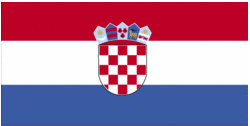
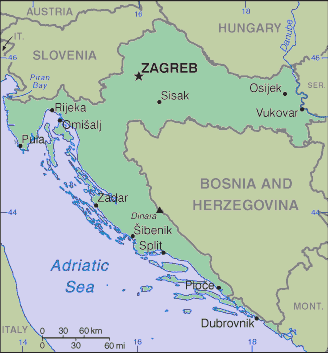
Croatia is located in Southeastern Europe, bordering the Adriatic Sea, between Bosnia and Herzegovina and Slovenia.
Land in Croatia is geographically diverse; flat plains along Hungarian border, low mountains and highlands near Adriatic coastline and islands.
Croatian land covers an area of 56542 square kilometers which is slightly smaller than West Virginia
As for the Croatian climate; Mediterranean and continental; continental climate predominant with hot summers and cold winters; mild winters, dry summers along coast.
Croat(s), Croatian(s) speak Croatian 96.1%, Serbian 1%, other and undesignated 2.9% (including Italian, Hungarian, Czech, Slovak, and German) (2001 census).
The lands that today comprise Croatia were part of the Austro-Hungarian Empire until the close of World War I. In 1918, the Croats, Serbs, and Slovenes formed a kingdom known after 1929 as Yugoslavia. Following World War II, Yugoslavia became a federal independent Communist state under the strong hand of Marshal TITO. Although Croatia declared its independence from Yugoslavia in 1991, it took four years of sporadic, but often bitter, fighting before occupying Serb armies were mostly cleared from Croatian lands. Under UN supervision, the last Serb-held enclave in eastern Slavonia was returned to Croatia in 1998.
Country profile: Croatia
Croatia emerged into the new millennium from a decade in which it experienced a bitter war as the former Yugoslavia broke up, and from several years of authoritarian nationalism under the late president, Franjo Tudjman.
By early 2003 it had made sufficient progress to apply for EU membership, becoming the second former Yugoslav republic after Slovenia to do so.
Accession talks were postponed because of Croatia's failure to detain Gen Ante Gotovina, wanted by the international war crimes tribunal in The Hague. However the green light for the talks to proceed was given in October 2005, and the fugitive general was arrested in Spain shortly afterwards.

Croatia is now hoping to become a member of the EU by 2010, remarkable progress since the time of Tudjman's death in December 1999 when the country was in a parlous state. Its citizens suffered from government-backed attacks on their civil and political rights. The governing party, the HDZ, was then corrupt and the economy was in difficulties, with around 20% of Croatians unemployed.
Presidential and parliamentary elections at the beginning of 2000 ushered in politicians who pledged commitment to Croatia's integration into the European mainstream.
The constitution has been changed to shift power away from the president to the parliament. Croatia has joined the World Trade Organisation and has pledged to open up its economy.
It has achieved growth and inflation is under control.
It has rumbling disputes with Slovenia over sea and land borders dating back to the break-up of Yugoslavia.
A country of striking natural beauty with a stunning Adriatic coastline, Croatia is again very popular as a tourist destination.
- Full name: Republic of Croatia
- Population: 4.4 million (UN, 2005)
- Capital: Zagreb
- Area: 56,594 sq km (21,851 sq km)
- Major language: Croatian
- Major religion: Christianity
- Life expectancy: 71 years (men), 78 years (women) (UN)
- Monetary unit: 1 kuna = 100 lipa
- Main exports: Machinery and transport equipment, clothing, chemicals
- GNI per capita: US $8,060 (World Bank, 2006)
- Internet domain: .hr
- International dialling code: +385
President: Stjepan Mesic
Mr Mesic won a second five-year term as president in January 2005. It is a largely ceremonial role.
The president proposes the prime minister but it is for parliament to approve the nomination. The president also has powers to dissolve parliament and call elections.
Prime minister: Ivo Sanader

President Mesic invited Ivo Sanader, leader of the right-wing Croatian Democratic Union (HDZ), to form a government following elections in November 2003 in which the HDZ won 66 out of the 152 seats in parliament.
Mr Sanader insists that his party has undergone major change since he took over from the late nationalist president, Franjo Tudjman, and now describes it as a traditional conservative party. He has pledged commitment to democracy and the rule of law as well as to upholding human rights and promoting a free market economy.
He has said that EU and Nato membership are the top priority in foreign policy.
On the economic front, Mr Sanader has promised to cut taxes and fight corruption.
He comes from an academic background and speaks several foreign languages, including English.
Foreign minister: Kolinda Grabar Kitarovic
Interior minister: Ivica Kirin
Finance minister: Ivan Suker
Croatia's media now operate in a climate of relative freedom following the restrictions of the Tudjman era. The constitution bans censorship and guarantees press freedom.
Croatian Radio-Television, HRT, is a national state-owned public broadcaster and is financed by a mixture of advertising and licence fee revenues. The frequencies of HRT's third national TV network were allocated to a private bidder in September 2003.
Public TV is the main source of news and information for most Croatians. National commercial networks and dozens of private local TV stations compete for viewers.
The press
Vecernji list
- daily
Jutarnji list - daily
Slobodna Dalmacija - daily
Novi list - daily
Glas Istre - daily
Poslovni dnevnik - business daily
Globus - weekly
Feral Tribune
- weekly
Nacional
- weekly
Business.hr - business weekly
Television
Croatian TV - public, operates national networks
RTL Televizija - national, private
Nova TV - national, private
Radio
Croatian Radio
- public, operates three national networks
Radio 101
- commercial
Otvoreni Radio - commercial
Narodni Radio - commercial
News agency
HINA - English-language pages
Before the dissolution of Yugoslavia, the Republic of Croatia, after Slovenia, was the most prosperous and industrialized area with a per capita output perhaps one-third above the Yugoslav average. The economy emerged from a mild recession in 2000 with tourism, banking, and public investments leading the way. Unemployment remains high, at about 18%, with structural factors slowing its decline. While macroeconomic stabilization has largely been achieved, structural reforms lag because of deep resistance on the part of the public and lack of strong support from politicians. Growth, while impressive at about 3% to 4% for the last several years, has been stimulated, in part, through high fiscal deficits and rapid credit growth. The EU accession process should accelerate fiscal and structural reform.
Croatian natural resources include oil, some coal, bauxite, low-grade iron ore, calcium, gypsum, natural asphalt, silica, mica, clays, salt, hydropower
controls most land routes from Western Europe to Aegean Sea and Turkish Straits
Croatian religion is Roman Catholic 87.8%, Orthodox 4.4%, other Christian 0.4%, Muslim 1.3%, other and unspecified 0.9%, none 5.2% (2001 census).
Natural hazards in Croatia include destructive earthquakes.
Croatia
This advice has been reviewed and reissued with an amendment to the Summary (passport), Local Travel section (crossing Serbia and Montenegro), Health and General section (Emergency passport). The overall level of the advice has not changed.
SUMMARY
- Croatia shares with the rest of the Europe a threat from international terrorism. Attacks could be indiscriminate and against civilian targets, including places frequented by foreigners.
- Unexploded land mines are still a danger. Highly populated areas and major routes are now clear of mines and are safe to visit. However, isolated areas in the mountains and countryside have not all been cleared. You should therefore be careful not to stray from roads and paved areas without an experienced guide.
- Around 250,000 British nationals visit Croatia each year. Most visits to Croatia are trouble-free. The main type of incident for which British nationals require consular assistance in Croatia is for replacing lost and stolen passports.
- Carry your passport at all times. You must be able to show some form of identification if required.
- We strongly recommend that you obtain comprehensive travel and medical insurance before travelling. You should check any exclusions, and that your policy covers you for the activities you want to undertake. Please see: Travel Insurance
SAFETY AND SECURITY
Crime
You should take sensible precautions when carrying money in busy tourist areas, where pickpockets are known to operate.
You should report all incidents of crime to the local police station and obtain a report.
Political Situation
Croatia Country Profile.
Local Travel
If you are planning to travel outside the normal tourist resorts you should be aware that there are areas affected by the war, which ended in 1995, where unexploded mines remain. These areas include the Danube region (Eastern Slavonia) and the former Krajina.
You should be wary about leaving cultivated land or marked paths. If in doubt seek local advice.
If you are planning to cross into the Republics of Serbia or Montenegro please contact the nearest Serbian or Montenegron embassies or look at the travel advice for the Republics of Serbia or Montenegro.
Please note that the Serbia and Montenegro government does not recognise border crossings with Kosovo and those between Kosovo and Albania or Macedonia.
For more information contact the nearest Serbia and Montenegro Embassy or see the Serbia and Montenegro travel advice.
Road Safety
Your UK driving license is valid for up to six months from entry into Croatia. If you are staying longer, you need to apply for a Croatian licence. International Driving Licences are not valid in Croatia.
If travelling by car you should ensure, before setting out, that your green card covers Croatia. Insurance can normally be purchased at the main border crossings, however some of the smaller crossings may not have this facility or have limited hours when the service is available. If you are driving to or through Bosnia and Herzegovina, including the 20km strip of coastline at Neum on the Dalmatian coastal highway, you should ensure that your Green Card includes cover for Bosnia and Herzegovina. If this is not the case, temporary third-party insurance can be purchased at the main border posts, or in Split and other large Croatian cities. Insurance cannot be obtained at the Neum border.
Road conditions in and around Zagreb and the larger towns are of a generally good standard. However, you should take care when overtaking and use caution around other road users who may unexpectedly overtake repeatedly in slower traffic. Minor roads are usually unlit at night.
Croatia has laws stating that it is illegal:-
- to drive with any alcohol in the system;
- to drive without dipped headlights on at all times; and
- to use a mobile phone whilst driving.
It is obligatory to carry a fluorescent vest in your car whilst driving in Croatia. You must keep the vest in the car and not in the boot. You must wear the vest whilst attending to a breakdown, e.g. changing a tyre.
There have been a number of reported incidents of gangs robbing car occupants after either indicating that they are in trouble and require assistance, or pulling alongside a car and indicating that there seems to be something wrong and they should pull over. You should therefore be extremely cautious should something similar to the above actions occur.
Sea Safety
Croatia has also adopted a law expressing zero tolerance on alcohol consumption by those in charge of yachts and other boats. If you intend to take charge of a boat in Croatia you should not consume alcohol. The penalties for being caught drunk in charge of a boat are likely to be heavy.
There have been a number of cases of yacht/boat skippers being arrested and taken to court for entering a non-designated entry port when arriving in Croatia, without informing the authorities, which has resulted in the skippers being heavily fined. If you are considering sailing to Croatia you should be aware of the rules on entry to Croatia. Enter only at a designated port/harbour; if this is not possible due to a problem, contact the local harbour master, or the police before entering a non-designated port/harbour.
LOCAL LAWS AND CUSTOMS
Carry your passport at all times. You must be able to show some form of identification if required. Keep a photocopy of the biographical details page (the page where your photograph is) in a safe location, including details of your next of kin.
A violation of local laws may result in a jail sentence, served in a local prison. Drugs related offences are punished with fines and jail sentences.
ENTRY REQUIREMENTS
You may need a visa to enter Croatia. As a British national you do not require a visa for tourist and business trips of less than three months. However, a visa may be required for other types of visit or stay. Additional information on entry and registration requirements, including those for yachts, their crews and passengers, may be obtained from the Consular section of the Croatian Embassy; Croatian representation in the UK.
Unless staying at a hotel or official tourist accommodation, all foreign nationals are required to register with the local police within 24 hours of arrival (in Zagreb you should register at the Police Station at Petrinjska 30, if outside Zagreb, you should register at the nearest main Police Station). Failure to do so may result in a fine or possible removal from Croatia (which may include a restriction on your ability to return to Croatia for a certain period).
When entering Croatia, you may be asked to produce evidence of the financial means necessary to cover subsistence during your stay and return to the UK or transit to a third country. The daily subsistence rate is fixed at one hundred Euros per day – this rate applies if your stay is at a hotel. If you staying in Croatia as the guest of a Croatian national, you will be asked to provide proof or residence. The daily subsistence rate for staying at a private residence is fifty Euros per day. Credit/bank cards, bank statements, cheques are accepted as proof that you have sufficient means to cover subsistence for the duration of your stay.
HEALTH
We strongly recommend that you take out comprehensive travel insurance. You should check any exclusions, and that your policy covers you for the activities you want to undertake. Please see: Travel Insurance.
Health care facilities, doctors and hospitals may expect up-front cash payment for medical services. We strongly advise you to take out comprehensive travel and medical insurance, and check with your insurer to make sure that their policy meets your needs.
Croatia has a reciprocal health agreement with the UK where no charge is made for ‘emergency’ treatment. However, only basic health care facilities are available in outlying areas and islands. This could result in a delay if you require urgent medical care.
You should seek medical advice on immunisations before travelling about immunisations, in particular against tick-borne encephalitis (TBE) in the summer months.
You should seek medical advice before travelling and ensure that all appropriate vaccinations are up to date. For further information on health check the Department of Health’s website at www.dh.gov.uk
Avian Influenza (Bird Flu)
In May 2006 the Croatian authorities confirmed that the avian influenza virus has been found in dead migratory birds in Viroviticko Podravska county (Zdenci municipality); Splitska Dalmatinska (Trogir), Vukovarsko Srijemska counties (Baranja) and near the Sava River in the outskirts of Zagreb.
The Croatian authorities have taken stringent measures to contain the outbreaks, including the culling of birds, the quarantining of poultry in closed buildings, the disinfecting of vehicles leaving the areas concerned, the banning of the sale of most poultry from the affected area and wild fowl hunting. No human infections or deaths have been reported.
The risk from Avian Influenza is believed to be very low, provided you avoid visiting live animal markets, poultry farms and other places where you may come into close contact with domestic, caged or wild birds; ensure poultry and egg dishes are thoroughly cooked.
You should read this advice in conjunction with: Avian and Pandemic Influenza Factsheet, which gives more detailed advice and information.
For further information on health, check the Department of Health's website at www.dh.gov.uk
GENERAL
If things go wrong when overseas, please see: What We Can Do To Help
The British Embassy in Zagreb does not issue full British Passports. These are issued at the British Embassy in Vienna. You should ensure that your passport has sufficient validity for the duration of you planned stay and a plentiful supply of unused pages. In an emergency an Emergency Passport (EP) valid for one journey back to the UK can be issued in Zagreb, Split or Dubrovnik. A Temporary Passport (TP) for multiple travel valid for one year can be issued in Zagreb only.
The loss or theft of a passport should be reported immediately to the local police and the British Embassy in Zagreb. The Embassy can assist you in obtaining a replacement passport. Applications for new passports are accepted in Zagreb for forwarding to the British Embassy in Vienna for processing, but this may take up to six to eight weeks. If a courier is used, you will have to meet the costs.
Personal and valuable items should not be left unattended, particularly on the beach. Many hotels have safe deposit boxes. If travelling by train, special care should be taken to guard valuables, especially at night.
If you intend staying in Croatia for an extended period of time you should register your presence with the Consular Section of the British Embassy in Zagreb (it can be done via e-mail at zagreb.consular@fco.gov.uk).
Money
All major credit/debit cards are accepted in most banks and hotels. Sterling, US Dollars and Euros are easily exchanged for local currency. There are plenty of cashpoints in Zagreb.
There have been reports of an increase in the number of forged Croatian Kuna banknotes being discovered, especially 200 and 500 notes. You are asked to take care when purchasing Kuna; you should only do this at reliable outlets, such as banks and cashpoints.