The use of the name Montenegro began in the 15th century when the Crnojevic dynasty began to rule the Serbian principality of Zeta; over subsequent centuries it was able to maintain its independence from the Ottoman Empire. From the 16th to 19th centuries, Montenegro became a theocratic state ruled by a series of bishop princes; in 1852, it was transformed into a secular principality. After World War I, Montenegro was part of the Kingdom of Yugoslavia, and, at the conclusion of World War II, it became a constituent republic of the Socialist Federal Republic of Yugoslavia. When the latter dissolved in 1992, Montenegro federated with Serbia, first as the Federal Republic of Yugoslavia and, after 2003, in a looser union of Serbia and Montenegro. Following a three-year postponement, Montenegro held an independence referendum in the spring of 2006 under rules set by the EU. The vote for severing ties with Serbia exceeded the 55% threshold, allowing Montenegro to formally declare its independence on 3 June 2006.
The republic of Montenegro severed its economy from federal control and from Serbia during the MILOSEVIC era and continues to maintain its own central bank, uses the euro instead of the Yugoslav dinar as official currency, collects customs tariffs, and manages its own budget. The dissolution of the loose political union between Serbia and Montenegro in 2006 led to separate membership in several international financial institutions, such as the IMF, World Bank, and the European Bank for Reconstruction and Development. Montenegro is pursuing its own membership in the World Trade Organization as well as negotiating a Stabilization and Association agreement with the European Union in anticipation of eventual membership. Severe unemployment remains a key political and economic problem for this entire region. Montenegro has privatized its large aluminum complex - the dominant industry - as well as most of its financial sector, and has begun to attract foreign direct investment in the tourism sector.
natural resources include bauxite, hydroelectricity
strategic location along the Adriatic coast
religion is Orthodox, Muslim, Roman Catholic.
Natural hazards in Montenegro include destructive earthquakes.
Travel Advice for Montenegro
MontenegroThis advice has been reviewed and issued with amendments to the Summary, Health and General sections. The overall level of the advice has not changed.
SUMMARY
- You should be aware of the global risk of indiscriminate terrorist attacks which could be in public areas, including those frequented by foreigners.
- The Kula pass (Rozaje-Pec road) is the only official entry/exit point between Montenegro and Kosovo.
- You must register with local police within 24 hours of your arrival in Montenegro. If you do not register you may be fined, detained or face a court appearance. If you are staying in a hotel or official tourist accommodation, you will be registered automatically on check-in.
- Most visits to Montenegro are trouble-free. The main type of incident for which British nationals require consular assistance in Montenegro is for replacing lost or stolen passports. You should be aware that you must carry your passport with you at all times for identification purposes.
- We strongly recommend that you obtain comprehensive travel and medical insurance before travelling. You should check any exclusions, and that your policy covers you for the activities you want to undertake. Please see: Travel Insurance
SAFETY AND SECURITY
Crime
You should be aware of the incidence of street crime, particularly in larger towns. Be extra vigilant for pick pocketing in public places such as airports and on public transportation. As a foreigner, you may be a target for criminals who may assume you are carrying large amounts of cash. Four wheel drive and luxury vehicles are also a popular target. For more information, please read our Security and General Tips page on the FCO website.
All incidents of crime should be reported to the local police, from whom you should obtain a report.
Local Travel
Special care should be taken in the areas that border Kosovo, and you should keep to the main roads. You should also avoid all areas of military activity.
Public transport (including the rail network) is outdated and overcrowded, although there have been improvements in the major towns. When using taxis, it is possible to negotiate fares where a meter is not in use. You should only use taxis that are officially marked.
Road Safety
You must have a valid international driver’s licence to drive in Montenegro. If you are taking your car, you must have vehicle registration/ ownership documents and a locally valid insurance policy. European green card vehicle insurance is valid in Montenegro.
You are advised to drive defensively and to avoid confrontation with other drivers. You are required by law to wear a seatbelt. You must drive with dipped headlights on during the day and must not use a mobile phone while driving. Excessive speeding (30km over the limit) could lead to your driving licence being temporarily confiscated. These offences could result in fines of between €20-300.
The general standard of roads is fair to poor with conditions worsening in rural areas, especially in the winter and after bad weather. Many roads are under construction, so there are often delays and detours. A particularly notorious road is the two-lane Moraca Canyon in Montenegro, which is often made dangerous by bad conditions and overcrowding. There are no toll roads in Montenegro. The only pay-to-drive-through point in Montenegro is the Sozina tunnel between Lake Skadar and the sea – the current fee is €2.50 per car.
You should check local developments before starting your journey.
Air Safety
Podgorica Airport has a new passenger terminal, which opened on 14 May 2006.The new terminal at Tivat Airport opened on 13 June 2006.
You should be aware that at Podgorica and Tivat airports in Montenegro, there is an €8/€16 departure tax on domestic/international flights. You should make sure you have sufficient cash to pay the charge on leaving the republic.
LOCAL LAWS AND CUSTOMS
Drugs laws are similar to those in the UK. Possession or trafficking of drugs will be met with strict penalties and usually a lengthy prison sentence.
There are no laws against homosexual activity and same-sex couples are tolerated, but the nature of society makes public displays of affection inadvisable.
Please note that taking photographs of military and police installations and/ or personnel or vehicles anywhere in Montenegro may lead to difficulties with the authorities.
ENTRY REQUIREMENTS
British passport holders do not require visas to enter Montenegro for stays of up to 90 days. Before you travel, you should ensure that your passport is undamaged and valid for the duration of your stay Montenegro.
On entering Montenegro, make sure that you get an entry stamp in your passport from the border police. If you try to leave Montenegro without an entry stamp or exit visa, you may face charges of illegal immigration, a heavy fine and possible imprisonment (see ‘Crime’). Temporary residents (in the country for more than 90 days) should obtain exit-entry visas as well as residence stamps in their passports. You should only enter Montenegro through recognised border crossings. The Kula pass (Rozaje-Pec road) is the only official entry/exit point between Montenegro and Kosovo.
It is essential that you register with local police in the town/city where you are staying within 24 hours of your arrival in Montenegro, unless you are staying in a hotel or official tourist accommodation, where you will be registered automatically on checking-in. If you do not register you may be fined, detained or face a court appearance. You are also advised to register with, or make your presence known to, the British Embassy in Podgorica.
HEALTH
We strongly recommend that you obtain comprehensive travel and medical insurance before travelling. You should check any exclusions, and that your policy covers you for the activities you want to undertake. Please see: Travel Insurance
There is a reciprocal healthcare agreement for British nationals, which entitles you to free genuine emergency treatment in Montenegro. However, the health system in Montenegro suffers from a widespread shortage of medicines and other essentials. In non-emergency cases, payment may be required and this would normally be made in cash. Therefore, you are advised to take out comprehensive travel insurance, which should also cover medical evacuation.
You should seek medical advice before travelling and ensure that all appropriate vaccinations are up to date. For further information on health, check the Department of Health’s website at: www.dh.gov.uk
NATURAL DISASTERS
Montenegro lies in a seismically active zone and earth tremors are common. Serious earthquakes are less frequent but do occur. The last serious earthquake was in 1979 when 94 people were killed and 1000 injured along the Montenegrin coast.
GENERAL
Please see What We Can Do To Help in case things go wrong when you are overseas.
You should carry your passport at all times. We therefore advise that you keep a photocopy of your passport in a safe place. This will help you to obtain a replacement, in case your passport is lost or stolen. If you lose your passport in Montenegro, exit visas are required in replacement travel documents, as your original entry stamp will have been lost with your passport. You can obtain this from the local police.
The loss or theft of a British passport should be reported immediately to the local police and the British Embassy in Podgorica. Currently the British Embassy in Podgorica cannot directly issue new passports but will assist with the arrangements to apply for a passport via the British Embassy in Belgrade. If your passport is lost or stolen the British Embassy in Belgrade can issue you an Emergency Passport (valid for up to 7 days and for return journey to UK only) or a Temporary Passport (valid for up to 12 months and for multiple journeys).
Please note that as of 23 August 2006, the British Embassy in Belgrade no longer issues new standard British passports. Applications for full passports will be electronically transferred from British Embassy in Belgrade to the British Embassy in Vienna for production, and the waiting period will be approximately four to six weeks. This is due to requirements for all new passports to be machine readable and capable of storing biometric information, as well as to help to reduce forgery.
For full details on applying for passports please visit the British Embassy, Belgrade website on http://www.britishembassy.gov.uk/serbia. For further information on passport photos and biometric passports, please visit the United Kingdom Passport Service website at http://www.passport.gov.uk/.
The official currency of Montenegro is the Euro. Credit cards and travellers’ cheques are now accepted in many of the larger hotels and shops, and ATMs increasingly accept international bank cards. However, American Express cards are not accepted anywhere in the country. Only Bank of England issued bank notes are recognised or exchanged in Montenegro. Scottish and Northern Irish pounds sterling bank notes are not accepted. Serbian Dinars are not accepted, but can be exchanged for Euros.
Police in Montenegro have recently seized large amounts of forged Euros. More counterfeit notes may still be in circulation, so you should take care to ensure that notes you receive from sources other than banks and legitimate Bureaus de Change are genuine.
Although there is no limit to the amount of money you can bring into Montenegro, you are advised to declare sums of money in excess of €2,000 (including travellers’ cheques or equivalent in other currencies). This is recommended because to take more than €2,000 out of the country you will need to provide proof that you brought the money in. Customs Officers at all border points hold declaration forms. On departure, you will need to return a certified copy of this declaration to customs so that the money can be taken out again. If you fail to comply with these rules, your money may be confiscated. In order to avoid customs charges you should declare items of value (eg. jewellery, photographic and computer equipment) that you are temporarily importing into Montenegro. These items should be intended for your own personal use and must be taken with you when you leave the country.
If you are interested in purchasing property in Montenegro you are strongly advised to seek independent qualified legal advice. For further information on Montenegro please visit the Republic of Montenegro website: Republic of Montenegro.
CONSULAR CONTACT DETAILS
The British Embassy in Podgorica, which opened in November 2006, does not yet have a Consular section, but is able to offer advice and should therefore be your first point of contact for consular enquiries. It should therefore be the first point of contact in an emergency.
A full consular service is available in Belgrade, Serbia at the British Embassy, which is located at Resavska 46, 11000, Belgrade (tel: + 381 11 2645 055; fax: +381 11 659 651).

 Search
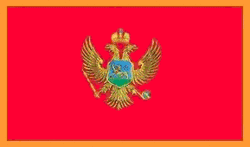 national flag (Flag of Montenegro)
 Montenegro country profile
 Travel advice for Montenegro
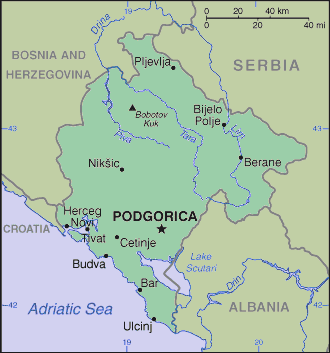 map
map