World index ... Europe ... Albania
Travelers word index

Albania

Continents
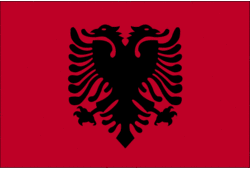
Albanian flag

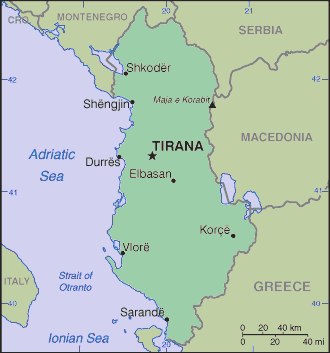
Albania is located in Southeastern Europe, bordering the Adriatic Sea and Ionian Sea, between Greece and Serbia and Montenegro.

Albania has borders with Greece for 282km, Montenegro for 172km and Macedonia for 151km.

Land in Albania is mostly mountains and hills; small plains along coast.

Albanian land covers an area of 28748 square kilometers which is slightly smaller than Maryland

As for the Albanian climate; mild temperate; cool, cloudy, wet winters; hot, clear, dry summers; interior is cooler and wetter.

Albanian(s) speak Albanian (official - derived from Tosk dialect), Greek, Vlach, Romani, Slavic dialects.

Albania country profile, Travel advice for Albania

Albanian Map
Places of note in Albania
Tirana
Durrës
Elbasan
Vlorë
Shkodër
(( Fier-Çifçi ))
Korçë
Berat
Lushnjë
Kavajë
Laç
Gjirokastër
Patos Fshat
Krujë
Lezhë
Kuçovë
Kukës
Burrel
Sarandë
Peshkopi
Cërrik
Shijak
Çorovodë
Librazhd-Qendër
Tepelenë
Gramsh
Bulqizë
Kamëz
Përmet
Poliçan
Fushë-Krujë
Ballsh
Rrëshen
Mamurras
Bajram Curri
Regions of Albania
Albania (general)
Berat
Dibër
Durrës
Elbasan
Fier
Gjirokastër
Korçë
Kukës
Lezhë
Shkodër
Tiranë
Vlorë

Between 1990 and 1992 Albania ended 46 years of xenophobic Communist rule and established a multiparty democracy. The transition has proven challenging as successive governments have tried to deal with high unemployment, widespread corruption, a dilapidated physical infrastructure, powerful organized crime networks, and combative political opponents. Albania has made progress in its democratic development since first holding multiparty elections in 1991, but deficiencies remain. International observers judged elections to be largely free and fair since the restoration of political stability following the collapse of pyramid schemes in 1997. In the 2005 general elections, the Democratic Party and its allies won a decisive victory on pledges of reducing crime and corruption, promoting economic growth, and decreasing the size of government. The election, and particularly the orderly transition of power, was considered an important step forward. Although Albania's economy continues to grow, the country is still one of the poorest in Europe, hampered by a large informal economy and an inadequate energy and transportation infrastructure. Albania has played a largely helpful role in managing inter-ethnic tensions in southeastern Europe, and is continuing to work toward joining NATO and the EU. Albania, with troops in Iraq and Afghanistan, has been a strong supporter of the global war on terrorism.

Country profile: Albania

Map of Albania With a landscape including rugged mountains and a lengthy stretch of Adriatic coastline, Albania is home to a rich blend of religions and cultures.

The origins of the Albanian people are shrouded in some mystery and their language is unique.

After World War II, Albania became a Stalinist state under Enver Hoxha, and remained staunchly isolationist until its transition to democracy after 1990.

The 1992 elections ended 47 years of communist rule, but the latter half of the decade saw a quick turnover of presidents and prime ministers.

Mosque, Tirana Many Albanians left the country in search of work; the money they send home remains an important source of revenue.

During the Nato bombing of Yugoslavia in 1999, nearly 500,000 ethnic Albanian refugees from Kosovo spilled over the border, imposing a huge burden on Albania's already fragile economy.

While there have been signs of economic progress with inflation under tighter control and some growth, the country remains one of the poorest in Europe. Unemployment is high and poverty widespread. The infrastructure is crumbling and corruption is a deterrent to foreign investment. Agriculture, an important sector, relies on antiquated equipment and old-fashioned methods.

In recognition of progress with political and economic reform in Albania, a Stabilisation and Association agreement with the EU was signed in June 2006 after three years of talks. The EU is keen to encourage further reform, particularly as regards stamping out organized crime and corruption and developing media freedom and property and minority rights.

President: Alfred Moisiu

Prime minister: Sali Berisha

The centre-right Democratic Party led by the former president, Sali Berisha, emerged as the winner of general elections held in July 2005.

Returned to power as premier in 2005 The vote was followed by wrangling over the count with re-runs demanded in a number of constituencies. It was nearly two months before the result was finally declared.

Although European monitors said the election had fallen short of democratic standards and it was followed by protracted bickering, there was relief when angry street protests, a feature of Albanian politics in the past, failed to materialise.

An erstwhile communist, Mr Berisha formed the Democratic Party in the early 1990s and in 1992 became Albania's first non-communist president since the second world war

His bid to liberalise the economy fast increased hardship for the majority. His presidency came to an end in 1997 when the collapse of fraudulent pyramid investment schemes led to violent unrest and anti-government street protests.

Mr Berisha promises to stamp out corruption, reduce taxation, attract greater foreign investment, develop the infrastructure and work for Albanian integration into the EU and Nato.

Known for his fiery rhetoric, he has faced accusations of authoritarianism in the past. In the run-up to the elections he sought to reassure critics by saying he had changed.

Mr Berisha was born in 1944 and is a former heart specialist.

  • Defence minister: Fatmir Mediu
  • Finance minister: Ridvan Bode
  • Foreign minister: Besnik Mustafaj

    The public broadcaster, Albanian Radio and TV (RTSh), operates national radio and TV networks. It faces competition from private stations, which have mushroomed since the late 1990s.

    Political parties, religious groups and state bodies are not allowed to own private TV and radio stations.

    Newspaper stall, Durres, Albania Many viewers can pick up Italian and Greek TV via terrestrial reception. Radio services in Albanian from the BBC, Deutsche Welle, Radio France Internationale, Radio Free Europe and the Voice of America are available on FM or mediumwave (AM).

    Sensationalism is often the norm in the print media. Political parties, trade unions and various societies publish their own newspapers; dependence on outside revenue tends to limit their objectivity.

    The press

  • Shekulli - daily
  • Gazeta Shqiptare - daily
  • Rilindja Demokratike - daily
  • Koha Ditore - daily
  • Korrieri - daily
  • Klan - news weekly
  • Zeri i Popullit - Socialist Party daily
  • Koha Jone - daily
  • Albanian Daily News - English-language news site

    Television

  • Albanian Radio and TV (RTSh) - public broadcaster, operates two networks
  • TV Klan - private network
  • TV Arberia (TVA) - private network

    Radio

  • Albanian Radio and TV (RTSh) - public broadcaster
  • Top Albania Radio - private
  • Radio Koha - private
  • Radio Kontakt - private
  • Radio Stinet - private
  • Radio +2 - private

    News agency

  • Albanian Telegraphic Agency (ATA)

    Lagging behind its Balkan neighbors, Albania is making the difficult transition to a more modern open-market economy. The government has taken measures to curb violent crime and to spur economic activity and trade. The economy is bolstered by annual remittances from abroad of $600-$800 million, mostly from Greece and Italy; this helps offset the towering trade deficit. Agriculture, which accounts for about one-quarter of GDP, is held back because of frequent drought and the need to modernize equipment, to clarify property rights, and to consolidate small plots of land. Energy shortages and antiquated and inadequate infrastructure contribute to Albania's poor business environment, which make it difficult to attract and sustain foreign investment. The planned construction of a new thermal power plant near Vlore and improved transmission and distribution facilities will help relieve the energy shortages. Also, the government is moving slowly to improve the poor national road and rail network, a long-standing barrier to sustained economic growth. On the positive side: growth was strong in 2003-05 and inflation is not a problem.

    Albanian natural resources include petroleum, natural gas, coal, bauxite, chromite, copper, iron ore, nickel, salt, timber, hydropower

    strategic location along Strait of Otranto (links Adriatic Sea to Ionian Sea and Mediterranean Sea)

    Albanian religion is Muslim 70%, Albanian Orthodox 20%, Roman Catholic 10%.

    Natural hazards in Albania include destructive earthquakes; tsunamis occur along southwestern coast; floods; drought.

    Travel Advice on Albania

    Albania

    This advice has been reviewed and reissued.  The overall level of the advice has not changed

    SUMMARY

    • We advise against all travel to the northeast border areas (i.e. the districts of Kukes, Has and Tropoje) between Albania and Kosovo because of the very poor condition of the roads and the risk of unexploded ordnance placed during the 1999 Kosovo crisis.

    • Although public security is generally good, particularly in Tirana, crime and violence still represent a serious problem in some areas.  Gun ownership is widespread.

    • Albania shares with the rest of Europe a threat from international terrorism.

    • You should be aware of the global risk of indiscriminate terrorist attacks, which could be against civilian targets, including places visited by foreigners.  Please read Security and General Tips and Risk of Terrorism when Travelling Overseas pages.

    • Around 16,000 British tourists visit Albania every year.  Most visits are trouble-free.  The main type of incident for which British nationals require consular assistance in Albania is for replacing lost or stolen passports.

    • We strongly recommend that you obtain comprehensive travel and medical insurance before travelling to Albania.  You should check any exclusions, and that your policy covers you for the activities you want to undertake.  Please see:  Travel Insurance


    SAFETY AND SECURITY

    Crime

    Public security is generally good, particularly in Tirana, and Albanians are very hospitable to visitors, but crime and violence still represent a serious problem in some areas.  In February 2006, a bus was hijacked near Rreshen (on the Tirana – Kukes route) resulting in the death of a passenger and a police officer.  Although there have been no recent reports of crime aimed at the expatriate community, you should be vigilant about personal security, dress modestly and not display expensive items such as watches and cameras.  Central Tirana is generally trouble-free.

    You should bear in mind the widespread ownership of firearms.

    Political Situation

    Albania Country Profile

    Local Travel

    We advise against all travel to the north east Border areas (i.e.  the districts of Kukes, Has and Tropoje) between Albania and Kosovo because of the very poor condition of the roads and the risk of unexploded ordnance placed near the border during the 1999 Kosovo crisis.  The areas around Tirana, Durres and Saranda are relatively trouble-free, but you should avoid travelling at night.

    Road Safety

    Driving can be very hazardous.  Roads are poor, especially (but not only) in rural areas.  In winter, mountain roads are snowy and icy.  During hot spells, the tarmac can melt and become slippery.  Flash flooding is possible throughout the year.  You should stay alert for large, unmarked potholes.  Street lighting in urban areas is subject to power cuts.  Elsewhere, except on the major inter-urban arterial routes, there is no street lighting, so night travel is best avoided.  We suggest using four-wheel drive vehicles in Albania.  There is no national recovery system, so cars should be self-sufficient, carrying minor repair equipment including jack, spare wheel, fan belts, wiper blades, local phrase book, first aid kit, water and overnight food when in remote areas.

    Drivers with foreign plated vehicles draw particular scrutiny from the Road Traffic Police.  You should adhere to road traffic law at all times as committing even minor offences may result in you being fined.

    Albanian driving can often be aggressive and erratic.  Minor traffic disputes can quickly escalate, especially as some motorists are likely to be armed.  If you intend to drive you are strongly advised to avoid reacting to provocative behaviour by other road users.  If you are involved in a traffic accident, even a minor one, you are required to wait until the police arrive.  This will usually happen quickly in built-up areas.

    You should expect queues at all border crossings, especially at weekends and during the summer months.

    Air Safety

    Security arrangements at Tirana’s Mother Teresa airport meet the required UK standards.  Direct flights now operate between the UK and Albania.

    Sea Safety
    Albania does not have a blue flag operator, and there is no recognised similar system of assessment of beaches.  However, several beaches along the Albanian coast are reported by the Albanian press to be polluted as a result of inadequate sewage disposal and treatment.


    LOCAL LAWS AND CUSTOMS

    Homosexuality is not illegal but is not yet accepted as a cultural norm.  We recommend discretion in relation to public displays of affection.
    Penalties for drug related crimes are severe.
    The Albanian authorities do not always inform the British Embassy when British nationals have been arrested.  If you are detained, you may insist on your right to contact a British Consular Officer.  Please see: What We Can Do To Help.


    ENTRY REQUIREMENTS

    British citizens are permitted to enter Albania for 30 days without a visa.  After that period, you must decide either to apply for a residence permit or leave the country.  If staying in Albania for more than 30 days, you should present yourself to your local police station 10 days before the expiry of the initial 30 days permit of stay.  The Albanian authorities require a UK police report, stating that you do not have a criminal record, to be submitted with the resident permit application form.  A family seeking to take up residence must additionally provide notarised birth and marriage certificates to the local police authorities.  British nationals working in Albania for charities, philanthropic and humanitarian organisations may be exempt from the residence permit fee.
    British passport holders are obliged to pay a 10 Euro entry tax.  The entry tax will be waived for holders of Albanian resident permits.
    Single parents or other adults travelling alone with children should be aware that some countries require documentary evidence of parental responsibility before allowing lone parents to enter the country or, in some cases, before permitting the children to leave the country.  For further information on exactly what will be required at immigration please contact:  Albanian representation in the UK


    HEALTH

    We strongly recommend that comprehensive travel and medical insurance is obtained before travelling to Albania, including evacuation by air ambulance.  You should check any exclusions, and that your policy covers you for the activities you want to undertake.  Please see Travel Insurance.  Medical facilities (including those for accident and emergency use) are very poor, particularly outside Tirana.  We do not recommend using the dental facilities.

    There are high levels of Hepatitis in Albania.  Rabies is also a matter of concern as there are large numbers of stray dogs, although the last reported case of the disease in Tirana was in 1978.
    Cases of tick borne encephalitis have been reported in the north of the country.  Vaccination is available but we advise that you keep all areas of your body covered when close to shrubs or bushes, and to inspect yourself regularly for ticks.

    Drink only bottled water and UHT milk.
    You should seek medical advice before travelling and ensure that all appropriate vaccinations are up to date.  For information on health, check the Department of Health’s website at:  www.dh.gov.uk.

    Avian Influenza (Bird Flu)

    In March 2006, the Albanian authorities confirmed outbreaks of Avian Influenza (Bird Flu) in domestic poultry in the village of Cuka near the Butrint Lagoon in south west Albania and in the village of Peze-Helmes, 14km from the capital Tirana. No human infections or deaths have been reported.

    The risk to humans from Avian Influenza is believed to be very low. As a precaution, you should avoid visiting live animal markets, poultry farms and other places where you may come into close contact with domestic, caged or wild birds; and ensure poultry and egg dishes are thoroughly cooked.

    You should read this advice in conjunction with Avian and Pandemic Influenza Factsheet, which gives more detailed advice and information.

    NATURAL DISASTERS

    Albania lies in a seismically active zone, and earth tremors are common.  Serious earthquakes are less frequent but do occur.


    GENERAL

    If things go wrong when overseas, please see:  What We Can Do To Help
    If you are visiting Albania for more than a couple of weeks, you should register with, or make your presence known to, the Consular Section of the British Embassy in Tirana.   On-line registration is available, this can be done by accessing the e-registration form in the Consular Information Section of the British Embassy’s website (see below).
    Major credit/debit cards are accepted in most banks and international hotels.  You may prefer to use cash as in the past foreigners have been victims of credit card fraud.  There are numerous ATM machines in Tirana and main towns, as well as bureaux de change where Sterling, US Dollars and Euros are widely accepted for exchange.  Although street money changers operate openly, they do so illegally.  We therefore advise you to only use banks or established bureaux de change.
    The British Embassy in Tirana does not have the facility to issue full passports.  You are advised to check the validity of your passport and, if necessary, to renew it before travelling to Albania.  You should ensure that you enter next of kin details in the back page of your passport. The Embassy can accept applications for new passports, which will be forwarded to the British Embassy in Rome for processing.  You should allow 4 to 6 weeks for receipt of the new passport.  If you lose a passport while in Albania, you must report this immediately to the police and obtain a police report.  The British Embassy does have the facility to issue you with an emergency travel document.


  • What is this world index all about?