World index ... Europe ... Greece
Travelers word index

Greece

Continents
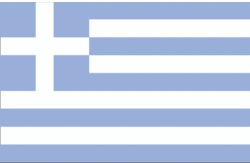
Greek flag

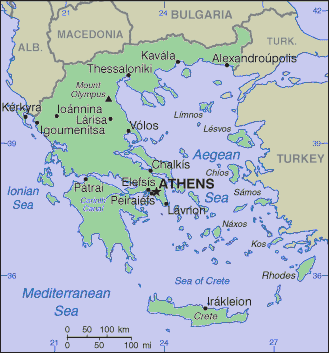
Greece is located in Southern Europe, bordering the Aegean Sea, Ionian Sea, and the Mediterranean Sea, between Albania and Turkey.

Greece has borders with Albania for 282km, Bulgaria for 494km, Macedonia for 246km and Turkey for 206km.
Land in Greece is mostly mountains with ranges extending into the sea as peninsulas or chains of islands.

Greek land covers an area of 131940 square kilometers which is slightly smaller than Alabama

As for the Greek climate; temperate; mild, wet winters; hot, dry summers.

Greek(s) speak Greek 99% (official), English, French.

Greece country profile, Travel advice for Greece

Greek Map
Places of note in Greece
Athens
Thessaloníki
Peiraiéfs
Pátrai
Peristérion
Irákleion
Lárisa
Kallithéa
Níkaia
Kalamariá
Vólos
Akharnaí
Néa Liósia
Keratsínion
Néa Smírni
Khalándrion
Aigáleo
Amaroúsion
Néa Ionía
Palaión Fáliron
Ioánnina
Víron
Ayía Paraskeví
Kavála
Galátsion
Ródos
Sérrai
Chaniá
Chalkís
Kateríni
Alexandroúpolis
Petroúpolis
Kalamáta
Tríkala
Xánthi
Regions of Greece
Achaḯa
Aitolía kai Akarnanía
Argolís
Arkadía
Árta
Attikí
Chalkidiki
Chaníon
Chíos
Dodekánisos
Dráma
Évros
Evrytanía
Évvoia
Flórina
Fokídos
Fthiótis
Greece (general)
Grevená
Ileía
Imathía
Ioánnina
Irákleion
Kardítsa
Kastoriá
Kavála
Kefallinía
Kérkyra
Kilkís
Korinthía
Kozáni
Kykládes
Lakonía
Lárisa
Lasíthi
Lefkás
Lésvos
Magnisía
Messinía
Pélla
Piería
Préveza
Rethýmnis
Rodópi
Sámos
Sérrai
Thesprotía
Thessaloníki
Tríkala
Voiotía
Xánthi
Zákynthos

Greece achieved independence from the Ottoman Empire in 1829. During the second half of the 19th century and the first half of the 20th century, it gradually added neighboring islands and territories, most with Greek-speaking populations. In World War II, Greece was first invaded by Italy (1940) and subsequently occupied by Germany (1941-44); fighting endured in a protracted civil war between supporters of the king and Communist rebels. Following the latter's defeat in 1949, Greece joined NATO in 1952. A military dictatorship, which in 1967 suspended many political liberties and forced the king to flee the country, lasted seven years. The 1974 democratic elections and a referendum created a parliamentary republic and abolished the monarchy. In 1981 Greece joined the EC (now the EU); it became the 12th member of the euro zone in 2001.

Country profile: Greece

Map of Greece

The historical and cultural heritage of Greece continues to resonate throughout the modern Western world - in its literature, art, philosophy and politics.

Situated in the far south of the Balkan peninsula, Greece combines the towering mountains of the mainland with over 1400 islands, the largest of which is Crete.

Post-World War II Greece has seen rapid economic and social change. Major contributors to the economy are tourism and shipping.

Greece has long been at odds with its close neighbour, Turkey, over territorial disputes in the Aegean and the divided island of Cyprus.

Relations warmed after both countries suffered earthquakes in 1999 and offered each other practical help. Although the disputes remain unresolved, the Greek government gives strong backing to Turkey's EU bid. It sees dividends to be gained from the increased regional stability that it believes membership would bring. The Parthenon in Athens

Greece has been in dispute since the early 1990s with the Former Yugoslav Republic of Macedonia. Greece contends that the use of the name Macedonia by the neighbouring country implies a territorial claim over Greece's own region of the same name. The UN is involved in continuing mediation efforts.

Athens stepped into the global spotlight when the Olympic Games returned home in 2004. The games were hailed as a success, despite widely publicised fears that the infrastructure would not be complete in time.

President: Karolos Papoulias

Prime minister: Costas Karamanlis

Greek PM and New Democracy leader

The Greek conservative New Democracy Party led by Costas Karamanlis took over the reins of government from the Pan Hellenic Socialist Movement (Pasok) following a convincing win in elections in early March 2004.

Pasok had been in government for over 10 years but was perceived in some quarters as ineffectual in improving living standards.

Mr Karamanlis is the nephew of former Greek President Constantine Karamanlis, who presided over the restoration of democracy in Greece after 1974. He has been party leader since 1996 and has no previous ministerial experience.

Since he came to power, high unemployment and rising inflation as well as government plans for pension and labour reforms have prompted industrial action.

At the same time, Mr Karamanlis is under pressure from Brussels to cut the budget deficit which is above the level permitted under the euro zone stability pact. Cutting the state bureaucracy and tackling corruption are other priority tasks

Mr Karamanlis was 47 at the time of his election. He is a lawyer by training.

  • Foreign minister: Dora Bakoyianni
  • Interior minister: Prokopis Pavlopoulos
  • Finance minister: Yeoryios Alogoskoufis

    State-run broadcasters enjoyed a near-monopoly in Greece until the late 1980s, when new commercial TV services quickly gained a lion's share of the audience. Public TV lost a large slice of its advertising revenue as a result.

    News, domestically-made variety programmes, comedies and game shows dominate the peak-time TV schedules.

    Broadcasting in Greece is relatively unregulated by European standards, and many of the country's approximately 1,700 private radio and TV stations are unlicensed. An attempt was made in 2001 to impose some order on the crowded FM dial in Athens, prompting a political row.

    The Greek media enjoy considerable freedom, although editors and publishers risk prosecution over material deemed offensive to the president or religious beliefs.

    The press

  • Eleftherotypia - evening daily
  • Ta Nea - evening daily
  • Kathimerini - morning daily, English-language pages
  • Athens News - English-language weekly

    Television

  • ERT - public, operates entertainment-based ET1, NET, regional and cultural channel ET3
  • Mega TV - major commercial station
  • Antenna TV - major commercial station
  • Alpha TV - major commercial station

    Radio

  • ERA - public, operates main network ERA1, entertainment station ERA2, cultural station ERA3, sport and music station ERA4, regional services, external service Voice of Greece
  • Antenna FM - commercial network
  • Athena 98,4 - municipal Athens station, one of the first non-state radios
  • Skai 100.3 - commercial network
  • Sfera 102.2 - commercial network

    News agencies

  • Athens News Agency
  • Netnews

    Greece has a capitalist economy with the public sector accounting for about 40% of GDP and with per capita GDP at least 75% of the leading euro-zone economies. Tourism provides 15% of GDP. Immigrants make up nearly one-fifth of the work force, mainly in menial jobs. Greece is a major beneficiary of EU aid, equal to about 3.3% of annual GDP. The Greek economy grew by about 4.0% for the between 2003 and 2005, largely because of an investment boom and infrastructure upgrades for the 2004 Athens Olympic Games. Economic growth slowed to about 3% in 2005. Greece has not met the EU's Growth and Stability Pact budget deficit criteria of 3% of GDP since 2000. Public debt, inflation, and unemployment are above the euro-zone average. To overcome these challenges, the Greek Government is expected to continue cutting government spending, reducing the size of the public sector, and reforming the labor and pension systems.

    Greek natural resources include lignite, petroleum, iron ore, bauxite, lead, zinc, nickel, magnesite, marble, salt, hydropower potential

    strategic location dominating the Aegean Sea and southern approach to Turkish Straits; a peninsular country, possessing an archipelago of about 2,000 islands

    Greek religion is Greek Orthodox 98%, Muslim 1.3%, other 0.7%.

    Natural hazards in Greece include severe earthquakes.

    Travel Advice on Greece

    Greece

    This advice has been reviewed and reissued with an amendment to the Summary and Terrorism section (Revolutionary Struggle).  The overall level of the advice has not changed.

    SUMMARY

    • On 12 January 2007, a self propelled explosive was fired at the US Embassy compound in central Athens from the surrounding area, causing minor damage to the front windows and the roof.  There were no casualties.  Greek anarcho-terrorist group ‘Revolutionary Struggle’ have claimed responsibility for the attack.  The British Embassy continues to take appropriate security precaution, and remains open for business as usual.

    • Around 3 million British people visit Greece every year.  Most visits are trouble-free.  The main type of incident for which British nationals require consular assistance in Greece is for replacing lost or stolen passports.

    • You should maintain high standards of public behaviour in Greece.  Greek courts impose heavy fines or prison sentences on people who behave indecently.

    • Greece shares with the rest of Europe a threat from terrorism.  Attacks could be indiscriminate and against civilian targets.  The Greek government has put in place measures to combat terrorism and has had notable success against the main Greek groups but a potential threat remains.

    • You should maintain at least the same level of personal security awareness in Greece as in the UK.

    • We strongly recommend that you obtain comprehensive travel and medical insurance before travelling.  You should check any exclusions, and that your policy covers you for the activities you want to undertake.  Please see: Travel Insurance.


    SAFETY AND SECURITY

    Crime
    Most visits to Greece are trouble-free, but you should be aware that the tourist season attracts an increase in incidents of theft of wallets, handbags etc. particularly in areas and events where crowds gather. You should leave valuables in safe custody at your hotel or apartment.
    Personal attacks, including sexual assaults and rape, are infrequent. However there have been incidents of sexual assault and rape on some Greek Islands.  The use of ‘date-rape’ drugs has also increased.  You are therefore advised to maintain at least the same level of personal security awareness as in the UK. We strongly advise lone visitors, in particular, never to accept lifts from strangers or passing acquaintances at any time.
    Political Situation

    Greece Country Profile.
    Greece is a stable democracy, however public protests are a standard feature of Greek political life.  You should take sensible precautions for your personal safety and avoid public gatherings and demonstrations, which have the potential to turn violent.
    Local Travel

    Generally there are no local travel restrictions, but you should be aware that certain areas near the Greek borders are militarily sensitive.  Although these areas can be visited without any problems, do not take photographs or make notes near military or official installations.  In addition, travellers should seek permission before photographing individuals.
    Road Safety
    Drivers should be extra cautious in view of the very high incidence of serious road traffic accidents in Greece.
    You are strongly advised not to hire motorcycles, scooters, mopeds or quad bikes, as accidents involving these forms of transport are common and can often result in very serious or even fatal injury. You should note that failure to wear a crash helmet might invalidate your travel insurance if you are involved in an accident.
    If you intend to hire a moped you should be aware that they would require a valid driving licence with at least category A1 - 'light motorcycle` for this purpose. Category P, which is valid in the UK for driving mopeds up to 50cc is not valid in Greece. Greek law requires you to wear a crash helmet on a scooter, moped or motorcycle.
    Quad bike riders require a full-face helmet (or non-full-face helmet plus goggles) under Greek law. Road insurance and a motorcycle licence are also mandatory.


    LOCAL LAWS AND CUSTOMS

    Greek people are renowned for their hospitality.  The Greek police are used to dealing with large numbers of foreign tourists, especially on the islands and do so in a low-key way.
    Indecent behaviour, including mooning, is not tolerated.  The police have made it clear that they will not hesitate to arrest those who do it.  You should be aware that the courts impose heavy fines or prison sentences on people who behave indecently.
    You should not become involved with drugs of any kind.  Possession of even small quantities can lead to long terms of imprisonment.
    Driving any vehicle whilst over the legal drinking limit is heavily penalised and can result in a heavy fine and/or imprisonment.
    If you are seeking employment in bars or night clubs in Greece, you are required to have a health certificate/licence issue by the local authorities.  Failure to have such a certificate is punishable by a fine and or imprisonment.
    In common with many countries there is a requirement in Greece to be able to identify yourself.  A passport or document with a photograph on it should be carried at all times.
    In order to comply with Greek law, you should ensure that you obtain a receipt for goods purchased.  If you purchase pirate CDs or DVDs in Greece you could be imprisoned.
    In 2005 there were an increased number of arrests and prosecutions of British nationals in Greece as a result of being in possession of an offensive weapon.  You should not purchase any offensive weapons whilst on holiday, this includes small-scale items such as knuckledusters or knives with a blade length of 10cm or above.


    ENTRY REQUIREMENTS

    Visas are not required to enter Greece. As a British passport holder you may stay as a visitor for three months. For longer stays, you will need to apply to the appropriate office for a residence permit.
    Non-EEA (European Economic Area) nationals travelling to Greece must have a passport valid for at least 3 months after the period of their intended stay or expiry date of their visa.
    Nationals of the EEA are exempt from the above regulation but must have a passport valid for the period of their intended stay.
    Single parents or other adults travelling alone with children should be aware that some countries require documentary evidence of parental responsibility before allowing lone parents to enter the country or, in some cases, before permitting the children to leave the country. For further information on exactly what will be required at immigration, please contact : Greek representation in the UK


    HEALTH

    The Greek National Health system provides a basic medical service to Greek nationals and it has a reciprocal agreement with the British National Health Service.

    The Form E111 is no longer valid. You should obtain a European Health Insurance Card (EHIC) before leaving the UK.  The EHIC is not a substitute for medical and travel insurance, but entitles you to emergency medical treatment on the same terms as Greek nationals.  You will not be covered for medical repatriation, on-going medical treatment or treatment of a non-urgent nature.  For more information about how to obtain the EHIC please see:  Europe and the EHIC.

    We strongly recommend that you obtain comprehensive travel and medical insurance before travelling.  You should check any exclusions, and that your policy covers you for the activities you want to undertake.  Please see:  Travel Insurance.

    There are many Public and Private Hospitals and Medical Centres in Greece, all of varying standards. Doctors and facilities are generally good on the mainland, but may be limited on the islands.  The standards of nursing and after care, particularly in the public health sector lag behind what is normally acceptable in the UK.  The Public Ambulance Service, which will normally respond to any accident, is rudimentary.  There are severe shortages of ambulances on some islands.

    You should seek medical advice before travelling and ensure that all appropriate vaccinations are up to date.  For further information on health, check the Department of Health’s website at:  www.dh.gov.uk.

    Avian Influenza (Bird Flu)
    The Greek government confirmed on 11 February 2006, that the H5N1 form of Avian Influenza had been found in swans in northern Greece.  The Greek government stresses, however, that urgent biosecurity measures have already been implemented in accordance with EU legislation. No human infections or deaths have been reported.
    The risk to humans from Avian Influenza is believed to be very low.  As a precaution you should avoid visiting live animal markets, poultry farms and other places where you may come into close contact with domestic, caged or wild birds; and ensure poultry and egg dishes are thoroughly cooked.

    You should read this advice in conjunction with Avian and Pandemic Influenza Factsheet, which gives more detailed advice and information.

    NATURAL DISASTERS

    Forest fires can occur in Greece during the summer months.  On 21 August 2006, a serous forest fire affected the Greek resort of Hanioti and nearby areas whilst there have also been other outbreaks, including Zakynthos and Laconia in southern Greece.  During especially hot and dry periods there is a danger that forest fires will become more frequent.  Please take care when visiting or driving through woodland areas; ensure that cigarette ends are properly extinguished, do not light barbecues and do not leave rubbish or empty bottles behind.

    Mainland Greece and most of the Greek islands popular with British tourists are in seismically active zones, and earth tremors are common.  Serious earthquakes are less frequent but do occur.


    GENERAL

    If things go wrong when overseas, please see: What We Can Do To Help.
    The revised EU-wide security measures that came into effect for all passengers departing from UK airports in November 2006 are also being implemented in Greece.  For more details about this please see:  DfT - Airline Security Update.

    Money

    You are reminded that the currency of Greece is the Euro.


  • What is this world index all about?