World index ... Europe ... Bulgaria
Travelers word index

Bulgaria

Continents
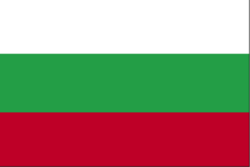
Bulgarian flag

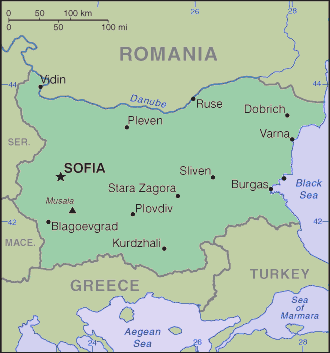
Bulgaria is located in Southeastern Europe, bordering the Black Sea, between Romania and Turkey.

Bulgaria has borders with Greece for 494km, Macedonia for 148km, Romania for 608km and Turkey for 240km.
Land in Bulgaria is mostly mountains with lowlands in north and southeast.

Bulgarian land covers an area of 110910 square kilometers which is slightly larger than Tennessee

As for the Bulgarian climate; temperate; cold, damp winters; hot, dry summers.

Bulgarian(s) speak Bulgarian 84.5%, Turkish 9.6%, Roma 4.1%, other and unspecified 1.8% (2001 census).

Bulgaria country profile, Travel advice for Bulgaria

Bulgarian Map
Places of note in Bulgaria
Sofia
Plovdiv
Varna
Burgas
Ruse
Stara Zagora
Pleven
Sliven
Dobrich
Shumen
Pernik
Yambol
Khaskovo
Pazardzhik
Blagoevgrad
Veliko Tŭrnovo
Vratsa
Tonchevtsi
Vidin
Asenovgrad
Kyustendil
Montana
Dimitrovgrad
Lovech
Silistra
Razgrad
Tŭrgovishte
Dupnitsa
Svishtov
Smolyan
Petrich
Samokov
Lom
Sandanski
Sevlievo
Regions of Bulgaria
Blagoevgrad
(BU29)
(BU30)
(BU31)
(BU32)
(BU33)
(BU34)
(BU35)
(BU36)
(BU37)
Bulgaria (general)
Burgas
Dobrich
Gabrovo
Khaskovo
Kŭrdzhali
Kyustendil
Lovech
Montana
Pazardzhit
Pernik
Pleven
Plovdiv
Razgrad
Ruse
Shumen
Silistra
Sliven
Smolyan
Sofiya
Sofiya-Grad
Stara Zagora
Tŭrgovishte
Varna
Veliko Tŭrnovo
Vidin
Vratsa
Yambol

The Bulgars, a Central Asian Turkic tribe, merged with the local Slavic inhabitants in the late 7th century to form the first Bulgarian state. In succeeding centuries, Bulgaria struggled with the Byzantine Empire to assert its place in the Balkans, but by the end of the 14th century the country was overrun by the Ottoman Turks. Northern Bulgaria attained autonomy in 1878 and all of Bulgaria became independent from the Ottoman Empire in 1908. Having fought on the losing side in both World Wars, Bulgaria fell within the Soviet sphere of influence and became a People's Republic in 1946. Communist domination ended in 1990, when Bulgaria held its first multiparty election since World War II and began the contentious process of moving toward political democracy and a market economy while combating inflation, unemployment, corruption, and crime. Today, reforms and democratization keep Bulgaria on a path toward eventual integration into the EU. The country joined NATO in 2004.

Country profile: Bulgaria

Map of BulgariaA Balkan country with spectacular mountains and a coastline on the Black Sea, Bulgaria was part of the Ottoman empire for around 500 years, although the Orthodox tradition remained strong. Bulgarian is a Slavic language.

After the second world war the country was a satellite of the Soviet Union for nearly half a century. It celebrated success in its bid for integration into western alliances when it became a Nato member in March 2004.

Its transition to democracy and a market economy after the collapse of communism has not been easy.

Rila monastery, south-west Bulgaria Throughout the first half of the 1990s, Bulgaria was wracked by political instability and strikes. The former communists remained a powerful influence. Although the end of the decade was more stable, there was little tangible progress with economic reform.

Under Bulgaria's former king, Simeon II, who was prime minister between 2001 and 2005, the country pressed ahead with market reforms designed to meet EU economic targets. The country achieved growth, saw unemployment fall from highs of nearly 20% and inflation come under control but incomes and living standards remained low.

Bulgaria was not among the countries invited to join the EU in 2004. However, it signed an EU accession treaty in April 2005 in preparation for joining in January 2007.

EU officials set tough entry requirements, reflecting their concerns about corruption and organised crime.

An area of friction has been the Kozloduy nuclear power plant which supplies around half of Bulgaria's electricity and earns millions of dollars for the country from electricity exports.

Under pressure from the EU, the Bulgarians agreed to shut the two oldest reactors at the end of 2002. Despite Bulgarian insistence that extensive safety improvements have been introduced in recent years, Brussels also wants two of the remaining four reactors to close.

President: Georgi Parvanov

Georgi Parvanov won a second five-year term with a landslide victory in October 2006. He beat nationalist Volen Siderov, who opposed the country's European Union entry in 2007.

Bulgaria's presidents are elected to five-year terms. Although the president is head of the armed forces, the role is largely ceremonial. Legislative power is exercised by the prime minister and parliament.

Prime minister: Sergei Stanishev

Bulgaria's main parties agreed in August 2005 to form a coalition, ending weeks of post-election deadlock.

Bulgarian PM

The Socialist Party led by Sergei Stanishev entered into government with the liberal Movement for Simeon II (NMS). The mostly ethnic Turkish Movement for Rights and Freedoms (MRF) is also part of the coalition.

The Socialists won the biggest number of seats in parliament in the June poll, but not enough to form a government on their own. The NMS, which led the former coalition, came second and the MRF third.

In the political manoeuvring that followed, the main parties blocked each other's attempts to form a government. As negotiations dragged on, the EU urged a rapid resolution of the situation in order to progress reforms required for accession in 2007.

Mr Stanishev has said that EU membership is his government's top priority and pledged to make up for lost time. He promises to intensify the campaign against corruption and organised crime although his government has faced criticism for failing to make sufficient progress.

Mr Stanishev's predecessor, former king Simeon Saxe-Coburg-Gotha, had been the first ex-monarch in post-communist eastern Europe to return to power.

  • Foreign minister: Ivailo Kalfin
  • Finance minister: Plamen Oresharski

    Bulgaria was one of the last east European countries to pass a broadcasting law. The 1996 legislation gave public broadcaster status to state-owned radio and TV.

    In 2000 Balkan News Corporation - part of Rupert Murdoch's News Corporation - launched bTV, Bulgaria's first national commercial channel. In 2003 Nova TV was awarded the second national commercial TV licence.

    There are several private regional TV channels and, by 2004, more than 130 radio stations were licensed.

    Freedom of the press is guaranteed under the constitution.

    The press

  • Dnevnik - daily, English-language pages
  • 24 Chasa - daily
  • Trud - daily
  • Novinar - daily
  • Monitor - daily
  • Standart - daily, English-language pages
  • Pari - business daily
  • Kapital - political, economic weekly
  • The Sofia Echo - English-language

    Television

  • BNT (Bulgarian National Television) - public, operates Kanal 1 and satellite channel TV Bulgaria
  • bTV - private, national
  • Nova TV - private, national
  • 7 Dni - private

    Radio

  • BNR (Bulgarian National Radio) - public, operates flagship network Horizont, cultural network Hristo Botev, external service Radio Bulgaria
  • Darik Radio - private, national

    News agency/internet

  • Bulgarian News Agency (BTA) - English-language pages
  • Novinite - English-language news site
  • Mediapool - news site
  • Focus - online news site, English-language pages

    Bulgaria, a former communist country striving to enter the European Union, has experienced macroeconomic stability and strong growth since a major economic downturn in 1996 led to the fall of the then socialist government. As a result, the government became committed to economic reform and responsible fiscal planning. Minerals, including coal, copper, and zinc, play an important role in industry. In 1997, macroeconomic stability was reinforced by the imposition of a fixed exchange rate of the lev against the German D-mark and the negotiation of an IMF standby agreement. Low inflation and steady progress on structural reforms improved the business environment; Bulgaria has averaged 4% growth since 2000 and has begun to attract significant amounts of foreign direct investment. Corruption in the public administration, a weak judiciary, and the presence of organized crime remain the largest challenges for Bulgaria.

    Bulgarian natural resources include bauxite, copper, lead, zinc, coal, timber, arable land

    strategic location near Turkish Straits; controls key land routes from Europe to Middle East and Asia

    Bulgarian religion is Bulgarian Orthodox 82.6%, Muslim 12.2%, other Christian 1.2%, other 4% (2001 census).

    Natural hazards in Bulgaria include earthquakes, landslides.

    Travel Advice on Bulgaria

    Bulgaria

    This advice has been reviewed and reissued with amendments to the Health section.  The overall level of the advice has not changed.

    SUMMARY

    • Bulgaria shares with the rest of Europe a threat from international terrorism.  Attacks could be indiscriminate and against civilian targets.

    • The main types of incident for which British nationals require consular assistance in Bulgaria are for involve petty crime, replacing lost or stolen passports and car theft.  You should be aware of young pickpockets in city centres especially in crowded areas e.g. buses, trains and busy streets.  Keep valuable belongings in a hotel safe where possible.

    • British citizens holding valid passports can enter Bulgaria for up to three months without requiring a visa.  However, we area aware of cases where individuals entering Bulgaria without a visa on “British subject” passports being refused entry.  If you are in any doubt you should contact the Bulgarian Embassy in London before you travel.  Please see the Entry Requirements section of this travel advice for more details.

    • You should carry a copy of the information pages of your passport at all times as proof of identity.

    • We strongly recommend that you obtain comprehensive travel and medical insurance before travelling.  You should check any exclusions, and that your policy covers you for the activities you want to undertake.  Please see: Travel Insurance.


    SAFETY AND SECURITY

    Crime
    Organised criminal groups are active in casinos, nightclubs, prostitution and elsewhere.  Serious crime is rare and people unconnected with these groups have not been targeted, although there is obviously a risk of accidental injury from such incidents.  You should beware of groups of young pickpockets (often children) in city centres, especially busy shopping areas and underpasses.  Thieves and pickpockets also target holidaymakers at Black Sea coastal resorts.  You should leave passports and other valuables in a hotel safe or other secure place.  (You are strongly advised, however, to carry a copy of the information pages of your passport as proof of identity).
    Please be aware that many local authority officials and police officers do not speak English.

    Political Situation

    Country Profile: Bulgaria.

    Local travel
    Most cities and larger towns have cheap and extensive public transport.  There are regular bus services between most major towns in the country.  There are several car-hire companies, including Hertz and Avis.  It is possible to fly between Sofia and the two major towns on the Black Sea coast, Varna and Bourgas.  If travelling on a domestic air flight, you should have your passport ready for inspection.
    Taxis are plentiful and cheap by UK standards, although vehicles may not be in very good condition.  Most taxis are metered and the yellow taxis are generally considered reliable.
    Rail Safety
    If travelling by train, you should check with operators on the availability of sleeping compartments and whether bicycles can be taken on board.  This may vary between regions, and there may be additional charges.  Thieves operate on trains, so take particular care that documents and other valuables are safe.  The train system is very poor by European standards and most Bulgarians prefer to travel by inter-city buses, which are frequent, relatively fast and comfortable.
    Road Safety

    If you enter Bulgaria in a private vehicle, you must have your driving licence, all original registration and ownership documents (including logbook) as well as evidence of insurance valid in Bulgaria.  If you have hired a car you must have the original contract document, which should state that the vehicle can be brought into Bulgaria.  Border officials will impound your vehicle if they are not satisfied that you won it or have permission to use it in Bulgaria.

    Since January 2005, tolls have been charged on motorways and main rods out of town.  These are payable in Euros.  The rate for cars is currently five Euros for a one-week vignette and 12 Euros for one month.  Rates are much higher for freight vehicles and coaches for eight or more passengers.  Vignettes can be purchased at ports and border points, and are also available for post offices and DZI bank offices.  You will be fined if you do not carry the appropriate vignette.

    If your vehicle is stolen while you are in Bulgaria, you will be considered liable for import duty and related taxes.  If you cannot pay, you will have to sign a declaration on departure confirming that you will pay the due amount.  We strongly recommend that, if possible, you take out insurance to cover this.

    Take care when driving, particularly at night.  Many roads are in poor condition and road works are often unlit or unmarked.  Driving standards are generally poor.  Avoid confrontations with aggressive drivers who may be armed.  You should observe the speed limit and ensure that your vehicle is roadworthy.  Spot fines are charged for minor violations. 

    Some criminals are reported to impersonate traffic policemen to flag vehicles down on major routes, especially near international border crossings.  If you are crossing Bulgaria by car, you should try to travel in daylight hours.


    LOCAL LAWS AND CUSTOMS

    Currency regulations are strict.  If you enter Bulgaria with cash of any currency amounting to the equivalent of Leva 8000 or more, you must declare it to customs officials (ie the red channel at the port of entry).  If you do not, the money will be confiscated, and you may possibly be detained and charged.

    The Bulgarian authorities treat all drug-related (including possession) and or sex offences very seriously (the age of consent is 16).  Custodial sentences can be expected for any foreigners convicted of such offences.  Offences relating to drunken, disorderly behaviour and hooliganism may also be treated more seriously than in the UK.

    Homosexuality is no longer illegal, but Bulgarians tend not to be very open about the subject and the gay community generally keeps a low profile.  There are a few gay bars and clubs in Sofia and, to a lesser extent, in other major towns in Bulgaria.

    Be careful if you are taking photographs in security-sensitive areas such as airports.  If in doubt, ask permission.


    ENTRY REQUIREMENTS

    British citizens holding valid passports can enter Bulgaria for up three months, and have the right to stay longer if exercising an EU Treaty right, although you will need to register with the police.  Prior to travelling you should ensure that your passport has a validity of three months beyond the end of your intended stay.  Damaged passports will not be accepted. 

    Please note that British subjects, e.g. of Irish descent and born before 1 January 1949, must obtain a visa from the Bulgarian Embassy in London prior to any visit to Bulgaria.  Failure to do so will mean that you will be refused entry.  If your passport classifies you as anything other than a British citizen you should contact the Bulgarian Embassy in London before you travel to see if you need a visa.
    If you wish to visit for longer than three months, and/or reside in Bulgaria on a more permanent basis exercising an EU Treaty right ((for example as a worker, student, self-employed person or self-sufficient), you will need to register with the police and get the appropriate permit.  Dual nationals of Bulgaria and any other country should enter and exit Bulgaria on their Bulgarian passports.  It is always advisable to carry your Bulgarian travel document with you as well as that of your second nationality.
    All children entering Bulgaria will need to have their own passport.  Children included in parents' passports will only be allowed in if the passport also contains their photograph.  Single parents or other adults travelling alone with children should be aware that some countries require documentary evidence of parental responsibility before allowing lone parents to enter the country or, in some cases, before permitting children to leave the country.  For further information on exactly what will be required please contact Bulgarian representation in the UK.


    HEALTH

    We strongly recommend that you take out comprehensive travel and medical insurance to cover the full period you will be in the country, and which includes medivac to the UK if necessary.  (You should be aware, however, that most insurance companies will not authorise medivac to the UK as a matter of routine, or because local hospitals are not up to UK standards.)  You should check any exclusions, and that your policy covers you for the activities you want to undertake.   Please see: Travel Insurance.
    The Form E111 is no longer valid.  You should obtain a European Health Insurance Card (EHIC) before leaving the UK.  The EHIC is not a substitute for medical and travel insurance, but entitles you to any medical treatment that becomes necessary on the same terms as Bulgarian nationals.  You will not be covered for medical repatriation, on-going medical treatment or treatment of a non-urgent nature.  For more information about how to obtain the EHIC please see Europe and the EHIC.
    Facilities in most Bulgarian hospitals are basic and old-fashioned compared to those in the UK.  Standards of medical care are acceptable, although specialised equipment/treatment may not be available, and hospital staff may not speak English.
    You should seek medical advice before travelling and ensure that all appropriate vaccinations are up to date.  For further information on health, check the Department of Health’s website at:  www.dh.gov.uk

    Avian Influenza (Bird Flu)

    There was a confirmed case H5N1 Avian Influenza in wild birds in the Vidin area in the north-western region of Bulgaria in the summer of 2006.  No human infections or deaths have been reported.
    The risk from Avian Influenza is believed to be very low.   As a precaution, you should avoid visiting live animal markets, poultry farms and other places where you may come into close contact with domestic, caged or wild birds; and ensure poultry and egg dishes are thoroughly cooked.

    You should read this advice in conjunction with the FCO’s Avian and Pandemic Influenza Factsheet, which gives more detailed advice and information.

    NATURAL DISASTERS

    Bulgaria regularly experiences earth tremors.   These are normally relatively minor (up to 4.5 on the Richter Scale) and do not have any major impact on the country


    GENERAL

    If things go wrong when overseas, please see: What We Can Do To Help.
    The British Embassy in Sofia does not issue full passports.  Before setting off, you should ensure that your passport has sufficient validity and a plentiful supply of unused pages.  Applications for new passports are accepted in Sofia for forwarding to the British Embassy in Vienna for processing, but this may take up to six weeks.  If a courier is used, the cost will have to be borne by the applicant.  If you lose your passport, the British Embassy can issue a temporary/emergency passport to enable your return to the UK.  You should keep a photocopy of your passport with you at all times.
     
    Money

    You can buy Leva from banks and foreign exchange offices in the UK.  There are many exchange bureaux in Bulgaria that normally exchange all major currencies.  However, check the rates of exchange before making a transaction where possible, you should change money in banks or in large hotels.  If you have travellers’ cheques you may need to go to a bank anyway.  You should also be aware that Scottish and Northern Irish bank notes/coins may not be exchanged in banks and bureaux de changes.
    There is now a large network of ATMs that accept standard international credit and debit cards.  Check with your UK bank/card provider whether you will be able to use these machines to draw Leva.
    Bulgaria is still largely a cash economy.  Credit cards are not yet very widely accepted, though they may be used in major hotels and, increasingly, in restaurants and retail outlets.


  • What is this world index all about?