
 Search
Traveling Luck for Austria. Austria, Europe
Austria is located in Central Europe, north of Italy and Slovenia.
Land in Austria is in the west and south mostly mountains (Alps); along the eastern and northern margins mostly flat or gently sloping.
Austrian land covers an area of 83870 square kilometers which is slightly smaller than Maine
Austria has borders with Switzerland for 164km, Czech Republic for 362km, Germany for 784km, Hungary for 366km, Italy for 430km, Liechtenstein for 35km, Slovenia for 330km and Slovakia for 91km.
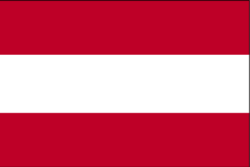 Austrian national flag (Flag of Austria)
 Austria country profile
 Travel advice for Austria
As for the Austrian climate; temperate; continental, cloudy; cold winters with frequent rain and some snow in lowlands and snow in mountains; moderate summers with occasional showers.
Austrian(s) speak German (official nationwide), Slovene (official in Carinthia), Croatian (official in Burgenland), Hungarian (official in Burgenland).
Places of note in Austria
- Vienna
- Graz
- Linz
- Salzburg
- Innsbruck
- Klagenfurt
- Villach
- Wels
- Sankt Pölten
- Dornbirn
- Steyr
- Wiener Neustadt
- Feldkirch
- Bregenz
- Wolfsberg
- Baden
- Leoben
- Weinzierl bei Krems
- Traun
- Amstetten
- Leonding
- Kapfenberg
- Mödling
- Lustenau
- Hallein
- Braunau am Inn
- Spittal an der Drau
- Traiskirchen
- Saalfelden am Steinernen Meer
- Kufstein
- Schwechat
- Ternitz
- Ansfelden
- Stockerau
- Feldkirchen in Kärnten
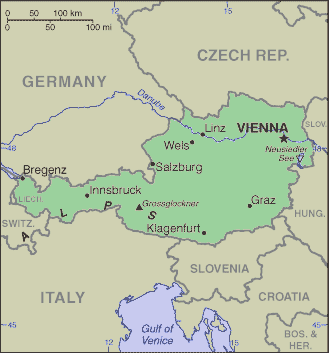 Austrian map
Regions of Austria
Once the center of power for the large Austro-Hungarian Empire, Austria was reduced to a small republic after its defeat in World War I. Following annexation by Nazi Germany in 1938 and subsequent occupation by the victorious Allies in 1945, Austria's status remained unclear for a decade. A State Treaty signed in 1955 ended the occupation, recognized Austria's independence, and forbade unification with Germany. A constitutional law that same year declared the country's "perpetual neutrality" as a condition for Soviet military withdrawal. Following the Soviet Union's collapse in 1991 and Austria's entry into the European Union in 1995, some Austrians have called into question this neutrality. A prosperous, democratic country, Austria entered the Economic and Monetary Union in 1999.
Austria, with its well-developed market economy and high standard of living, is closely tied to other EU economies, especially Germany's. The Austrian economy also benefits greatly from strong commercial relations, especially in the banking and insurance sectors, with central, eastern, and southeastern Europe. The economy features a large service sector, a sound industrial sector, and a small, but highly developed agricultural sector. Membership in the EU has drawn an influx of foreign investors attracted by Austria's access to the single European market and proximity to the new EU economies. The current government has successfully pursued a comprehensive economic reform program, aimed at streamlining government, creating a more competitive business environment, further strengthening Austria's attractiveness as an investment location, pursuing a balanced budget, and implementing effective pension reforms. Weak domestic consumption and slow growth in Europe have held the economy to growth rates of 0.4% in 2002, 1.4% in 2003, 2.4% in 2004, and 1.8% in 2005. To meet increased competition from both EU and Central European countries, particularly the new EU members, Austria will need to continue restructuring, emphasizing knowledge-based sectors of the economy, and encouraging greater labor flexibility and greater labor participation by its aging population.
Austrian natural resources include oil, coal, lignite, timber, iron ore, copper, zinc, antimony, magnesite, tungsten, graphite, salt, hydropower
landlocked; strategic location at the crossroads of central Europe with many easily traversable Alpine passes and valleys; major river is the Danube; population is concentrated on eastern lowlands because of steep slopes, poor soils, and low temperatures elsewhere
Austrian religion is Roman Catholic 73.6%, Protestant 4.7%, Muslim 4.2%, other 3.5%, unspecified 2%, none 12% (2001 census).
Natural hazards in Austria include landslides; avalanches; earthquakes.
Travel Advice for Austria
AustriaSUMMARY
- Austria shares with the rest of Europe a threat from international terrorism. Attacks could be indiscriminate and against civilian targets.
- There are complex driving laws in Austria, especially for caravan and motor home owners. It is compulsory that cars are driven with headlights switched on throughout the day all year round. This regulation applies to all roads including city/towns and all drivers are required to have a warning vest. Please see "Road Safety" section of this travel advice for more details.
- If you intend to ski you should be aware that during and around the winter season there is continued danger of avalanches in some areas of Austria – this has increased particularly in the Southern Alps, due to the recent large amount of snow which has fallen. You should take advice on weather and local avalanche conditions before you travel and throughout your visit. Please see the Skiing section of this travel advice for more details.
- Around 750,000 British nationals visit Austria each year. Most visits are trouble-free. The main types of incident for which British nationals require consular assistance in Austria are skiing and road accidents (22 and five cases respectively in 2005). There are also dozens of cases of British nationals who need assistance after the loss or theft of their passport.
- We strongly recommend that you obtain comprehensive travel and medical insurance before travelling to Austria. You should check any exclusions, and that your policy covers you for the activities you want to undertake. Please see the: Travel Insurance.
SAFETY AND SECURITY
You should take normal, common sense precautions to avoid becoming a victim of crime. Do not leave valuables unattended. Be aware that pickpockets and muggers operate in and around the city centre of Vienna, including restaurants, cafes, hotel lobbies and on public transport. You should be especially vigilant around major railway stations and city centre parks after dark.
Political Situation
Austria Country Profile
Road Safety
Only persons over 18 years of age holding valid driving licences may drive in Austria. When driving in Austria, you should always carry a full British licence, ownership documents and insurance details. Warning vests are required for all drivers and must be worn day or night when exiting the vehicle on the hard shoulder or in the event of breakdown. Only "hands free" mobile telephones can be used whilst driving.
It is compulsory that cars are driven with headlights switched on throughout the day all year round. This regulation applies to all roads including city/towns.
If you use Austrian motorways and "S" roads you must display a Motorway Vignette on your vehicle as you enter Austria. Failure to have one will mean a heavy, on-the-spot fine. Motorway Vignettes are obtainable at all major border crossings into Austria and at larger petrol stations.
All vehicles above 3.5 tonnes maximum permitted laden weight and using the Austrian network of motorways and expressways are required to attach a small device - called the “GO-Box” - to their windscreen. Note that this includes larger private vehicles such as motor caravans that are above the weight limit. If your vehicle is close to the weight limit you are advised to carry documentation confirming the maximum permitted laden weight. If your registration documents do not clearly state this, you will need to produce alternative certification e.g. from a weighbridge.
The GO-Box uses the high frequency range to communicate with the around 400 fixed-installation toll points covering the whole of Austria, making it possible to effect an automatic toll deduction without slowing down or stopping the flow of traffic. The on-board devices can be obtained for a one-off handling fee of Euro 5.00 at approximately 220 sales centres in Austria and in neighbouring countries, or via the Internet. For further information, visit the website at: http://www.go-maut.at.
There is a ban on all lorries over 7.5 tonnes laden weight (without trailer) or over 3.5 tonnes (with trailer) which applies throughout the year on all motorways on Saturdays between 15:00 hours and 24:00 hours and all day on Sundays and Public Holidays. Lorries over 7.5 tonnes laden weight are also prohibited from using motorways throughout the year between 22:00 hours and 05:00 hours. There is a ban on lorries over 7.5 tonnes laden weight overtaking on several motorways. Drivers should look out for special prohibiting signs.
The Transport Ministry and ASFINAG (the semi-privatised motorway operator) are continuing to carry out stringent checks on HGVs. It is therefore vital that such vehicles are roadworthy, and are correctly documented. Vehicles found to have defects have been impounded until the completion of necessary repairs.
LOCAL LAWS AND CUSTOMS
ENTRY REQUIREMENTS
HEALTH
Avian Influenza (Bird Flu)
In early 2006, the Austrian authorities confirmed that a number of wildfowl found dead in Austria were infected with the H5N1 strain of Avian Influenza. No human infections or deaths have been reported.
The risk to humans from Avian Influenza is believed to be very low. As a precaution you should avoid visiting live animal markets, poultry farms and other places where you may come into close contact with domestic, caged or wild birds; and ensure poultry and egg dishes are thoroughly cooked.
You should read this advice in conjunction with the FCO’s Avian and Pandemic Influenza Factsheet, which gives more detailed information and advice.
GENERAL