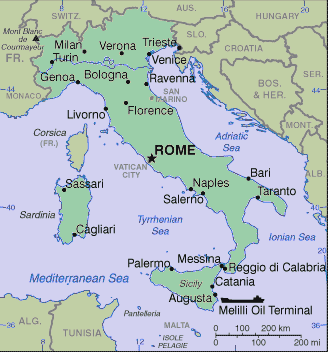
Italy is located in Southern Europe, a peninsula extending into the central Mediterranean Sea, northeast of Tunisia.
Land in Italy is mostly rugged and mountainous; some plains, coastal lowlands.
Italian land covers an area of 301230 square kilometers which is slightly larger than Arizona
As for the Italian climate; predominantly Mediterranean; Alpine in far north; hot, dry in south.
Italian(s) speak Italian (official), German (parts of Trentino-Alto Adige region are predominantly German speaking), French (small French-speaking minority in Valle d'Aosta region), Slovene (Slovene-speaking minority in the Trieste-Gorizia area).
Italy became a nation-state in 1861 when the regional states of the peninsula, along with Sardinia and Sicily, were united under King Victor EMMANUEL II. An era of parliamentary government came to a close in the early 1920s when Benito MUSSOLINI established a Fascist dictatorship. His disastrous alliance with Nazi Germany led to Italy's defeat in World War II. A democratic republic replaced the monarchy in 1946 and economic revival followed. Italy was a charter member of NATO and the European Economic Community (EEC). It has been at the forefront of European economic and political unification, joining the Economic and Monetary Union in 1999. Persistent problems include illegal immigration, organized crime, corruption, high unemployment, sluggish economic growth, and the low incomes and technical standards of southern Italy compared with the prosperous north.
Country profile: Italy
Take the art works of Botticelli, Leonardo da Vinci, Michelangelo, Tintoretto and Caravaggio, the operas of Verdi and Puccini, the cinema of Federico Fellini, add the architecture of Venice, Florence and Rome and you have just a fraction of Italy's treasures from over the centuries.
While the country is renowned for these and other delights, it is also notorious for its precarious political life and has had several dozen governments since the end of World War II.
The Italian political landscape underwent a seismic shift in the 1990s when the "Clean Hands" operation exposed corruption at the highest levels of politics and big business. Several former prime ministers were implicated and thousands of businessmen and politicians were investigated.

Italy was one of the six countries which signed the 1951 Paris Treaty setting Europe off on the path to integration. It has been staunchly at the heart of Europe ever since, although watchful eyes fell on the influence of right-wing eurosceptics in the former government of Silvio Berlusconi.
Mr Berlusconi voiced support for Washington and London in the build-up to the US-led campaign in Iraq. There has been mounting public controversy over Italy's continuing deployment there. The current prime minister, Romano Prodi, strongly opposed the invasion and has pledged that Italian troops will be withdrawn.
The Italian economy has been facing increasing difficulties. It has proved difficult to keep the budget deficit down, growth is low, inflation is rising and plans for pension reform and public spending cuts have given rise to protest.
There is concern over the country's birth rate - the lowest in Europe. With the population forecast to fall by nearly a third over the next 50 years, the late Pope, John Paul II, instructed Italians to "rediscover the culture of life and love and... their mission as parents".
- Full name: Italian Republic
- Population: 57.2 million (UN, 2005)
- Capital: Rome
- Area: 301,338 sq km (116,346 sq miles)
- Major language: Italian
- Major religion: Christianity
- Life expectancy: 77 years (men), 83 years (women) (UN)
- Monetary unit: 1 euro = 100 cents
- Main exports: Machinery and transport equipment, chemicals, clothes, wine
- GNI per capita: US $30,010 (World Bank, 2006)
- Internet domain: .it
- International dialling code: +39
President: Giorgio Napolitano
Giorgio Napolitano, a former Communist Party member, was sworn in as Italy's 11th post-war president in May 2006.
The Italian president heads the armed forces and has powers to veto legislation, disband parliament and call elections.
Prime minister: Romano Prodi

Opposition leader and former prime minister Romano Prodi won closely-fought general elections in April 2006. His broad-based leftist Union bloc gained a wafer-thin majority in the lower house of parliament and won just enough seats to control the Senate, the upper house.
The defeated prime minister, Silvio Berlusconi, disputed the result but Italy's appeals court confirmed that Mr Prodi had won a majority of seats in both houses - just.
The new government's top priority is to tackle Italy's economic woes. Mr Prodi promises that his government will reduce the budget deficit, cut bureaucracy and increase competition.
Coalition unity will be crucial to its work. Disagreements in the leftist coalition brought down the last government led by Mr Prodi in 1998 after two years in office.
His government was given a boost just weeks after coming to power when a national referendum rejected constitutional reforms proposed by the former government of Silvio Berlusconi. Mr Prodi had campaigned strongly against the proposals.
Once president of the European Commission, Mr Prodi, known as The Professor, is an economist and former academic. He is noted for the quietness of his style which is in sharp contrast to that of his predecessor.
He was born in 1939.
Foreign minister: Massimo D'Alema
Economy minister: Tommaso Padoa Schioppa
Interior minister: Giuliano Amato
Defence minister: Arturo Parisi
Italy's heady blend of politics and media has made headlines inside and outside the country, with watchdogs and some politicians pointing to former Prime Minister Berlusconi's influence over both public and private broadcasting.
The public broadcaster, Rai, has traditionally been subject to political influence, and Mr Berlusconi's Mediaset empire operates Italy's top private TV stations.
The Berlusconi family has a major stake in TV giant Mediaset
2006: Prodi vows to overhaul 'awful TV'
Between them, Rai and Mediaset effectively control Italy's TV market and are a potentially powerful political tool.
A media law, passed in 2004, heralded the creation of new digital TV channels and the partial privatisation of Rai. Critics said the bill reinforced Mr Berlusconi's hold on the media. Romano Prodi's government wants to replace the legislation.
The Italian press is highly-regionalised. Milan in particular is home to a large number of dailies and news magazines. Most newspapers are privately-owned, often linked to a political party or run by a large media group.
Rupert Murdoch's News Corp secured a virtual monopoly of the pay-TV sector when it launched Sky Italia in July 2003. The service was created through the merger of two existing pay-TV services - Stream and Telepiu.
Around 2,500 commercial radio stations broadcast in Italy. A few of them have national coverage; most are music-based. They share the airwaves with public broadcaster Rai's radio stations.
The press
Corriere della Sera - major daily
La Repubblica - daily, owned by L'Espresso group
Il Messaggero - Rome-based daily
La Stampa - daily, owned by Fiat group
Il Sole 24 Ore - financial daily
Television
Rai - public, stations include Rai Uno, Rai Due, Rai Tre, rolling news channel Rai News 24 and cable/satellite services
Mediaset - main private TV broadcaster, operates Italia 1, Rete 4 and Canale 5
Radio
Rai - public, stations include flagship national network Radio 1, entertainment-based Radio 2, cultural station Radio 3 and parliamentary station GR Parlamento
Radio 24 - commercial network, news and business
R101 - commercial network, pop music
Radio Italia - commercial network, Italian pop music
News agency
Ansa
Italy has a diversified industrial economy with roughly the same total and per capita output as France and the UK. This capitalistic economy remains divided into a developed industrial north, dominated by private companies, and a less-developed, welfare-dependent, agricultural south, with 20% unemployment. Most raw materials needed by industry and more than 75% of energy requirements are imported. Over the past decade, Italy has pursued a tight fiscal policy in order to meet the requirements of the Economic and Monetary Unions and has benefited from lower interest and inflation rates. The current government has enacted numerous short-term reforms aimed at improving competitiveness and long-term growth. Italy has moved slowly, however, on implementing needed structural reforms, such as lightening the high tax burden and overhauling Italy's rigid labor market and over-generous pension system, because of the current economic slowdown and opposition from labor unions. But the leadership faces a severe economic constraint: the budget deficit has breached the 3% EU ceiling. The economy experienced almost no growth in 2005, and unemployment remained at a high level.
Italian natural resources include coal, mercury, zinc, potash, marble, barite, asbestos, pumice, fluorospar, feldspar, pyrite (sulfur), natural gas and crude oil reserves, fish, arable land
strategic location dominating central Mediterranean as well as southern sea and air approaches to Western Europe
Italian religion is approximately 90% Roman Catholic (about one-third regularly attend services); mature Protestant and Jewish communities and a growing Muslim immigrant community.
Natural hazards in Italy include regional risks include landslides, mudflows, avalanches, earthquakes, volcanic eruptions, flooding; land subsidence in Venice.
Italy
This advice has been reviewed and reissued with an amendment to the Summary and Local Travel section (strikes). The overall level of the advice has not been changed.
SUMMARY
- Italy shares with the rest of Europe a threat from international terrorism. Attacks could be indiscriminate and against civilian targets. There continue to be isolated cases of domestic terrorism in Italy by extreme left wing and secessionist groups, which are aimed primarily at official Italian targets.
- There is currently a risk of unannounced wildcat strikes by municipal transport workers in cities across Italy. See Local Travel below for dates of major re-planned strikes.
- Around 3.5 million British tourists visit Italy every year. Most visits are trouble-free. The main types of incidents for which British nationals require consular assistance are street and car crime such as theft, bag snatching and breaking into cars. You should be alert to the dangers of car and street crime in cities.
- There continues to be non-violent volcanic activity on the island of Stromboli. Italy is in an earthquake zone.
- Visitors to ski resorts should take advice on weather and avalanche conditions before they travel and should make themselves aware of local skiing laws and regulations throughout their visit (see: http://www.goski.com/italy.htm and http://www.avalanches.org).
- We strongly recommend that you obtain comprehensive travel and medical insurance before travelling. You should check any exclusions, and that your policy covers you for the activities you want to undertake. Please see: Travel Insurance.
SAFETY AND SECURITY
Crime
Levels of crime are generally low but there are higher levels of petty crime in the big city centres. Take care on public transport and in crowded areas where pickpockets and bag snatchers may be operating. In Rome, take particular care around the main railway station, Termini, on the number 64 bus, which goes to and from St Peter's Square, and when unloading your baggage from airport/city coaches. Also take care in and around railway stations in other large Italian cities. Be particularly wary of groups of children who may try to distract your attention whilst trying to steal from you. Passports, credit cards, travel tickets and cash should not be carried together in handbags or pockets. Only carry with you what you need for the day. Consider making use of safety deposit facilities in hotels.
Cars, at rest stops and motorway service stations are targets for robbers. You should treat with caution offers of help if you find yourself with a flat tyre, particularly on the motorway from Naples to Salerno, as sometimes the tyre will have been punctured deliberately.
Always lock your vehicle and never leave valuables in the vehicle even if you will only be away for a short time or are nearby. There have been a number of cases of cars containing luggage, or of luggage left in cars being stolen. You should avoid leaving luggage in cars overnight or for any length of time.
Be vigilant when travelling on sleepers/night trains. Thieves sometimes operate on trains in Italy and may take the opportunity, during the night, to rob sleeping travellers. Theft can also take place on trains during the day. Do not leave bags containing valuables unattended.
Police in Europe have issued warnings that counterfeit Euro notes are in circulation on the continent. You should take reasonable precautions to ensure that any notes received from sources other than banks and legitimate Bureau de Change are genuine.
Political Situation
Italy Country Profile
Holy See Country Profile
Local Travel
If you need a taxi, travel in only officially licensed taxis. These will have a taxi sign on the roof. Also ensure that the meter in the taxi has been restarted before commencing your journey.
There is a continuing risk of strikes by a range of workers’ organisations in Italy, particularly in the transport sector. You should be aware that other strikes could be called at little or no notice. Major strikes, which are likely to cause significant disruption, will be listed here.
-
20 February: Air Traffic Control 12.00 – 16.00
-
20 February: Air Traffic Control Milan 24 hours
-
13 March: Air Traffic Control Rome 10.00 – 14.00
-
14 March; Air Traffic Control 12.00 – 16.00
Because of heightened security at ports and other sensitive areas, delays at security check-points may occur. You should plan your travel accordingly.
If travelling on public transport, you should note that tickets need to be endorsed in a ticket machine before starting a journey. The machines are usually positioned at the entrance to platforms in railway stations, in the entrance hall to metro stations and on board buses and trams. Officials patrol all means of public transport and will issue an on the spot fine of Euros 50 to 60 if you do not hold an endorsed ticket.
Road Safety
If you wish to drive in Italy you must have a valid UK driving licence, insurance and vehicle documents. If you are driving a vehicle that does not belong to you then written permission from the registered owner may also be requested.
On-the-spot fines' for minor traffic offences operate in Italy. These may range typically between €150 - 250. You are strongly advised to stick to the rules of the road, and/or have enough cash if you have to pay a fine. Failure to do so may seriously inconvenience your visit.
You must use dipped headlights during the day while travelling on motorways and major roads outside cities. There are also strict rules on drink driving. The limit for alcohol in the bloodstream is now 0.5 grams per litre. The use of mobile telephones in cars is prohibited unless they are fitted with speaker devices or used with headphones.
You should carry at least one reflective safety jacket in your vehicle and wear it when standing with, inspecting or repairing your vehicle if you are on a public highway.
If you rent a car in Italy, you should check the rental insurance terms carefully. Some policies will not cover an accident that does not include a third party eg a collision with a wall. Certain provisions in policies, such as fire and theft, might not apply for all regions of Italy.
Further advice on driving outside the UK can be obtained from motoring organisations such as the AA and RAC.
Road hauliers
Trucks over 7.5 tonnes (75 quintali) are not allowed on Italian roads, including motorways, on Sundays from 07:00 until midnight, local time. These restrictions do not apply to those trucks already granted an exception, such as those carrying perishable goods and petrol supplies.
Both the Mont Blanc and Frejus road tunnels, linking Italy and France, are open but the restrictions introduced following the fires in 1999 and 2005 respectively continue to be applied to HGVs. These can be summarised as follows:
Mont Blanc: height restricted to 4.7m; minimum speed 50 km/h; maximum speed 70 km/h. Consult: http://www.tunnelmb.net.html or by telephone on number 00 33 (0)45 05 55 500.
Fréjus: Vehicles of more than 3.5 tonnes are subject to 1-hour alternate traffic flows starting at 08:00 leaving Italy. Special regulations apply to vehicles carrying dangerous loads. Details can be obtained from: http://www.tunneldufrejus.com/index.html
Sea Safety
The passenger safety certificates of two roll-on/roll-off ferries (the Campania and the Sicilia) operating on the Naples/Palermo route were not renewed by the UK because inspectors judged that the ferries did not fully comply with their interpretation of certain requirements of the International Convention for the Safety of Life at Sea (SOLAS). The ferries continue to operate but are no longer under the UK flag. We have no information about other vessels on this or other routes to Sicily.
LOCAL LAWS AND CUSTOMS
In the cities of Venice and Florence, you should observe public notices about conduct. You may be fined if you drop litter. It is also an offence to sit on steps/courtyards or to eat and drink in the immediate vicinity of the main churches and public buildings in Florence.
ENTRY REQUIREMENTS
You do not need a visa to enter Italy but as a British national you will need to have a valid passport.
Single parents or other adults travelling alone with children should be aware that some countries require documentary evidence of parental responsibility before allowing lone parents to enter the country or, in some cases, before permitting the children to leave the country. For further information on exactly what will be required at immigration, please contact the Italian Embassy, 14 Three Kings Yard, Davies Street, London, W1K 4EH; tel: 020 7312 2200; fax: 020 7312 2230; e-mail: ambasciata.londra@esteri.it ; website: www.amblondra.esteri.it
HEALTH
We strongly recommend that you obtain comprehensive travel and medical insurance before travelling. You should check any exclusions, and that your policy covers you for the activities you want to undertake. Please see: Travel Insurance.
Form E111 is no longer valid. You should obtain a European Health Insurance Card (EHIC) before leaving the UK. The EHIC is not a substitute for medical and travel insurance, but entitles you to emergency medical treatment on the same terms as Italian nationals. You will not be covered for medical repatriation, on-going medical treatment or treatment of a non-urgent nature. For more information about the EHIC please see Europe and the EHIC.
You should seek medical advice before travelling and ensure that all appropriate vaccinations are up-to-date. For further information on health, check the Department of Health’s website at: www.dh.gov.uk.
Avian Influenza (Bird Flu)
The Italian government confirmed on 11 February 2006 that the H5N1 form of Avian Influenza had been found in six migratory swans in Sicily and southern Italy. The Italian government has confirmed that urgent biosecurity measures have already been implemented in accordance with EU legislation. No human infections or deaths have been reported.
The risk to humans from Avian Influenza is believed to be very low. As a precaution, you should avoid visiting live animal markets, poultry farms and other places where you may come into close contact with domestic, caged or wild birds; and ensure poultry and egg dishes are thoroughly cooked.
You should read this advice in conjunction with the Avian and Pandemic Influenza Factsheet on the FCO website, which gives more detailed advice and information.
NATURAL DISASTERS
Many parts of Italy lie on a major seismic fault line. Minor tremors and earthquakes are almost a daily occurrence.
Major Earthquakes on 31 October and 1 November 2002, affected the Abruzzo, Molise and Puglia regions of southern Italy. The epicentre of the worst tremor was near Campobasso in Molise. Further tremors in this region cannot be ruled out.
There continues to be non-violent volcanic activity on the island of Stromboli. Further information on Stromboli and other volcanoes around the world can be found at: http://www.stromboli.net.
Visitors to Venice should note that parts of Venice are liable to flooding at certain times of year, especially in late autumn and early spring.
GENERAL
If things go wrong when overseas, please see: What We Can Do To Help.
The revised EU-wide security measures that came into effect for all passengers departing from UK airports in November 2006 are also being implemented in Italy. For more details about this please see: DfT - Airline Security Update.
Skiing
If you are planning a skiing holiday it is advisable to contact the Italian State Tourist Board for advice on safety and weather conditions before travelling. They can be contacted at:
1 Princes Street
London W1R 9AY
Tel: 020 7 355 1557/1439
You should be aware that off-piste skiing is highly dangerous. All safety instructions should be followed meticulously given the dangers of avalanches in some areas. Italy has introduced a law forcing skiers and snowboarders to carry tracking equipment if going off-piste. The law also obliges under-14s to wear a helmet and there are plans for snowboarders to be banned from certain slopes.
Further information can be obtained at the following websites:
http://www.goski.com/italy.htm
http://www.avalanches.org
You are reminded that the currency in Italy is the Euro. Further information can be obtained from the FCO website at: Dealing with the Euro "Money Matters and the Euro".
European Union
Information on the EU can be found at: Britain in the EU
The British Honorary Consulate in Catania will be closed until April 2007. If you require assistance or advice there is an Honorary Consulate in Palermo and a Consulate in Naples. Contact details for both can be found at the British Embassy, Rome website http://www.britain.it
The British Consulate, Venice has relocated to:
British Consulate,
Piazzale Donatori di Sangue 2/5
Venice-Mestre
30171
Tel: (0039) 041 5055990 or (0039) 041 5069389
Fax: (0039) 041 950254