World index ... Europe ... Liechtenstein
Travelers word index

Liechtenstein

Continents
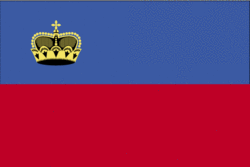
Liechtenstein flag

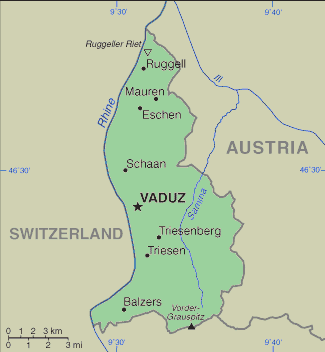
Liechtenstein is located in Central Europe, between Austria and Switzerland.

Liechtenstein has borders with Austria for 34.9km and Switzerland for 41.1km.

Land in Liechtenstein is mostly mountainous (Alps) with Rhine Valley in western third.

Liechtenstein land covers an area of 160 square kilometers which is about 0.9 times the size of Washington, DC

As for the Liechtenstein climate; continental; cold, cloudy winters with frequent snow or rain; cool to moderately warm, cloudy, humid summers.

Liechtensteiner(s) speak German (official), Alemannic dialect.

Liechtenstein country profile

Liechtenstein Map
Places of note in Liechtenstein
Schaan
Vaduz
Triesen
Balzers
Eschen
Mauren
Triesenberg
Ruggell
Gamprin
Schellenberg
Planken
Regions of Liechtenstein
Balzers
Eschen
Gamprin
Liechtenstein (general)
Mauren
Planken
Ruggell
Schaan
Schellenberg
Triesen
Triesenberg
Vaduz

The Principality of Liechtenstein was established within the Holy Roman Empire in 1719; it became a sovereign state in 1806. Until the end of World War I, it was closely tied to Austria, but the economic devastation caused by that conflict forced Liechtenstein to enter into a customs and monetary union with Switzerland. Since World War II (in which Liechtenstein remained neutral), the country's low taxes have spurred outstanding economic growth. Shortcomings in banking regulatory oversight have resulted in concerns about the use of the financial institutions for money laundering. Liechtenstein has, however, implemented new anti-money-laundering legislation and recently concluded a Mutual Legal Assistance Treaty with the US.

Country profile: Liechtenstein

Map of LiechtensteinThe Principality of Liechtenstein is a tiny, landlocked country tucked away between Switzerland and Austria and with mountain slopes rising above the Rhine valley.

Much of its wealth is based on its status as a low tax haven. Around 75,000 companies have their nominal "letter box" offices in Liechtenstein, where business tax rates are very favourable.

This status came under the spotlight in 2000 when two international reports criticised Liechtenstein for lax financial controls. The reports said that the Liechtenstein banking system enabled gangs from Russia, Italy and Colombia to launder money from their criminal activities.

Liechtenstein mountains

Stung by the criticism, Liechtenstein reformed its laws. Customers opening bank accounts may now no longer remain anonymous.

Liechtenstein remained neutral in World War II. A report commissioned by the government in 2001 after allegations that the country's banks had had dealings with the Nazis found that the banks' actions had been above board. It also found that slave labour from Nazi concentration camps had been used on Crown estates in Austria, but described the principality as a bystander rather than a perpetrator.

The country has come through a lengthy political wrangle over the role and power of the hereditary monarchy.

After a campaign which was at times bitterly divisive the people voted in March 2003 in a constitutional referendum to give Prince Hans-Adam sweeping new political powers. The outcome was decisive with just over 64% in favour of the changes.

In effect, the referendum made Liechtenstein Europe's only absolute monarchy. It gave Prince Hans-Adam the power to hire and fire the government, despite publicly-expressed fears that the development could usher in dictatorship.

The Roman Catholic church has traditionally had a strong role in Liechtenstein. Women faced a year in jail for having abortions until new legislation legalised it in late 2005. A bid by pro-life activists to stop the legislation from being passed failed when voters strongly rejected their proposals in a referendum.

Head of state: Prince Hans-Adam II

Prince Hans-Adam, a successful banker, became head of state following the death of his father, Prince Franz Josef, in 1989. In August 2004 he handed over the day-to-day running of the principality to his son, Crown Prince Alois, while remaining titular head of state.

Prince Hans-Adam II of Liechtenstein (left) with son Prince Alois

In 2003 the royals won sweeping new powers in a constitutional referendum which gave them the power to veto parliamentary decisions and to sack the government.

The family also won powers over the appointment of judges, powers which Prince Hans-Adam said were essential to ensure that the judiciary was independent enough to tackle tasks such as chasing illegal assets effectively.

Prince Hans-Adam pointed out that the changes to the constitution took away his right to rule by emergency decree for an unlimited period and to nominate government officials.

Prince Hans-Adam, 58 at the time of the referendum, had threatened to leave Liechtenstein for Austria if he lost.

Prince Alois, who was 36 when he took over the running of his country, trained at Britain's Sandhurst military academy. He is the eldest of Prince Hans-Adam's four children.

Prime minister: Otmar Hasler

Following elections in spring 2005, the Progressive Citizens Party (PCP) and Patriotic Union (PU) formed a coalition government with Otmar Hasler of the PCP continuing as prime minister.

The new government consists of five ministers, three from the PCP and two from the PU. The members of the previous government all came from the PCP.

Mr Hasler, who has been prime minister since 2001, has pledged to continue working to bolster the country's reputation as a bona fide location for financial services.

  • Deputy prime minister: Klaus Tschütscher
  • Foreign minister: Rita Kieber-Beck
  • Finance minister: Otmar Hasler

    Liechtenstein has a very sparse media scene, with the circulation figures of its newspapers at around 10,000 or less.

    Its citizens rely on foreign and satellite broadcasters for most TV and radio services.

    The press

  • Liechtensteiner Vaterland
  • Liechtensteiner Volksblatt

    Radio

  • Radio Liechtenstein

    Despite its small size and limited natural resources, Liechtenstein has developed into a prosperous, highly industrialized, free-enterprise economy with a vital financial service sector and living standards on a par with its large European neighbors. The Liechtenstein economy is widely diversified with a large number of small businesses. Low business taxes - the maximum tax rate is 20% - and easy incorporation rules have induced many holding or so-called letter box companies to establish nominal offices in Liechtenstein, providing 30% of state revenues. The country participates in a customs union with Switzerland and uses the Swiss franc as its national currency. It imports more than 90% of its energy requirements. Liechtenstein has been a member of the European Economic Area (an organization serving as a bridge between the European Free Trade Association (EFTA) and the EU) since May 1995. The government is working to harmonize its economic policies with those of an integrated Europe.

    Liechtenstein natural resources include hydroelectric potential, arable land

    along with Uzbekistan, one of only two doubly landlocked countries in the world; variety of microclimatic variations based on elevation

    Liechtenstein religion is Roman Catholic 76.2%, Protestant 7%, unknown 10.6%, other 6.2% (June 2002).

    Natural hazards in Liechtenstein include NA.


  • What is this world index all about?