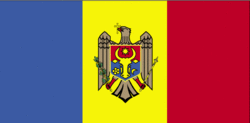
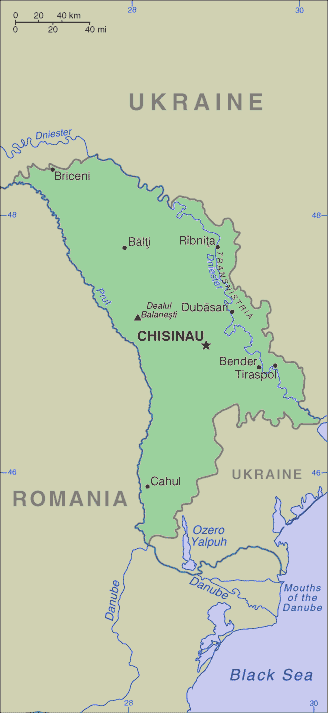
Moldova is located in Eastern Europe, northeast of Romania.
Land in Moldova is rolling steppe, gradual slope south to Black Sea.
Moldovan land covers an area of 33843 square kilometers which is slightly larger than Maryland
As for the Moldovan climate; moderate winters, warm summers.
Moldovan(s) speak Moldovan (official, virtually the same as the Romanian language), Russian, Gagauz (a Turkish dialect).
Formerly part of Romania, Moldova was incorporated into the Soviet Union at the close of World War II. Although independent from the USSR since 1991, Russian forces have remained on Moldovan territory east of the Dniester River supporting the Slavic majority population, mostly Ukrainians and Russians, who have proclaimed a "Transnistria" republic. The poorest nation in Europe, Moldova became the first former Soviet state to elect a Communist as its president in 2001.
Country profile: Moldova
Sandwiched between Romania and Ukraine, Moldova emerged as an independent republic following the collapse of the USSR in 1991.
The bulk of it, between the rivers Dniester and Prut, is made up of an area formerly known as Bessarabia. This territory was annexed by the USSR in 1940 following the carve-up of Romania in the Ribbentrop-Molotov pact between Hitler's Germany and Stalin's USSR.
Two-thirds of Moldovans are of Romanian descent, the languages are virtually identical and the two countries share a common cultural heritage.
The industrialised territory to the east of the Dniester, generally known as Trans-Dniester or the Dniester region, was formally an autonomous area within Ukraine before 1940 when the Soviet Union combined it with Bessarabia to form the Moldavian Soviet Socialist Republic.
This area is mainly inhabited by Russian and Ukrainian speakers. As people there became increasingly alarmed at the prospect of closer ties with Romania in the tumultuous twilight years of the Soviet Union, Trans-Dniester unilaterally declared independence from Moldova in 1990.
There was fierce fighting there as it tried to assert this independence following the collapse of the USSR and the declaration of Moldovan sovereignty. Hundreds died. The violence ended with the introduction of Russian peacekeepers. Trans-Dniester's independence has never been recognised and the region has existed in a state of lawless and corrupt limbo ever since.
The region reasserted its demand for independence and also expressed support for a plan ultimately to join Russia in a September 2006 referendum which was unrecognised by Chisinau and the international community.
It still houses a stockpile of old Soviet military equipment and a contingent of troops of the Russian 14th army. Withdrawal began under international agreements in 2001 but was halted when the Trans-Dniester authorities blocked the dispatch of weapons. Subsequent agreements to resume did not reach fruition as relations between Moscow and Chisinau cooled.
The Moldovan parliament granted autonomous status to the Turkic-language speaking Gagauz region in the southwest of the republic in late 1994. It has powers over its own political, economic and cultural affairs.
Moldova is one of the very poorest countries in Europe and has a large foreign debt and high unemployment. Its once-flourishing wine trade has been in decline and it is heavily dependent on Russia for energy supplies.
The Russian gas supplier Gazprom cut the gas supply off at the beginning of 2006 when Moldova refused to pay twice the previous price. A temporary compromise arrangement was reached soon afterwards and the two sides agreed a new price in July 2006.
- Population: 4.3 million (UN, 2005)
- Capital: Chisinau
- Area: 33,800 sq km (13,050 sq miles)
- Major languages: Moldovan, Russian
- Major religion: Christianity
- Life expectancy: 64 years (men), 71 years (women)
- Monetary unit: 1 leu = 100 bani
- Main exports: Foodstuffs, animal and vegetable products, textiles
- GNI per capita: US $880 (World Bank, 2006)
- Internet domain: .md
- International dialling code: +373
President: Vladimir Voronin
Moldova's parliament returned Mr Voronin of the Communist Party for a second term as president in April 2005.
He first took office after the Communists swept back to power in parliamentary elections early in 2001, ending a decade of largely ineffectual post-Soviet reformist government.
The Communist Party topped the poll in fresh elections in March 2005 and the new parliament again gave Mr Voronin its backing.
Mr Voronin's has been a presidency in two halves. He first came to power promising to forge closer ties with Russia. Relations cooled sharply in 2003 after Mr Voronin pulled out of a proposed deal on Trans-Dniester settlement following protests by those who said it gave too much influence to Moscow.
He said that from then on he would seek more substantial support from the West in resolving the conflict. He has since welcomed Ukrainian settlement proposals and accused Moscow of getting in the way of a deal. He has repeatedly called for Russian forces to withdraw from Trans-Dniester and has called for them to be replaced by internationally supervised peacekeepers.
When he first became president, he accused his predecessors of having reduced Moldova to dire poverty. Under his leadership, the country has remained one of the very poorest in Europe.
At the start of his second term he promised to focus on European integration, resolve the Trans-Dniester issue and improve living standards and media freedom.
A former bakery director, Mr Voronin was born in 1941. He rose through the ranks of the Communist Party and was briefly Soviet-era interior minister at the end of the 1980s.
Prime minister: Vasile Tarlev
Foreign minister: Andrei Stratan
Finance minister: Mihai Pop
While the Moldovan constitution guarantees freedom of the press, the penal code and press laws prohibit defamation and insulting the state.
Political parties publish their own newspapers, which often criticise the government. Moldovan editions of Russian titles are among the most-popular Russian-language publications.
In 2003 there were more than 20 radio stations and some 30 TV stations on the air, many of them rebroadcasting stations from Russia and Romania.
The authorities in the breakaway Trans-Dniester region operate their own TV and radio outlets.
The press
Timpul - Moldovan
Flux - Moldovan
Kommersant Moldoviy - Russian-language
Komsomolskaya Pravda - Russian-language
Nezavisimaya Moldova - Russian-language
Television
Moldova One - operated by state-run Teleradio-Moldova
Pro TV Chisinau - commercial
Radio
Radio Moldova - operated by state-run Teleradio-Moldova
Radio Nova - commercial
News agencies
BASA-press - English-language pages
Moldova Azi - news portal, English-language pages
Moldova remains one of the poorest countries in Europe despite recent progress from its small economic base. It enjoys a favorable climate and good farmland but has no major mineral deposits. As a result, the economy depends heavily on agriculture, featuring fruits, vegetables, wine, and tobacco. Moldova must import almost all of its energy supplies. Energy shortages contributed to sharp production declines after the breakup of the Soviet Union in December 1991. As part of an ambitious reform effort after independence, Moldova introduced a convertible currency, freed prices, stopped issuing preferential credits to state enterprises, backed steady land privatization, removed export controls, and freed interest rates. The government entered into agreements with the World Bank and the IMF to promote growth and reduce poverty. The economy returned to positive growth in 2000, and has remained at or above 6% every year since. Further reforms will come slowly because of strong political forces backing government controls. The economy remains vulnerable to higher fuel prices, poor agricultural weather, and the skepticism of foreign investors.
Moldovan natural resources include lignite, phosphorites, gypsum, arable land, limestone
landlocked; well endowed with various sedimentary rocks and minerals including sand, gravel, gypsum, and limestone
Moldovan religion is Eastern Orthodox 98%, Jewish 1.5%, Baptist and other 0.5% (2000).
Natural hazards in Moldova include landslides (57 cases in 1998).
Moldova
This advice has been reviewed and reissued with amendments to the Summary and Entry Requirements section. The overall level of the advice has not changed.
SUMMARY
- The threat from terrorism is low. But you should be aware of the global risk of indiscriminate terrorist attacks which could be against civilian targets, including places frequented by foreigners.
- We advise caution if considering travelling to Transnistria, where there is no official British representation and British consular services may be limited in their ability to help. You should consult the British Embassy, Chisinau for the most up-to-date information.
- The main type of incident for which British Nationals require consular assistance in Moldova is for medical emergencies.
- You should be vigilant to petty crime, particularly in Chisinau. Leave your passport, travel documents and other valuable items in a safe place. But you should always carry a photocopy of your passport for identification purposes, as police checks are frequent.
- There are strong penalties for possession or use of drugs.
- Avoid taking photographs of military or government installations.
- British citizens holding valid passports can enter Moldova for up to 90 days without requiring a visa.
- The Moldovan authorities are now strictly enforcing penalties (including deportation) against foreign visitors who overstay the terms of their visas. As a visitor you are allowed to spend no more than 90 days in a 6 months period in Moldova. Alternatively, you must regularise your stay by applying for a residence or work visa. Please see the Entry Requirements section of this travel advice for more details.
- We strongly recommend that you obtain comprehensive travel and medical insurance before travelling. You should check any exclusions, and that your policy covers you for the activities you want to undertake. Please see: Travel Insurance
SAFETY AND SECURITY
Road Safety
You should avoid driving after dark outside Chisinau. There is little street lighting, people and animals are often on the road, and road conditions are poor.
Travel to Transnistria
Transnistria (northeast Moldova) is not under Moldovan government control and seeks independence. Since July 2006, there have been two explosions on or near public transport in the regional capital Tiraspol. While the exact motives remain unclear, there is no evidence to suggest that these attacks were linked to any terrorist group or organisation. If you are thinking of going to Transnistria, you should consult the British Embassy in Chisinau for the latest information; (tel: +373 22 225902; fax: +373 22 242500; email: enquiries.chisinau@fco.gov.uk.
It is very important to avoid getting into difficulty with the Transnistrian authorities.
The Embassy will do its best to provide Consular help where needed. But in practice this will be very limited. Anyone in trouble with the Transnistrian authorities should try to telephone the Embassy in Chisinau at an early stage.
LOCAL LAWS AND CUSTOMS
There is a zero tolerance policy in Moldova for possessing or supplying any drugs. Whilst legislation stipulates that fines are possible penalties for drug use/supply, in practice possession of even small quantities of drugs (Class B/C drugs as well as Class A) could result in long prison terms (2-5 years, 5-8 for repeat offenders) in addition to heavy fines.
There is no legal ban on gay/lesbian relationships. There is an active social and lobbying group on gay/lesbian issues in Chisinau. But public attitudes are less tolerant. The Moldovan government does not formally recognise unmarried partners.
The authorities in the Transnistrian region of Moldova can be uncomfortable with visitors taking photos in Transnistria. We advise caution if taking photos of even the most normal buildings/monuments, and we strongly advise against taking photographs of any peacekeeping or military staff/installations, which could lead to difficulty.
You should also avoid taking photos of military facilities in Moldova proper.
There are frequent police checks. You should carry with you at least a copy of identification documents (passport) at all times. Drivers should hold a valid international driving licence and original car/insurance documents, and should keep to speed limits.
ENTRY REQUIREMENTS
The Moldovan Government lifted the visa requirement for EU nationals on 1 January 2007. Visas are no longer required to enter Moldova if your stay is under 90 days. The Moldovan Embassy in London: Moldovan representation in the UK, now issues visas.
You should check your visa after it has been issued and before travelling to ensure that it is valid for the time of the proposed visit, as there have been occasional errors resulting in fines and delays to travel plans. The Moldovan authorities are now strictly enforcing penalties (including deportation) against foreign visitors who overstay the terms of their visas. As a visitor you are allowed to spend no more than 90 days in a 6 months period in Moldova. Alternatively, you must regularise your stay by applying for a residence or work visa.
Before setting off you should ensure that your passport has at least six months validity and at least one unused page.
If you arrive in Moldova by air you will automatically be registered with the local authorities. If you travel to Moldova by land you are required to register your stay if you intend to stay in private accommodation for more than three days. If you are staying in hotel accommodation then registration should be automatic. You must register with the Department of Information Technologies (address: 42 Pushkin Str. Chisnau; tel:; 504 656) or the local passport office (the British Embassy can provide you with the address of the relevant passport office for your area) within three working days. To register your stay in Moldova you must present the following documents:
-
a written request for registration giving details of where your are staying, for how long and the reason for the visit; and
-
your passport
Failure to register may result in fines and/or difficulties when leaving Moldova.
Single parents or other adults travelling alone with children should be aware that some countries require documentary evidence of parental responsibility before allowing lone parents to enter the country or, in some cases, before permitting the children to leave the country. For further information on exactly what will be required at immigration, please contact the Moldovan representation in the UK.
HEALTH
We recommend that you take out full, comprehensive insurance and make sure that this covers medical evacuation in an emergency. You should check any exclusions, and that your policy covers you for the activities you want to undertake. Please see: Travel Insurance.
Non Russian/Romanian speakers may encounter difficulties in a medical emergency. The Embassy has details of English-speaking doctors.
You are advised to drink only bottled water.
You should seek medical advice before travelling and ensure that all appropriate vaccinations are up-to-date. For further information on health, check the Department of Health website at www.dh.gov.uk.
Avian Influenza (Bird Flu)
There have been no reported cases of Avian Influenza (Bird Flu) in Moldova during the current series of outbreaks. But the World Health Organisation has confirmed cases elsewhere in the region.
You should read this advice in conjunction with the Avian and Pandemic Influenza Factsheet on the FCO website.
GENERAL
If things go wrong when overseas, please see: What We Can Do To Help
The British Embassy in Chisinau does not issue passports. Applications for new passports are accepted in Chisinau for forwarding to the British Embassy in Bucharest for processing, but this may take up to 20 working days. If you use a courier, you will have to pay the cost.
Money
The most widely accepted foreign currencies are the US Dollar and the Euro. We recommend that you carry some US Dollars cash. The Dollar notes should be in perfect condition or they may not be accepted. It is not always easy to exchange Sterling for the local currency. Credit cards are not widely accepted in Moldova, though Lei can be obtained from a number of ATM machines in Chisinau.