
 Search
Traveling Luck for Western Sahara. Western Sahara, Africa
Western Sahara is located in Northern Africa, bordering the North Atlantic Ocean, between Mauritania and Morocco.
Land in Western Sahara is mostly low, flat desert with large areas of rocky or sandy surfaces rising to small mountains in south and northeast.
Sahrawi, Sahrawian, Sahraouian land covers an area of 266000 square kilometers which is about the size of Colorado
Western Sahara has borders with Algeria for 42km, Morocco for 443km and Mauritania for 1561km.
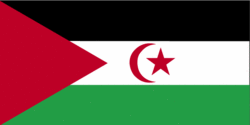 Sahrawi, Sahrawian, Sahraouian national flag (Flag of Western Sahara)
 Western Sahara country profile
 Travel advice for Western Sahara
As for the Sahrawi, Sahrawian, Sahraouian climate; hot, dry desert; rain is rare; cold offshore air currents produce fog and heavy dew.
Sahrawi(s), Sahraoui(s) speak Hassaniya Arabic, Moroccan Arabic.
Places of note in Western Sahara
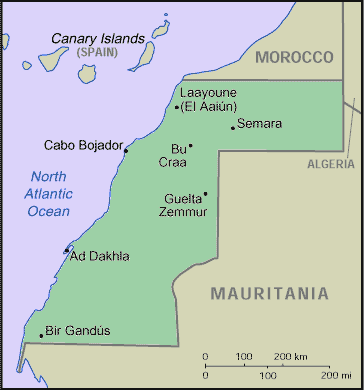 Sahrawi, Sahrawian, Sahraouian map
Regions of Western Sahara
Morocco virtually annexed the northern two-thirds of Western Sahara (formerly Spanish Sahara) in 1976, and the rest of the territory in 1979, following Mauritania's withdrawal. A guerrilla war with the Polisario Front contesting Rabat's sovereignty ended in a 1991 UN-brokered cease-fire; a UN-organized referendum on final status has been repeatedly postponed.
Western Sahara depends on pastoral nomadism, fishing, and phosphate mining as the principal sources of income for the population. The territory lacks sufficient rainfall for sustainable agricultural production, and most of the food for the urban population must be imported. All trade and other economic activities are controlled by the Moroccan Government. Moroccan energy interests in 2001 signed contracts to explore for oil off the coast of Western Sahara, which has angered the Polisario. Incomes and standards of living in Western Sahara are substantially below the Moroccan level.
Sahrawi, Sahrawian, Sahraouian natural resources include phosphates, iron ore
the waters off the coast are particularly rich fishing areas
Sahrawi, Sahrawian, Sahraouian religion is Muslim.
Natural hazards in Western Sahara include hot, dry, dust/sand-laden sirocco wind can occur during winter and spring; widespread harmattan haze exists 60% of time, often severely restricting visibility.
Travel Advice for Western Sahara
Western SaharaSUMMARY
- Western Sahara is a disputed territory and the UK regards its status as undetermined. There is no British diplomatic or consular presence in Western Sahara. However, you should register with the British Embassy in Rabat (Morocco) before you visit the territory.
- Developments in the region may trigger public unrest, especially after Friday prayers. You should avoid large gatherings of people and demonstrations, which can turn hostile. Be particularly alert in public places.
- The British Embassy in Rabat (Morocco) can provide only emergency consular services in Western Sahara and, in most cases, this will be by telephone.
- There is a high threat from terrorism, as there is in neighbouring Morocco.
- There are thousands of unexploded mines in the Western Sahara. You should avoid driving off road and take care on main roads especially when driving in more remote areas.
- Travel is restricted and while organised groups are generally permitted, independent overland travellers should be aware that they could be turned back at the border.
- The main types of incident for which British nationals require consular assistance in Western Sahara are difficulties with entry to and exit from the territory.
- We strongly recommend that you obtain comprehensive travel and medical insurance before travelling. You should check any exclusions, and that your policy covers you for the activities you want to undertake. Please see: Travel Insurance
SAFETY AND SECURITY