
 Search
Traveling Luck for Somalia. Somalia, Africa
Somalia is located in Eastern Africa, bordering the Gulf of Aden and the Indian Ocean, east of Ethiopia.
Land in Somalia is mostly flat to undulating plateau rising to hills in north.
Somali land covers an area of 637657 square kilometers which is slightly smaller than Texas
Somalia has borders with Djibouti for 58km, Ethiopia for 1600km and Kenya for 682km.
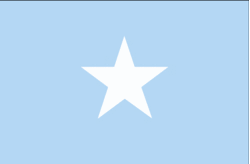 Somali national flag (Flag of Somalia)
 Somalia country profile
 Travel advice for Somalia
As for the Somali climate; principally desert; northeast monsoon (December to February), moderate temperatures in north and very hot in south; southwest monsoon (May to October), torrid in the north and hot in the south, irregular rainfall, hot and humid periods (tangambili) between monsoons.
Somali(s) speak Somali (official), Arabic, Italian, English.
Places of note in Somalia
- Mogadishu
- Hargeysa
- Berbera
- Chisimayu
- Jamaame
- Baidoa
- Burao
- Bender Cassim
- Afgooye
- Galcaio
- Beledweyne
- Qoryooley
- Giohar
- Jilib
- Baardheere
- Erigavo
- Luuq
- Buurhakaba
- Ceeldheere
- Wanlaweyn
- Eyl
- Buulobarde
- Qandala
- Bandarbeyla
- Garbahaarrey
- Hobyo
- Bereeda
- Jalalaqsi
- Ceelbuur
- Yeed
- Mahadday Weyne
- Saacow
- Laasqoray
- Bargaal
- Waajid
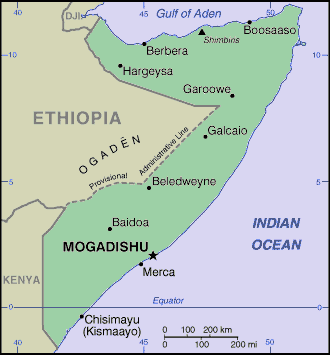 Somali map
Regions of Somalia
The regime of Mohamed SIAD Barre was ousted in January 1991; turmoil, factional fighting, and anarchy have followed in the years since. In May of 1991, northern clans declared an independent Republic of Somaliland that now includes the administrative regions of Awdal, Woqooyi Galbeed, Togdheer, Sanaag, and Sool. Although not recognized by any government, this entity has maintained a stable existence, aided by the overwhelming dominance of a ruling clan and economic infrastructure left behind by British, Russian, and American military assistance programs. The regions of Bari, Nugaal, and northern Mudug comprise a neighboring self-declared autonomous state of Puntland, which has been self-governing since 1998, but does not aim at independence; it has also made strides toward reconstructing a legitimate, representative government, but has suffered some civil strife. Puntland disputes its border with Somaliland as it also claims portions of eastern Sool and Sanaag. Beginning in 1993, a two-year UN humanitarian effort (primarily in the south) was able to alleviate famine conditions, but when the UN withdrew in 1995, having suffered significant casualties, order still had not been restored. The mandate of the Transitional National Government (TNG), created in August 2000 in Arta, Djibouti, expired in August 2003. A two-year peace process, led by the Government of Kenya under the auspices of the Intergovernmental Authority on Development (IGAD), concluded in October 2004 with the election of Abdullahi YUSUF Ahmed as Transitional Federal President of Somalia and the formation of a transitional government, known as the Somalia Transitional Federal Institutions (TFIs). The Somalia TFIs include a 275-member parliamentary body, known as the Transitional Federal Assembly (TFA), a transitional Prime Minister, Ali Mohamed GHEDI, and a 90-member cabinet. The TFIs are currently divided between Mogadishu and Jowhar, but discussions to co-locate the TFIs in one city are ongoing. Suspicion of Somali links with global terrorism further complicates the picture.
Somalia's economic fortunes are driven by its deep political divisions. The northwestern area has declared its independence as the "Republic of Somaliland"; the northeastern region of Puntland is a semi-autonomous state; and the remaining southern portion is riddled with the struggles of rival factions. Economic life continues, in part because much activity is local and relatively easily protected. Agriculture is the most important sector, with livestock normally accounting for about 40% of GDP and about 65% of export earnings, but Saudi Arabia's ban on Somali livestock, due to Rift Valley Fever concerns, has severely hampered the sector. Nomads and semi-nomads, who are dependent upon livestock for their livelihood, make up a large portion of the population. Livestock, hides, fish, charcoal, and bananas are Somalia's principal exports, while sugar, sorghum, corn, qat, and machined goods are the principal imports. Somalia's small industrial sector, based on the processing of agricultural products, has largely been looted and sold as scrap metal. Despite the seeming anarchy, Somalia's service sector has managed to survive and grow. Telecommunication firms provide wireless services in most major cities and offer the lowest international call rates on the continent. In the absence of a formal banking sector, money exchange services have sprouted throughout the country, handling between $500 million and $1 billion in remittances annually. Mogadishu's main market offers a variety of goods from food to the newest electronic gadgets. Hotels continue to operate, and militias provide security. The ongoing civil disturbances and clan rivalries, however, have interfered with any broad-based economic development and international aid arrangements. Somalia's arrears to the IMF continued to grow in 2005. Statistics on Somalia's GDP, growth, per capita income, and inflation should be viewed skeptically. In late December 2004, a major tsunami caused an estimated 150 deaths and resulted in destruction of property in coastal areas.
Somali natural resources include uranium and largely unexploited reserves of iron ore, tin, gypsum, bauxite, copper, salt, natural gas, likely oil reserves
strategic location on Horn of Africa along southern approaches to Bab el Mandeb and route through Red Sea and Suez Canal
Somali religion is Sunni Muslim.
Natural hazards in Somalia include recurring droughts; frequent dust storms over eastern plains in summer; floods during rainy season.
Travel Advice for Somalia
SomaliaSUMMARY
- We advise against all travel to Somalia because of the recent conflict between the Transitional Federal Government and the Union of Islamic Courts, the dangerous level of criminal activity and general internal insecurity. Although the Union of Islamic Courts is now largely defeated, tension remains high. We advise any British citizens in Somalia to leave.
- Westerners and those working for western organisations have been targeted. A western journalist was shot fatally in Mogadishu on 23 June 2006. A western nurse and her escort were shot dead in Mogadishu on 17 September 2006.
- Piracy has been a major problem along the Somali coastline. Please see the Sea Safety section of this travel advice for further details.
- There is a high threat from terrorism in Somalia. On 30 November 2006, a suicide bomb killed six at a checkpoint in Baidoa and on 18 September 2006, car bombs exploded in Baidoa killing 11 people.
- There is no British representation in Somalia. Somaliland is covered by the British Embassy in Addis Ababa whilst other parts of Somalia are covered by the British High Commission in Nairobi.
- If you decide to travel to or remain in Somalia against this advice, you do so at your own risk. If the situation deteriorates the FCO will not be able to assist you. Should you decide to travel to Somalia against this advice, we strongly recommend that you obtain comprehensive travel and medical insurance before travelling. You should check any exclusions, and that your policy covers you for the activities you want to undertake. Please see: Travel Insurance.
- We are unable to provide consular assistance in Somalia.
SAFETY AND SECURITY
We advise against all travel to Somalia. There is a high threat to Western, including British, interests from terrorism in Somalia. Tension remains very high. Forces and militias in all parts of Somalia are fully mobilised. Fighting between the Union of Islamic Courts and the Transitional Federal Government, supported by Ethiopian troops, broke out in December. Although the Union of Islamic Courts troops are largely defeated the situation remains tense and unstable.
In May 2004, a remote-controlled landmine was found planted in a remote airstrip in the south of Somalia. UN and European Commission flights to Somalia are consequently now much restricted.
The Somaliland authorities have established a Special Protection Unit (SPU) which accompanies all UN missions outside Hargeisa. NGOs and individuals can also apply for an SPU escort at a cost of US$4.00 per day (or US$7.00 per 24 hours). British nationals who decide to stay in or visit Somaliland, despite our advice to the contrary, are urged to obtain details of the new system and to ensure that, when travelling, they take adequate security precautions.
You should be aware of the global risk of indiscriminate terrorist attacks, which could be against civilian targets, including places frequented by foreigners. Please read “Security and General Tips” and “Risk of Terrorism when Travelling Overseas” pages for further information and advice.
Crime
There is a dangerous level of criminal activity by numerous bodies of armed militia throughout Somalia. As a result there is a significant level of armed robbery and there have been a number of incidents of kidnapping for ransom. Two people were reportedly killed in July 2006, after fundamentalists attempted to prevent spectators watching the football World Cup. A number of British nationals and Westerners have been killed and injured in attacks in Somaliland (see Terrorism section above). The Somaliland authorities believe these were terrorist inspired; however, the motives for the attacks have yet to be established. There are regular and sporadic outbreaks of inter-clan violence throughout the south of Somalia and especially in Mogadishu.
Political Situation
Sea Safety
Attacks of piracy and armed robbery against ships in and around Somalia's waters are frequent and continuing. Mariners should be vigilant. Attacks of piracy and armed robbery against ships in and around Somalia's waters are frequent and continuing. The Department for Transport currently advise mariners to remain at least 150 nautical miles from the Somali coast when transiting between the equator and 08N (latitude) and 100 nautical miles from Somalia’s northern coastline in the Gulf of Aden. Extreme caution should be also exercised when transiting the horn of Africa. We strongly advise mariners to maintain a high level of vigilance in and around Somali waters.
On 5 November 2005, while 70 nautical miles from the SomaliCoast, a cruise ship was attacked by pirates. The pirates fired rocket propelled grenades against the ship but were successfully repelled in this case. We strongly advise mariners to maintain a high level of vigilance in and around Somali waters.
HEALTH
If, despite our advice, you travel to Somalia, you should seek medical advice before travelling and ensure that all appropriate vaccinations are up to date. For further information on health, check the Department of Health’s website at: www.dh.gov.uk.
GENERAL