
 Search
Traveling Luck for Djibouti. Djibouti, Africa
Djibouti is located in Eastern Africa, bordering the Gulf of Aden and the Red Sea, between Eritrea and Somalia.
Land in Djibouti is coastal plain and plateau separated by central mountains.
Djiboutian land covers an area of 23000 square kilometers which is slightly smaller than Massachusetts
Djibouti has borders with Eritrea for 109km, Ethiopia for 349km and Somalia for 58km.
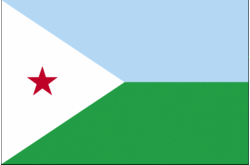 Djiboutian national flag (Flag of Djibouti)
 Djibouti country profile
 Travel advice for Djibouti
As for the Djiboutian climate; desert; torrid, dry.
Djiboutian(s) speak French (official), Arabic (official), Somali, Afar.
Places of note in Djibouti
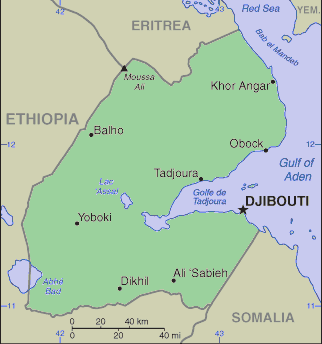 Djiboutian map
Regions of Djibouti
The French Territory of the Afars and the Issas became Djibouti in 1977. Hassan Gouled APTIDON installed an authoritarian one-party state and proceeded to serve as president until 1999. Unrest among the Afars minority during the 1990s led to a civil war that ended in 2001 following the conclusion of a peace accord between Afar rebels and the Issa-dominated government. In 1999, Djibouti's first multi-party presidential elections resulted in the election of Ismail Omar GUELLEH; he was re-elected to a second and final term in 2005. Djibouti occupies a strategic geographic location at the mouth of the Red Sea and serves as an important transshipment location for goods entering and leaving the east African highlands. The present leadership favors close ties to France, which maintains a significant military presence in the country, but is also developing stronger ties with the US. Djibouti hosts the only US military base in sub-Saharan Africa and is a front-line state in the global war on terrorism.
The economy is based on service activities connected with the country's strategic location and status as a free trade zone in northeast Africa. Two-thirds of the inhabitants live in the capital city; the remainder are mostly nomadic herders. Scanty rainfall limits crop production to fruits and vegetables, and most food must be imported. Djibouti provides services as both a transit port for the region and an international transshipment and refueling center. Djibouti has few natural resources and little industry. The nation is, therefore, heavily dependent on foreign assistance to help support its balance of payments and to finance development projects. An unemployment rate of at least 50% continues to be a major problem. While inflation is not a concern, due to the fixed tie of the Djiboutian franc to the US dollar, the artificially high value of the Djiboutian franc adversely affects Djibouti's balance of payments. Per capita consumption dropped an estimated 35% over the last seven years because of recession, civil war, and a high population growth rate (including immigrants and refugees). Faced with a multitude of economic difficulties, the government has fallen in arrears on long-term external debt and has been struggling to meet the stipulations of foreign aid donors.
Djiboutian natural resources include geothermal areas, gold, clay, granite, limestone, marble, salt, diatomite, gypsum, pumice, petroleum
strategic location near world's busiest shipping lanes and close to Arabian oilfields; terminus of rail traffic into Ethiopia; mostly wasteland; Lac Assal (Lake Assal) is the lowest point in Africa
Djiboutian religion is Muslim 94%, Christian 6%.
Natural hazards in Djibouti include earthquakes; droughts; occasional cyclonic disturbances from the Indian Ocean bring heavy rains and flash floods.
Travel Advice for Djibouti
DjiboutiSUMMARY
- Djibouti shares with the rest of the region a high threat from terrorism. We continue to receive information that you are at risk from terrorist attacks in areas frequented by Westerners.
- There is no British Embassy in Djibouti and the Honorary Consul can offer only limited assistance.
- You should be aware of the risk of banditry if travelling outside the capital city.
- We strongly recommend that you obtain comprehensive travel and medical insurance before travelling. You should check any exclusions, and that your policy covers you for the activities you want to undertake. Please see: Travel Insurance
SAFETY AND SECURITY
Incidences of petty crime are not uncommon in Djibouti. We advise against walking around town alone, late at night. Valuables, particularly cameras and passports should be kept out of sight.
You should be aware of the risk of banditry if travelling outside the capital city.
Political Situation
Djibouti Country Profile.
Local Travel
You should avoid travelling outside of the cityafter dark, as vehicles often have no lights and livestock may be roaming the roads.
Rail Safety
Sabotage and derailment on the Djibouti/Ethiopia railway occasionally occur. In September 2003 a bomb exploded on a train, killing two people. If you intend to travel into the Republic of Djibouti by rail you should check with the British Embassy in Addis Ababa on the current situation before setting off.
Sea Safety
Mariners should be aware that incidents of piracy have been reported in the Red Sea and Gulf of Aden and are advised to exercise vigilance and seek local advice.
LOCAL LAWS AND CUSTOMS
French is widely spoken as is Arabic and Somali.
ENTRY REQUIREMENTS
British nationals applying for a Djibouti visa in Ethiopia generally require a letter from the British Embassy in Addis Ababa for presentation at the Djibouti Embassy. There is a fee for this service payable in local currency.
Single parents or other adults travelling alone with children should be aware that some countries require documentary evidence of parental responsibility before allowing lone parents to enter the country, or in some cases, before permitting the children to leave the country. For further information on exactly what will be required at immigration, please contact the French Embassy in London.
There is a 20 US Dollars departure tax at the airport.
HEALTH
You should seek medical advice before travelling and ensure that all appropriate vaccinations are up to date. For further information on health, check the Department of Health’s website at www.dh.gov.uk.
Since early April 2006, Djibouti has had three confirmed cases of poultry deaths from Avian Influenza (Bird Flu). There has also been one confirmed case of human infection and two further suspected cases. No human deaths have been reported.
GENERAL
There is no British Embassy in Djibouti. The British Embassy in Addis Ababa, Ethiopia is responsible for Britain's relations with Djibouti.
The Honorary Consul in Djibouti, Mr Alain Martinet, can offer only limited assistance. Most consular cases and renewals of passports are handled by the British Embassy in Addis Ababa, however the Honorary Consul can accept passport applications and forward them to Addis Ababa.
Credit cards are accepted at only a very few outlets in Djibouti and it is not possible to obtain currency advances against a credit card. Visitors should ensure they have an adequate supply of hard currency or travellers' cheques.
British nationals living and working in Djibouti should register with the Consulate on first arrival. Those who are already registered should make sure that their details are kept up to date.