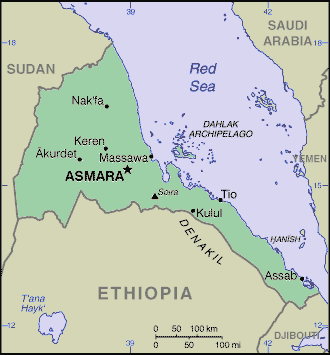
Eritrea is located in Eastern Africa, bordering the Red Sea, between Djibouti and Sudan.
Land in Eritrea is dominated by extension of Ethiopian north-south trending highlands, descending on the east to a coastal desert plain, on the northwest to hilly terrain and on the southwest to flat-to-rolling plains.
Eritrean land covers an area of 121320 square kilometers which is slightly larger than Pennsylvania
As for the Eritrean climate; hot, dry desert strip along Red Sea coast; cooler and wetter in the central highlands (up to 61 cm of rainfall annually, heaviest June to September); semiarid in western hills and lowlands.
Eritrean(s) speak Afar, Arabic, Tigre and Kunama, Tigrinya, other Cushitic languages.
Eritrea was awarded to Ethiopia in 1952 as part of a federation. Ethiopia's annexation of Eritrea as a province 10 years later sparked a 30-year struggle for independence that ended in 1991 with Eritrean rebels defeating governmental forces; independence was overwhelmingly approved in a 1993 referendum. A two-and-a-half-year border war with Ethiopia that erupted in 1998 ended under UN auspices in December 2000. Eritrea currently hosts a UN peacekeeping operation that is monitoring a 25 km-wide Temporary Security Zone on the border with Ethiopia. An international commission, organized to resolve the border dispute, posted its findings in 2002 but final demarcation is on hold due to Ethiopian objections.
Country profile: Eritrea
Eritrea emerged from its long war of independence in 1993 only to plunge once again into military conflict, first with Yemen and then, more devastatingly, with its old adversary, Ethiopia.
Today, a fragile peace prevails and Eritrea faces the gigantic tasks of rebuilding its infrastructure and of developing its economy after more than 30 years of fighting.
A former Italian colony, Eritrea was occupied by the British in 1941. In 1952 the United Nations resolved to establish it as an autonomous entity federated with Ethiopia as a compromise between Ethiopian claims for sovereignty and Eritrean aspirations for independence. However, 10 years later the Ethiopian emperor, Haile Selassie, decided to annex it, triggering a 32-year armed struggle.
AT-A-GLANCE- Politics: The government has been accused of repression and of hindering the development of democracy
- Economy: Eritrea is said to exist on loans and the earnings of the diaspora
- International: The border dispute which turned into a full-scale war with Ethiopia is still a source of tension
This culminated in independence after an alliance of the Eritrean People's Liberation Front (EPLF) and a coalition of Ethiopian resistance movements defeated Haile Selassie's communist successor, Mengistu Haile Mariam.
In 1993, in a referendum supported by Ethiopia, Eritreans voted almost unanimously for independence, leaving Ethiopia landlocked.
The two countries hardly became good neighbours, with the issues of Ethiopian access to the Eritrean ports of Massawa and Assab and unequal trade terms souring relations.
In 1998 border disputes around the town of Badme erupted into open hostilities. This conflict ended with a peace deal in June 2000, but not before leaving both sides with tens of thousands of soldiers dead. A security zone, patrolled by UN forces, separates the two countries.
The unresolved border issue compounds other pressing problems. These include Eritrea's inability to provide enough food; two thirds of the population receive food aid. Moreover, economic progress is hampered by the proportion of Eritreans who are in the army rather than the workforce.
- Full name: The State of Eritrea
- Population: 4.4 million (UN, 2005)
- Capital: Asmara
- Area: 117,400 sq km (45,300 sq miles)
- Major languages:
Tigrinya, Tigre, Arabic, English
- Major religions: Islam, Christianity
- Life expectancy: 51 years (men), 55 years (women) (UN)
- Monetary unit: 1 Nakfa = 100 cents
- Main exports: Livestock, hides, sorghum, textiles, salt, light manufactures
- GNI per capita: US $220 (World Bank, 2006)
- Internet domain: .er
- International dialling code: +291
President: Isaias Afewerki
Isaias Afewerki was elected president of independent Eritrea by the national assembly in 1993. He had been the de facto leader before independence.

Presidential elections, planned for 1997, never materialised. Eritrea is a one-party state, with the ruling People's Front for Democracy and Justice the only party allowed to operate.
Mr Afewerki has been criticised for failing to implement democratic reforms. His government has clamped down on its critics and has closed the private press.
Born in 1946 in Asmara, Isaias Afewerki joined the Eritrean Liberation Front (ELF) in 1966. He received military training in China the same year, then went on to be deputy divisional commander.
In 1970 he co-founded the Eritrean People's Liberation Front (EPLF) and in 1987 he was elected secretary-general of the organisation.
Eritrea is the only African country to have no privately-owned news media. In 2005 the US-based Committee to Protect Journalists (CPJ) described it as one of the world's leading jailers of journalists.
Another press watchdog, Reporters Without Borders, notes that there is "no freedom of expression".
The government closed the private press in 2001 for "endangering national security" and arrested many journalists after several publications printed the dissenting views of some National Assembly members.
There are no private radio or TV stations.
The press
Hadas Eritrea - government-owned, published three days a week
Eritrea Profile - government-owned weekly, in English
Tirigta - pro-government youth weekly owned by ruling party
Geled - weekly youth paperTelevision
Eri TV - state-runRadio
Voice of the Broad Masses of Eritrea (Dimtsi Hafash) - state-run, operates two networks, programmes in 11 languages
Radio Zara - state-run, FM network
News agency
Erina (Eritrean News Agency) - state-run
Since independence from Ethiopia in 1993, Eritrea has faced the economic problems of a small, desperately poor country. Like the economies of many African nations, the economy is largely based on subsistence agriculture, with 80% of the population involved in farming and herding. The Ethiopian-Eritrea war in 1998-2000 severely hurt Eritrea's economy. GDP growth fell to zero in 1999 and to -12.1% in 2000. The May 2000 Ethiopian offensive into northern Eritrea caused some $600 million in property damage and loss, including losses of $225 million in livestock and 55,000 homes. The attack prevented planting of crops in Eritrea's most productive region, causing food production to drop by 62%. Even during the war, Eritrea developed its transportation infrastructure, asphalting new roads, improving its ports, and repairing war-damaged roads and bridges. Since the war ended, the government has maintained a firm grip on the economy, expanding the use of the military and party-owned businesses to complete Eritrea's development agenda. Erratic rainfall and the delayed demobilization of agriculturalists from the military kept cereal production well below normal, holding down growth in 2002-05. Eritrea's economic future depends upon its ability to master social problems such as illiteracy, unemployment, and low skills, as well as the willingness to open its economy to private enterprise so that the diaspora's money and expertise can foster economic growth.
Eritrean natural resources include gold, potash, zinc, copper, salt, possibly oil and natural gas, fish
strategic geopolitical position along world's busiest shipping lanes; Eritrea retained the entire coastline of Ethiopia along the Red Sea upon de jure independence from Ethiopia on 24 May 1993
Eritrean religion is Muslim, Coptic Christian, Roman Catholic, Protestant.
Natural hazards in Eritrea include frequent droughts; locust swarms.
Eritrea
This advice has been reviewed and reissued with amendments to the Summary and Local Travel section. The overall level of the advice has not changed.
SUMMARY
- We advise against all travel to the border areas with Ethiopia and Sudan. Since 5 October 2005, restrictions placed on the UN Monitoring force by the Government of Eritrea have further heightened tensions along the Ethiopia/Eritrea border. This advice includes Tesseney, near the Sudan border. We also advise against travel in the area north of Afabet in the Sahel region and along one road in the west of the country (See the Local Travel section of this advice for more details).
- Since 1 June 2006, all foreign nationals (including resident diplomats) are required to have a travel permit to visit other areas outside Asmara. (See the Local Travel section of this advice for more details).
- If you intend to travel anywhere in Eritrea you should be aware that the new restrictions might severely hamper your plans. You should also be aware that the way recent consular cases have been handled by the government of Eritrea indicate that the Embassy might not be informed of British citizens in need of consular assistance. These restrictions and precedent are likely to hamper, perhaps severely, the ability of the British Embassy to provide any Consular assistance let alone even doing so quickly or effectively. You should take this into account before deciding whether or not to travel to Eritrea. (See the Local Travel section of this advice for more details).
- In November 2005, UN agencies in Eritrea withdrew families of their personnel in response to increased tension between Ethiopia and Eritrea over their disputed border. In December 2005, the UN Mission to Ethiopia and Eritrea (UNMEE) staff from USA, Canada, Europe and the Russian Federation began relocating to Ethiopia. The relocation of these personnel to Ethiopia is now complete.
- Eritrea shares with the rest of the Horn of Africa a threat from terrorism.
- You should register with the Embassy on arrival.
- You should be aware that travel options to and from Asmara are limited following the cancellation of scheduled flights between Asmara and Nairobi.
- We strongly recommend that you obtain comprehensive travel and medical insurance before travelling. You should check any exclusions, and that your policy covers you for the activities you want to undertake. Please see: Travel Insurance.
SAFETY AND SECURITY
Crime
Street crime such as theft and robbery is rare in Asmara and other cities and towns. However, you should take normal and sensible precautions with regard to their personal safety. We advise against walking around any town, late at night alone. Valuables, particularly cameras and passports should be kept out of sight.
Political Situation
Eritrea Country Profile
Local Travel
We advise against all travel to the border area between Ethiopia and Eritrea, which remains a predominantly military zone, despite the December 2000 peace agreement between the two countries. In recent weeks, restrictions placed on the UN Monitoring force by the Government of Eritrea have further heightened tensions. In particular, we advise against travel south of the Barentu-Dekemahare line due to the UN controlled Temporary Security Zone. There is also a strict no fly zone in force in the border area between Ethiopia and Eritrea for all other than UN aircraft. The Eritrea/Ethiopia border remains closed. We also advise against all travel to border areas with Sudan where there continues to be military activity. The Eritrea/Sudan border is presently closed.
Since 1 June 2006, all foreign nationals (including resident diplomats) are required to have a travel permit to visit other areas outside Asmara. Foreign nationals residing or working in areas outside Asmara are also required to have a travel permit to travel outside the area of their residence or work. Applications for travel permits are processed by the Department of Protocol in Asmara and by Zonal Administration Offices in other areas. It is not known how long it will take for applications to be processed.
If you intend to travel anywhere in Eritrea you should be aware that the new restrictions might severely hamper your plans. You should also be aware that the way recent consular cases have been handled by the government of Eritrea indicate that the Embassy might not be informed of British citizens in need of consular assistance. These restrictions and precedent are likely to hamper, perhaps severely, the ability of the British Embassy to provide any Consular assistance, let alone even doing so quickly or effectively. You should take this into account before deciding whether or not to travel to Eritrea.
You should note that permits are required from the Ministry of Tourism (on Hartnet Avenue) to travel to all areas in Eritrea.
On 6 December 2005, the Government of Eritrea told the UN Mission staff of USA, Canada, Europe and the Russian Federation to leave the Mission within 10 days. The relocation of these personnel to Ethiopia is now complete. You should also be aware that over the weekend of 18-20 November 2005, the UN agencies in Eritrea decided to withdraw families of their personnel in response to the increased tension between Ethiopia and Eritrea over their disputed border. These families left Eritrea by 4 December 2005. This was due to a number of incidents that occurred in October 2005. Near Shambuko a bus struck a newly laid mine, killing one person. There have also been reports of two ambushes on vehicles south of Tesseney and an attack on two vehicles in the west of Eritrea in which two people were killed.
There are extensive mine fields in Eritrea, especially near the border with Ethiopia. In addition to avoiding the border areas detailed above, you should avoid all travel in the west of the country along the Agordat to Hawashayt road where we have had reports of landmine incidents. Travelling on main roads outside of the border areas is generally safe but we advise against off-road driving. Walking/hiking in the countryside is inadvisable for the same reason.
You should avoid travelling north of Afabet in the Sahel region, following the attack on a Mercy Corps vehicle on 9 August 2003.
Do not travel after dark in rural areas. In many parts of the country roads are difficult or impassable during rain.
Travel options to and from Asmara are more limited following the cancellation of scheduled flights between Asmara and Nairobi in May 2005.
Sea Safety
There have been attacks of piracy and armed robbery against ships in the area. Mariners are advised to be vigilant and take appropriate precautions.
LOCAL LAWS AND CUSTOMS
Photography of government buildings and military installations is not allowed. You should dress modestly. Shorts and T-shirts are likely to draw attention. Homosexual behaviour is illegal, although the penalty for such behaviour is unclear.
ENTRY REQUIREMENTS
British nationals need a visa to enter Eritrea. These should be obtained from: Eritrean representation in the UK. You should ensure that any necessary travel documentation (including exit visas) remain valid. Dual British/Eritrean nationals who enter Eritrea will be classed as Eritrean by the authorities. The British Embassy is unlikely to be granted consular access to or obtain information on dual nationals who have been detained. Dual nationals who have entered Eritrea on their Eritrean identity card should be aware that are required to obtain an exit visa from the Immigration Office in Asmara before they can leave Eritrea. Dual nationals should read the page on dual nationals on this website which sets out what a Consul can and cannot do for them in the country of their other nationality. Yellow Fever Vaccination certificates are an entry requirement for all visitors over the age of one year if you are travelling from an infected country.
You should be aware that you are required to declare all foreign currency being brought into the country. There is no limit on the amount you can bring in, however you may be asked to demonstrate the sum you declare. On departure you will have to show that money unaccounted for was changed at an official bureau or bank. Eritrean Nakfa may only be changed back to hard currency at the airport on presentation of the original currency transaction receipt. You may face prosecution if you fail to comply with these regulations.
HEALTH
We strongly recommend that you obtain comprehensive travel and medical insurance before travelling. You should check any exclusions, and that your policy covers you for the activities you want to undertake. You should ensure that your medical insurance covers the cost of air ambulance evacuation out of Eritrea in the event of a serious accident or illness. Please see: Travel Insurance
There are hospitals in Asmara and other large towns. Elsewhere medical facilities are limited. You should carry a comprehensive medical pack.
You should seek medical advice before travelling and ensure that all appropriate vaccinations are up to date. For further information on health, check the Department of Health’s website at: www.dh.gov.uk
GENERAL
If things go wrong when overseas, please see: What We Can Do To Help. You should be aware that the British Embassy may encounter difficulties in providing you with effective Consular assistance if you travel outside of Asmara. The Local Travel section of this advice provides more details about this.
The British Embassy in Asmara does not issue passports. Applications for passports and renewal of passports are forwarded to the British Embassy in Addis Ababa. However, the British Embassy can normally issue emergency travel documents within two working days upon production of satisfactory proof of nationality. You should keep a copy of the bio data (photograph and personal details) page of your passport in a safe place or with friends/family in the UK.
You should register with the Embassy on arrival. Credit cards are accepted at few outlets in Asmara. The economy is essentially cash based. Note that it is illegal to exchange currency other than at registered bureaux de change.