
 Search
Traveling Luck for Kenya. Kenya, Africa
Kenya is located in Eastern Africa, bordering the Indian Ocean, between Somalia and Tanzania.
Land in Kenya is low plains rise to central highlands bisected by Great Rift Valley; fertile plateau in west.
Kenyan land covers an area of 582650 square kilometers which is slightly more than twice the size of Nevada
Kenya has borders with Ethiopia for 861km, Sudan for 232km, Somalia for 682km, Tanzania for 769km and Uganda for 933km.
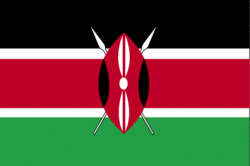 Kenyan national flag (Flag of Kenya)
 Kenya country profile
 Travel advice for Kenya
As for the Kenyan climate; varies from tropical along coast to arid in interior.
Kenyan(s) speak English (official), Kiswahili (official), numerous indigenous languages.
Places of note in Kenya
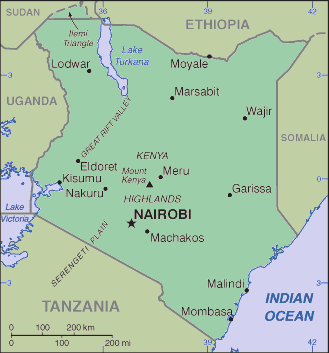 Kenyan map
Regions of Kenya
Founding president and liberation struggle icon Jomo KENYATTA led Kenya from independence in 1963 until his death in 1978, when President Daniel Toroitich arap MOI took power in a constitutional succession. The country was a de facto one-party state from 1969 until 1982 when the ruling Kenya African National Union (KANU) made itself the sole legal party in Kenya. MOI acceded to internal and external pressure for political liberalization in late 1991. The ethnically fractured opposition failed to dislodge KANU from power in elections in 1992 and 1997, which were marred by violence and fraud, but were viewed as having generally reflected the will of the Kenyan people. President MOI stepped down in December 2002 following fair and peaceful elections. Mwai KIBAKI, running as the candidate of the multiethnic, united opposition group, the National Rainbow Coalition, defeated KANU candidate Uhuru KENYATTA and assumed the presidency following a campaign centered on an anticorruption platform.
The regional hub for trade and finance in East Africa, Kenya has been hampered by corruption and by reliance upon several primary goods whose prices have remained low. In 1997, the IMF suspended Kenya's Enhanced Structural Adjustment Program due to the government's failure to maintain reforms and curb corruption. A severe drought from 1999 to 2000 compounded Kenya's problems, causing water and energy rationing and reducing agricultural output. As a result, GDP contracted by 0.2% in 2000. The IMF, which had resumed loans in 2000 to help Kenya through the drought, again halted lending in 2001 when the government failed to institute several anticorruption measures. Despite the return of strong rains in 2001, weak commodity prices, endemic corruption, and low investment limited Kenya's economic growth to 1.2%. Growth lagged at 1.1% in 2002 because of erratic rains, low investor confidence, meager donor support, and political infighting up to the elections. In the key December 2002 elections, Daniel Arap MOI's 24-year-old reign ended, and a new opposition government took on the formidable economic problems facing the nation. In 2003, progress was made in rooting out corruption and encouraging donor support. GDP grew more than 5% in 2005.
Kenyan natural resources include limestone, soda ash, salt, gemstones, fluorspar, zinc, diatomite, gypsum, wildlife, hydropower
the Kenyan Highlands comprise one of the most successful agricultural production regions in Africa; glaciers are found on Mount Kenya, Africa's second highest peak; unique physiography supports abundant and varied wildlife of scientific and economic value
Kenyan religion is Protestant 45%, Roman Catholic 33%, indigenous beliefs 10%, Muslim 10%, other 2%.
Natural hazards in Kenya include recurring drought; flooding during rainy seasons.
Travel Advice for Kenya
KenyaSUMMARY
- Kenya shares with neighbouring countries a high threat from terrorism. This threat remains. Previous attacks have been against civilian or visibly Western targets where foreigners have been present. These have included bomb attacks on a hotel and a western Embassy, both of which resulted in significant loss of life, and an unsuccessful attempt to bring down a civilian airliner in Mombasa.
- Muggings and armed attacks are prevalent, particularly in Nairobi and Mombasa. There have been a number of violent attacks and murders of non-indigenous residents since 2004. Incidents of car-jacking and armed robbery in and around Nairobi are commonplace. On occasion, these result in fatal shootings, most recently in January 2007. You should avoid travelling at night outside Nairobi and remain vigilant.
- We remain concerned about the inadequate security arrangements in place at Wilson airport in Nairobi. The airport is mainly used for domestic flights, including charters. These have been raised with the Kenyan authorities. We continue to monitor the situation. You should remain vigilant at all times.
- Political rallies will be held in the run-up to elections in late 2007. You should avoid political rallies and demonstrations and exercise caution.
- The Kenyan government closed the Kenya - Somalia border on 3 January 2007 due to increased instability in Somalia. There have been skirmishes and inter-clan fighting in the North Eastern Province, along the Somalia border. People have been killed. Travel in the north east should only be undertaken with care and after consulting the Police.
- An outbreak of Rift Valley Fever has been reported in the Central, Coast, Eastern and North Eastern Provinces of Kenya.
- Around 150,000 British nationals visit Kenya each year. The main types of incident for which British nationals require consular assistance in Kenya are road accidents and muggings (5 and 8 cases respectively in 2006.
- We strongly recommend that you obtain comprehensive travel and medical insurance before travelling. You should check any exclusions, and that your policy covers you for the activities you want to undertake. Please see Travel Insurance
SAFETY AND SECURITY
You should read the Security and General Tips and Risk of Terrorism when Travelling Overseas on the FCO website.
Crime
Incidents of car-jacking and armed robbery involving foreign nationals in and around Nairobi are commonplace. On occasion, these result in fatal shootings, most recently in January 2007.
Kenya Country Profile.
Presidential and parliamentary elections will be held in Kenya in late 2007. Most political parties will hold rallies in the run-up to the elections.
Most visits to game reserves and other tourist areas are trouble-free. In 2006 there have been robberies on visitors to game parks, including the Masai Mara. If you wish to visit reserves you should use reputable tour operators and arrive at your destination in daylight hours. You are strongly advised not to buy safari tours from touts but only through reputable agencies or from your hotel.
LOCAL LAWS AND CUSTOMS
You must obtain a valid work permit before taking up any paid or volunteer work in Kenya; the penalties for not doing so can be a fine, jail or deportation depending on the nature of the offence.
The taking of photographs of official buildings, including Embassies, is not recommended and can lead to detention. If in any doubt about what a building is used for, do not photograph it or film around it.
Although there are no strict dress codes, you should note that the coastal areas are predominantly Muslim in tradition. You should dress conservatively away from the tourist resorts and hotels, especially in Mombasa town, to avoid offending local sensitivities. You should respect local customs and sensitivities at all times, especially during the holy month of Ramadan or if you intend to visit religious areas.
Permission to carry any kind of firearm must be obtained from the local authorities prior to entry
It is illegal to destroy Kenyan currency whatever the denomination.
Homosexual activity is illegal in Kenya.
ENTRY REQUIREMENTS
If you are coming to live and work in Kenya, you should be aware that there can be delays in obtaining work permits. It is illegal to work without a permit and this also applies to voluntary work and to the self-employed. British nationals living in Kenya are advised to register with the British High Commission in Nairobi: Kenya: British High Commission Nairobi
Single parents or other adults travelling alone with children should be aware that some countries require documentary evidence of parental responsibility before allowing lone parents to enter the country or, in some cases, before permitting the children to leave the country. For further information on exactly what will be required at Immigration, please contact the Kenya High Commission in London.
HEALTH
In December 2006, January and February 2007, there was an outbreak of Rift Valley fever in Central, Coast, Eastern and North-Eastern Provinces. The North Eastern Province (Garissa, Wajir and Ijara Districts) and Coast Province (Tana River District) of Kenya have been most affected. Cases have also been reported in Kilifi (an area frequented by tourists). Rift Valley fever is a mosquito-borne disease. You should take necessary precautions to prevent mosquito bites if you are travelling in this area. For further information please see: http://www.nathnac.org/pro/clinical_updates/rvf_010207.htm.
Malaria is endemic outside of Nairobi and in areas below 1,800 metres above sea level. However, in 2006, there was an outbreak of highland malaria in the West Pokot District (north western Kenya) that was associated with several fatalities. More than three-quarters of British travellers who contracted malaria in 2005 did not take preventive measures, such as malaria prevention tablets. However, malaria can occur despite appropriate prevention, and therefore you should promptly seek medical care in the event of a fever or flu-like illness in the first year following your return from travelling to a malaria risk country. Before travelling you should seek medical advice about the malaria risk in Kenya.
GENERAL
British nationals visiting Kenya for more than a month and/or travelling to remote areas should register with the High Commission on arrival.
There is a Safety and Communication Centre operated by the Kenya Tourism Federation which can give up to the minute advice on tourist and travel matters, road conditions etc as well as providing help in an emergency. This can be accessed at any time by telephoning + 254 20 604730 or by e-mail to: safetour@wananchi.com
We advise that you leave your passport in the hotel safe, but carry a photocopy for ID purposes
It is advisable to confirm return flights.
Local time is three hours ahead of British winter time (GMT) and two hours ahead of British summer time.
Money
It is unlikely that you will be able to exchange Scottish or Northern Irish banknotes in Kenya. ATMs are widely available in Nairobi and the main towns. Credit cards and travellers’ cheques are widely accepted.