
 Search
Traveling Luck for United Kingdom. United Kingdom, Europe
United Kingdom is located in Western Europe, islands including the northern one-sixth of the island of Ireland between the North Atlantic Ocean and the North Sea, northwest of France.
Land in United Kingdom is mostly rugged hills and low mountains; level to rolling plains in east and southeast.
British land covers an area of 244820 square kilometers which is slightly smaller than Oregon
United Kingdom has borders with Ireland for 360km.
 British national flag (Flag of United Kingdom)
 United Kingdom country profile
As for the British climate; temperate; moderated by prevailing southwest winds over the North Atlantic Current; more than one-half of the days are overcast.
Briton(s), British (collective plural) speak English, Welsh (about 26% of the population of Wales), Scottish form of Gaelic (about 60,000 in Scotland).
Places of note in United Kingdom
- London
- Birmingham
- Glasgow
- Liverpool
- Leeds
- Sheffield
- Edinburgh
- Bristol
- Manchester
- Leicester
- Coventry
- Kingston upon Hull
- Caerdydd
- Bradford
- Belfast
- Stoke-on-Trent
- Wolverhampton
- Plymouth
- Nottingham
- Southampton
- Reading
- Derby
- Dudley
- Northampton
- Portsmouth
- Luton
- Newcastle upon Tyne
- Preston
- Aberdeen
- Sunderland
- Norwich
- Bournemouth
- Walsall
- Swansea
- Southend-on-Sea
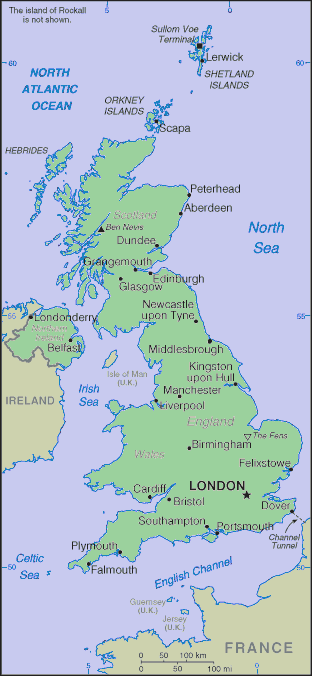 British map
Regions of United Kingdom
- Aberdeen City
- Aberdeenshire
- Angus
- Antrim
- Ards
- Argyll and Bute
- Armagh
- Ballymena
- Ballymoney
- Banbridge
- Barking and Dagenham
- Barnet
- Barnsley
- Bath and North East Somerset
- Bedfordshire
- Belfast
- Bexley
- Birmingham
- Blackburn with Darwen
- Blackpool
- Blaenau Gwent
- Bolton
- Bournemouth
- Bracknell Forest
- Bradford
- Brent
- Bridgend
- Brighton and Hove
- Bristol, City of
- Bromley
- Buckinghamshire
- Bury
- Caerphilly
- Calderdale
- Cambridgeshire
- Camden
- Cardiff
- Carmarthenshire
- Carrickfergus
- Castlereagh
- Ceredigion
- Cheshire
- Clackmannanshire
- Coleraine
- Conwy
- Cookstown
- Cornwall
- Coventry
- Craigavon
- Croydon
- Cumbria
- Darlington
- Denbighshire
- Derby
- Derbyshire
- Derry
- Devon
- Doncaster
- Dorset
- Down
- Dudley
- Dumfries and Galloway
- Dundee City
- Dungannon
- Durham
- Ealing
- East Ayrshire
- East Dunbartonshire
- East Lothian
- East Renfrewshire
- East Riding of Yorkshire
- East Sussex
- Edinburgh, City of
- Eilean Siar
- Enfield
- Essex
- Falkirk
- Fermanagh
- Fife
- Flintshire
- Gateshead
- Glasgow City
- Gloucestershire
- Greenwich
- Gwynedd
- Hackney
- Halton
- Hammersmith and Fulham
- Hampshire
- Haringey
- Harrow
- Hartlepool
- Havering
- Herefordshire
- Hertfordshire
- Highland
- Hillingdon
- Hounslow
- Inverclyde
- Isle of Anglesey
- Isle of Wight
- Islington
- Kensington and Chelsea
- Kent
- Kingston upon Hull, City of
- Kingston upon Thames
- Kirklees
- Knowsley
- Lambeth
- Lancashire
- Larne
- Leeds
- Leicester
- Leicestershire
- Lewisham
- Limavady
- Lincolnshire
- Lisburn
- Liverpool
- London, City of
- Luton
- Magherafelt
- Manchester
- Medway
- Merthyr Tydfil
- Merton
- Middlesbrough
- Midlothian
- Milton Keynes
- Monmouthshire
- Moray
- Moyle
- Neath Port Talbot
- Newcastle upon Tyne
- Newham
- Newport
- Newry and Mourne
- Newtownabbey
- Norfolk
- Northamptonshire
- North Ayrshire
- North Down
- North East Lincolnshire
- North Lanarkshire
- North Lincolnshire
- North Somerset
- North Tyneside
- Northumberland
- North Yorkshire
- Nottingham
- Nottinghamshire
- Oldham
- Omagh
- Orkney Islands
- Oxfordshire
- Pembrokeshire
- Perth and Kinross
- Peterborough
- Plymouth
- Poole
- Portsmouth
- Powys
- Reading
- Redbridge
- Redcar and Cleveland
- Renfrewshire
- Rhondda Cynon Taff
- Richmond upon Thames
- Rochdale
- Rotherham
- Rutland
- Salford
- Sandwell
- Scottish Borders, The
- Sefton
- Sheffield
- Shetland Islands
- Shropshire
- Slough
- Solihull
- Somerset
- Southampton
- South Ayrshire
- Southend-on-Sea
- South Gloucestershire
- South Lanarkshire
- South Tyneside
- Southwark
- Staffordshire
- St. Helens
- Stirling
- Stockport
- Stockton-on-Tees
- Stoke-on-Trent
- Strabane
- Suffolk
- Sunderland
- Surrey
- Sutton
- Swansea
- Swindon
- Tameside
- Telford and Wrekin
- Thurrock
- Torbay
- Torfaen
- Tower Hamlets
- Trafford
- (UK01)
- (UK08)
- (UK11)
- (UK12)
- (UK13)
- (UK17)
- (UK19)
- (UK29)
- (UK32)
- (UK36)
- (UK52)
- (UK64)
- (UK80)
- (UK81)
- (UK82)
- (UK83)
- (UK84)
- (UK85)
- (UK86)
- (UK87)
- (UK88)
- (UK89)
- (UK90)
- (UK91)
- (UK92)
- (UK93)
- (UK96)
- United Kingdom (general)
- Vale of Glamorgan, The
- Wakefield
- Walsall
- Waltham Forest
- Wandsworth
- Warrington
- Warwickshire
- West Berkshire
- West Dunbartonshire
- West Lothian
- Westminster
- West Sussex
- Wigan
- Wiltshire
- Windsor and Maidenhead
- Wirral
- Wokingham
- Wolverhampton
- Worcestershire
- Wrexham
- York
Great Britain, the dominant industrial and maritime power of the 19th century, played a leading role in developing parliamentary democracy and in advancing literature and science. At its zenith, the British Empire stretched over one-fourth of the earth's surface. The first half of the 20th century saw the UK's strength seriously depleted in two World Wars. The second half witnessed the dismantling of the Empire and the UK rebuilding itself into a modern and prosperous European nation. As one of five permanent members of the UN Security Council, a founding member of NATO, and of the Commonwealth, the UK pursues a global approach to foreign policy; it currently is weighing the degree of its integration with continental Europe. A member of the EU, it chose to remain outside the Economic and Monetary Union for the time being. Constitutional reform is also a significant issue in the UK. The Scottish Parliament, the National Assembly for Wales, and the Northern Ireland Assembly were established in 1999, but the latter is suspended due to wrangling over the peace process.
The UK, a leading trading power and financial center, is one of the quintet of trillion dollar economies of Western Europe. Over the past two decades, the government has greatly reduced public ownership and contained the growth of social welfare programs. Agriculture is intensive, highly mechanized, and efficient by European standards, producing about 60% of food needs with less than 2% of the labor force. The UK has large coal, natural gas, and oil reserves; primary energy production accounts for 10% of GDP, one of the highest shares of any industrial nation. Services, particularly banking, insurance, and business services, account by far for the largest proportion of GDP while industry continues to decline in importance. GDP growth slipped in 2001-03 as the global downturn, the high value of the pound, and the bursting of the "new economy" bubble hurt manufacturing and exports. Output recovered in 2004, to 3.2% growth, but fell in 2005, to 1.7%. Despite slower growth, the economy is one of the strongest in Europe; inflation, interest rates, and unemployment remain low. The relatively good economic performance has complicated the BLAIR government's efforts to make a case for Britain to join the European Economic and Monetary Union (EMU). Critics point out that the economy is doing well outside of EMU, and public opinion polls show a majority of Britons are opposed to the euro. Meantime, the government has been speeding up the improvement of education, transport, and health services, at a cost in higher taxes and a widening public deficit.
British natural resources include coal, petroleum, natural gas, iron ore, lead, zinc, gold, tin, limestone, salt, clay, chalk, gypsum, potash, silica sand, slate, arable land
lies near vital North Atlantic sea lanes; only 35 km from France and linked by tunnel under the English Channel; because of heavily indented coastline, no location is more than 125 km from tidal waters
British religion is Christian (Anglican, Roman Catholic, Presbyterian, Methodist) 71.6%, Muslim 2.7%, Hindu 1%, other 1.6%, unspecified or none 23.1% (2001 census).
Natural hazards in United Kingdom include winter windstorms; floods.