World index ... Europe ... Ireland
Travelers word index

Ireland

Continents
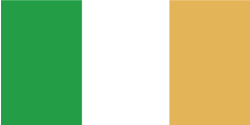
Irish flag

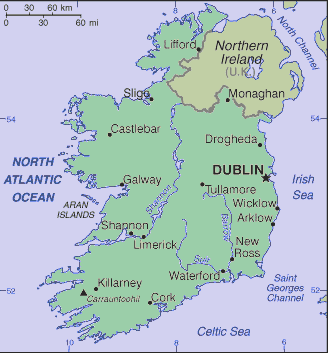
Ireland is located in Western Europe, occupying five-sixths of the island of Ireland in the North Atlantic Ocean, west of Great Britain.

Ireland has borders with United Kingdom for 360km.
Land in Ireland is mostly level to rolling interior plain surrounded by rugged hills and low mountains; sea cliffs on west coast.

Irish land covers an area of 70280 square kilometers which is slightly larger than West Virginia

As for the Irish climate; temperate maritime; modified by North Atlantic Current; mild winters, cool summers; consistently humid; overcast about half the time.

Irishman(men), Irishwoman(women), Irish (collective plural) speak English (official) is the language generally used, Irish (official) (Gaelic or Gaeilge) spoken mainly in areas located along the western seaboard.

Ireland country profile, Travel advice for Ireland

Irish Map
Places of note in Ireland
Baile Átha Cliath
Cork
Dún Laoghaire
Limerick
Galway
Port Láirge
Drogheda
Dún Dealgan
Bray
Sord
An Uaimh
Inis
Trá Lí
Cill Chainnigh
An Nás
Sligeach
Ceatharlach
Droichead Nua
Cill Droichid
Loch Garman
Clonmel
An Muileann gCearr
Letterkenny
Baile Átha Luain
Leixlip
Malahide
Port Laoise
Carraig Uí Leighin
Castlebar
Na Clocha Liatha
Tullamore
Maynooth
Balbriggan
Arklow
Cobh
Regions of Ireland
Carlow
Cavan
Clare
Cork
Donegal
Dublin
Galway
Ireland (general)
Kerry
Kildare
Kilkenny
Laois
Leitrim
Limerick
Longford
Louth
Mayo
Meath
Monaghan
Offaly
Roscommon
Sligo
Tipperary
Waterford
Westmeath
Wexford
Wicklow

Celtic tribes arrived on the island between 600-150 B.C. Invasions by Norsemen that began in the late 8th century were finally ended when King Brian BORU defeated the Danes in 1014. English invasions began in the 12th century and set off more than seven centuries of Anglo-Irish struggle marked by fierce rebellions and harsh repressions. A failed 1916 Easter Monday Rebellion touched off several years of guerrilla warfare that in 1921 resulted in independence from the UK for 26 southern counties; six northern (Ulster) counties remained part of the UK. In 1948 Ireland withdrew from the British Commonwealth; it joined the European Community in 1973. Irish governments have sought the peaceful unification of Ireland and have cooperated with Britain against terrorist groups. A peace settlement for Northern Ireland, known as the Good Friday Agreement and approved in 1998, is being implemented with some difficulties.

Country profile: Ireland

Map of Republic of IrelandAlthough the history of Ireland has seen troubled times, its people have always been associated with a love of music, storytelling and a bit of craic, as a good time with friends is known.

Since joining the European Community in 1973, the Republic of Ireland has accelerated its growth from a largely agricultural society into a prosperous, modern, technologically-advanced Celtic Tiger economy. Tourism too continues to flourish.

For centuries British dominion in Ireland gave rise to unrest which erupted into violence with the Easter Rising of 1916 when independence was proclaimed. The rising was crushed and many of its leaders executed but the campaign carried on.

Ha'penny Bridge - a Dublin landmark

In the early 1920s, 26 counties of Ireland gained independence from London following negotiations which led to partition. The island's other six counties, part of the province of Ulster, remained in the United Kingdom of Great Britain and Northern Ireland. Partition was followed by a year of civil war.

Relations between Dublin and London remained strained for many years afterwards. Northern Ireland saw decades of violent conflict between those campaigning for a united Ireland and those wishing to stay in the United Kingdom.

In an unprecedented and concerted effort to resolve the situation, the Irish and UK governments worked closely together in negotiations which led to the Good Friday Agreement on the future of Northern Ireland in 1998.

Ireland's economy began to grow rapidly in the 1990s, fuelled by foreign investment. This attracted a wave of incomers to a country where, traditionally, mass emigration had been the norm.

Ireland is the birthplace of many famous English-language writers, among them W.B. Yeats, James Joyce, Samuel Beckett, Oscar Wilde and George Bernard Shaw.

President: Mary McAleese

Prime minister: Bertie Ahern

Prime Minister Ahern's government has overseen economic prosperity

Profile: Bertie Ahern

Irish PM Fianna Fail's Bertie Ahern, prime minister (taoiseach) in a coalition government with the Progressive Democrats since 1997, continued in the role following general elections in May 2002 when the coalition became the first government to win re-election in Ireland in more than three decades.

Voters were impressed by the Ahern government's record in building a prosperous economy and by his contribution to the Northern Ireland peace process.

Mr Ahern recognises the tremendous boost Ireland has received from being a member of the EU. One of his main challenges is maintaining the feel-good factor in a country where people have grown used to prosperity.

Though he has been dubbed the "Teflon Taoiseach" for his relatively scandal-free political record, Mr Ahern came under fire in 2006 over controversial loans he received from friends when he was finance minister in the 1990s.

Patrick Bartholomew Ahern was born in Dublin in 1951. He entered parliament in 1977 and served as the city's mayor in 1986-87. He became Fianna Fail leader in 1994.

  • Deputy prime minister: Michael McDowell
  • Foreign minister: Dermot Ahern
  • Finance minister: Brian Cowen

    Public broadcaster Radio Telefis Eireann (RTE) dominates the radio and TV sector. It provides a comprehensive service in both English and Irish. TV3, the main commercial TV broadcaster, opened in 1998.

    Competition for RTE comes mainly from British public and private terrestrial TV channels. Satellite stations, including those carried by Britain's BSkyB, are widely available. There is extensive take-up of cable TV.

    The Irish print and broadcast media operate freely within the confines of the law. Broadcasting is regulated by a commission appointed by the Department of Communications. The Competition Authority safeguards against unfair competition in the press sector.

    Cross-media ownership is permitted within limits - press groups may own up to 25% of local radio and TV stations.

    The press

  • The Irish Times - national daily
  • Irish Independent - national daily
  • Irish Examiner - Cork-based daily
  • Unison.ie - local, regional newspaper portal

    Television

  • RTE - public, operates three networks: RTE 1, RTE 2 and Irish-language TG4
  • TV3 - national, commercial
  • Channel 6 - national, commercial, via cable

    Radio

  • RTE - public, operates four networks: flagship station Radio 1, pop music station 2 FM, Irish-language Raidio na Gaeltachta, classical and cultural station Lyric FM
  • Today FM - national, commercial
  • Newstalk - semi-national, commercial

    Ireland is a small, modern, trade-dependent economy with growth averaging a robust 7% in 1995-2004. Agriculture, once the most important sector, is now dwarfed by industry and services. Industry accounts for 46% of GDP, about 80% of exports, and 29% of the labor force. Although exports remain the primary engine for Ireland's growth, the economy has also benefited from a rise in consumer spending, construction, and business investment. Per capita GDP is 10% above that of the four big European economies and the second highest in the EU behind Luxembourg. Over the past decade, the Irish Government has implemented a series of national economic programs designed to curb price and wage inflation, reduce government spending, increase labor force skills, and promote foreign investment. Ireland joined in circulating the euro on 1 January 2002 along with 11 other EU nations.

    Irish natural resources include natural gas, peat, copper, lead, zinc, silver, barite, gypsum, limestone, dolomite

    strategic location on major air and sea routes between North America and northern Europe; over 40% of the population resides within 100 km of Dublin

    Irish religion is Roman Catholic 88.4%, Church of Ireland 3%, other Christian 1.6%, other 1.5%, unspecified 2%, none 3.5% (2002 census).

    Natural hazards in Ireland include NA.

    Travel Advice on Ireland

    Ireland

    This advice has been reviewed and reissued with an amendment to the Health section (EHIC).  The overall level of the advice has not changed.

    SUMMARY

    • Ireland shares with the rest of Europe a threat from terrorism.  Attacks could be indiscriminate and against civilian targets.

    • We recommend you carry an acceptable form of photo-identification for travel between the UK and Ireland.

    • The currency in Ireland is the Euro.

    • Around 3.5 million British tourists visit Ireland each year.  They usually require consular assistance for lost passports; when they are victims of petty theft; or if they are care-in-the-community psychiatric patients, finding themselves in trouble for public order offences, after travelling to Ireland alone and not taking their medication regularly.  Most incidents occur in the Dublin area.

    • We strongly recommend that you obtain comprehensive travel and medical insurance before travelling.  You should check any exclusions, and that your policy covers you for the activities you want to undertake.  Please see: Travel Insurance


    SAFETY AND SECURITY

    Terrorism
    Ireland shares with the rest of Europe a threat from terrorism.  Attacks could be indiscriminate and against civilian targets.  Please see the Security and General Tips and Risk of Terrorism when Travelling Overseas pages for further information and advice.
    Crime
    Most visitors to Ireland enjoy a trouble-free time and experience no difficulties during their stay.  The capital, Dublin, is a bustling city and tends to be the centre for nightlife and shopping, attracting a lot of people.  The Dublin shopping centre is very busy especially at weekends.  Take normal, sensible precautions to avoid personal attacks, bag snatching and pick pocketing.  Try to avoid carrying valuables and large sums of money.
    You should make sure that vehicles are properly secured, and where possible park in secure parking lots.  Do not leave valuables such as handbags or mobile phones in your car.
    Political Situation
    Ireland Country Profile


    LOCAL LAWS AND CUSTOMS

    In January 2005 Ireland changed all road signs from imperial to metric measurements.
    Do not drink and drive over the legal drinking limit.  You may be heavily penalised or even imprisoned.
    It is now illegal to smoke in places of employment in Ireland.  This covers pubs and restaurants.  Do not be tempted to light up.
    Do not become involved with drugs of any kind.  Possession of even small quantities can lead to long terms of imprisonment.  Do not offer to carry parcels or luggage for any other person when entering or leaving Ireland.


    ENTRY REQUIREMENTS

    Ireland, along with the UK, is a member of the Common Travel Area.  This means that UK passport holders do not require their passport to visit Ireland for immigration purposes.  However, we recommend you carry an acceptable form of photo-identification for travel between the UK and Ireland (and between UK airports).


    HEALTH

    We strongly recommend that you obtain comprehensive travel and medical insurance before travelling.  You should check any exclusions, and that your policy covers you for the activities you want to undertake.  Please see: Travel Insurance.  You should ensure that you have sufficient medical insurance to cover your stay in Ireland.  If you need a doctor you may be asked to pay for the consultation there and then.
    You should obtain a European Health Insurance Card (EHIC) before leaving the UK.  The EHIC is not a substitute for medical and travel insurance, but entitles you to emergency medical treatment on the same terms as Irish nationals.  You will not be covered for medical repatriation, on-going medical treatment or treatment of a non-urgent nature.  For more information about how to obtain the EHIC please see the Europe and EHIC page on the FCO website via the following link Europe and the EHIC.
    You should seek medical advice before travelling and ensure that all appropriate vaccinations are up-to-date.  For further information on health, check the Department of Health’s website at www.dh.gov.uk


    GENERAL

    If things go wrong when overseas, please see: What We Can Do To Help
    The revised EU-wide security measures that came into effect for all passengers departing from UK airports in November 2006 are also being implemented in Ireland.  For more details about this please see: DfT - Airline Security Update
    Check before you travel that your bank cash card can be used in ATM machines in Ireland.  Remember that the currency in Ireland is the Euro.


  • What is this world index all about?