
 Search
Traveling Luck for Ivory Coast. Ivory Coast, Africa
Cote d'Ivoire is located in Western Africa, bordering the North Atlantic Ocean, between Ghana and Liberia.
Land in Cote d'Ivoire is mostly flat to undulating plains; mountains in northwest.
Ivoirian land covers an area of 322460 square kilometers which is slightly larger than New Mexico
Ivory Coast has borders with Burkina Faso for 584km, Ghana for 668km, Guinea for 610km, Liberia for 716km and Mali for 532km.
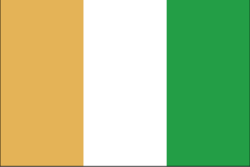 Ivoirian national flag (Flag of Ivory Coast)
 Ivory Coast country profile
 Travel advice for Ivory Coast
As for the Ivoirian climate; tropical along coast, semiarid in far north; three seasons - warm and dry (November to March), hot and dry (March to May), hot and wet (June to October).
Ivoirian(s) speak French (official), 60 native dialects with Dioula the most widely spoken.
Places of note in Ivory Coast
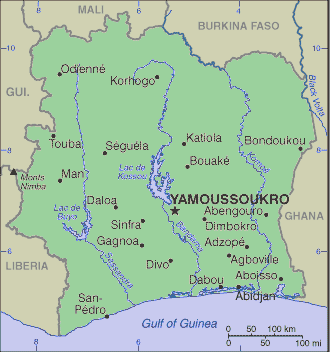 Ivoirian map
Regions of Ivory Coast
- Agnéby
- Bafing
- Bas-Sassandra
- Côte dʼIvoire (general)
- Denguélé
- Dix-Huit Montagnes
- Fromager
- Haut-Sassandra
- (IV01)
- (IV03)
- (IV04)
- (IV05)
- (IV06)
- (IV07)
- (IV11)
- (IV12)
- (IV14)
- (IV16)
- (IV17)
- (IV18)
- (IV20)
- (IV21)
- (IV23)
- (IV25)
- (IV26)
- (IV27)
- (IV28)
- (IV29)
- (IV30)
- (IV31)
- (IV32)
- (IV33)
- (IV34)
- (IV35)
- (IV36)
- (IV37)
- (IV38)
- (IV39)
- (IV40)
- (IV41)
- (IV42)
- (IV43)
- (IV44)
- (IV45)
- (IV46)
- (IV47)
- (IV48)
- (IV49)
- (IV50)
- (IV51)
- (IV52)
- (IV53)
- (IV54)
- (IV55)
- (IV56)
- (IV57)
- (IV58)
- (IV59)
- (IV60)
- (IV61)
- (IV62)
- (IV63)
- (IV64)
- (IV65)
- (IV66)
- (IV67)
- (IV68)
- (IV69)
- (IV70)
- (IV71)
- (IV72)
- (IV73)
- Lacs
- Lagunes
- Marahoué
- Moyen-Cavally
- Moyen-Comoé
- Nʼzi-Comoé
- Savanes
- Sud-Bandama
- Sud-Comoé
- Vallée du Bandama
- Worodougou
- Zanzan
Close ties to France since independence in 1960, the development of cocoa production for export, and foreign investment made Cote d'Ivoire one of the most prosperous of the tropical African states, but did not protect it from political turmoil. In December 1999, a military coup - the first ever in Cote d'Ivoire's history - overthrew the government. Junta leader Robert GUEI blatantly rigged elections held in late 2000 and declared himself the winner. Popular protest forced him to step aside and brought runner-up Laurent GBAGBO into power. Ivorian dissidents and disaffected members of the military launched a failed coup attempt in September 2002. Rebel forces claimed the northern half of the country, and in January 2003 were granted ministerial positions in a unity government under the auspices of the Linas-Marcoussis Peace Accord. President GBAGBO and rebel forces resumed implementation of the peace accord in December 2003 after a three-month stalemate, but issues that sparked the civil war, such as land reform and grounds for citizenship, remain unresolved. The central government has yet to exert control over the northern regions and tensions remain high between GBAGBO and opposition leaders. Several thousand French and West African troops remain in Cote d'Ivoire to maintain peace and facilitate the disarmament, demobilization, and rehabilitation process.
Cote d'Ivoire is among the world's largest producers and exporters of coffee, cocoa beans, and palm oil. Consequently, the economy is highly sensitive to fluctuations in international prices for these products and weather conditions. Despite government attempts to diversify the economy, it is still heavily dependent on agriculture and related activities, engaging roughly 68% of the population. Growth was negative in 2000-03 because of the difficulty of meeting the conditions of international donors, continued low prices of key exports, and severe civil war. In November 2004, the situation deteriorated when President GBAGBO's troops attacked and killed nine French peacekeeping forces, and the UN imposed an arms embargo. Political turmoil damaged the economy in 2005, with fear among Ivorians spreading, foreign investment shriveling, French businesses and expats fleeing, travel within the country falling, and criminal elements that traffic in weapons and diamonds gaining ground. The government will continue to survive financially off of the sale of cocoa, which represents 90% of foreign exchange earnings. Though the 2005 harvest was largely unaffected by past fighting, the government will likely lose between 10% and 20% of its cocoa harvest to northern rebels, who smuggle the cocoa they control to neighboring countries where cocoa prices are higher. The government remains hopeful that ongoing exploration of Cote d'Ivoire's offshore oil reserves will result in significant production that could boost daily crude output from roughly 33,000 barrels per day (b/d) to over 200,000 b/d by the end of the decade.
Ivoirian natural resources include petroleum, natural gas, diamonds, manganese, iron ore, cobalt, bauxite, copper, gold, nickel, tantalum, silica sand, clay, cocoa beans, coffee, palm oil, hydropower
most of the inhabitants live along the sandy coastal region; apart from the capital area, the forested interior is sparsely populated
Ivoirian religion is Muslim 35-40%, indigenous 25-40%, Christian 20-30% (2001).
Natural hazards in Cote d'Ivoire include coast has heavy surf and no natural harbors; during the rainy season torrential flooding is possible.
Travel Advice for Ivory Coast
Ivory CoastSUMMARY
- We continue to advise against all travel to Ivory Coast. The situation in the country remains fragile and unpredictable, especially in the far west of the country, which should be avoided at all times.
- There is potential for unrest, with implications for the sudden deterioration of law and order, at any time. Political tensions are particularly heightened at present as the peace process is at a critical stage with UN Security Council Resolution 1633 expiring on 31 October.
- If against our advice you decide to travel to Ivory Coast, you should take strong security precautions and register with the British High Commission in Accra or our local warden network in Abidjan (details are given below). Events can move fast and violence could erupt at short notice.
- Operations at the British Embassy in Abidjan were suspended on 1 April 2005. The UK government does not offer formal consular protection in the Ivory Coast. Only very limited consular assistance can be provided from Accra.
- We will be unable to mount an evacuation of British nationals as we did in November 2004. Should there be a serious breakdown in order, you should seek the assistance of other EU missions in Abidjan. But you should be aware that other countries may not be able to mount rescue operations as happened then.
- The threat from terrorism in Ivory Coast is assessed as low.
- We strongly recommend that you obtain comprehensive travel and medical insurance before travelling. You should check any exclusions, and that your policy covers you for the activities you want to undertake. Please see: Travel Insurance.
SAFETY AND SECURITY
If, despite our advice you decide to travel to Ivory Coast, you should be aware that violent crime in Abidjan is on the increase as the security situation deteriorates. There is a significant risk of car-jackings, as well as armed break-ins to private residences and hold- ups in streets and restaurants, particularly those frequented by Westerners. Weapons circulate freely.
If you are the victim of a robbery, co-operate with your assailants and give them what they want without hesitation. Keep your eyes down and do not make a lot of noise; you are less likely to be physically harmed.
In Abidjan you should be cautious, particularly after dark. You should avoid confrontation with police and security forces. Respect army and police roadblocks and co-operate politely if you need to pass through one. Do not be surprised if you are asked for money by people in uniform. Do not carry valuables in public. Do not walk around at night and avoid using taxis. Avoid driving late at night. Avoid crossing the two bridges over the lagoon in Abidjan on foot, even in daylight hours.
Foreign travellers are increasingly becoming targets by scam artists. The scams come in many forms, and can pose great financial loss to victims. Scam artists are also targeting individuals in the UK. Relatives or friends in the UK should first check with the person who has travelled to before becoming involved in the transfer of money. If you are concerned about someone who has travelled to Ivory Coast you should contact the Consular Section of the British High Commission, Accra (E-mail: high.commission.accra@fco.gov.uk). Schemes in operation by West African criminal networks are designed to facilitate victims parting with money, known as advance fee or 419 fraud. Scam artists are also known to be targeting internet dating/personal sites with the intention of soliciting money from victims. For further information on advance fee fraud please see: http://www.met.police.uk/fraudalert.
Political Situation
Cote d'Ivoire Country Profile
We continue to advise against all travel to Ivory Coast. If, despite this advice, you decide to travel to Ivory Coast, you should be very careful about, and confident of, your personal security arrangements throughout your visit. We will be unable to mount an evacuation as we did in November 2004. Other countries may not be able to mount rescue operations as happened then.
We strongly recommend you stay in contact with our local warden network and the British High Commission in Accra.
Political tensions are particularly heightened at present as the peace process is at a critical stage with UN Security Council Resolution 1633 expiring on 31 October.
On 2 January 2006, a group of disaffected soldiers attacked a military base in Abidjan. Gunfire and heavy explosions were reported during the attack. Approximately 10 people were killed. Calm was restored soon after the incident.
On the night of the 5 February 2006, an unidentified group attacked Pehapan, a village in Guiglo district. Twelve people were reported killed and others wounded. In April 2006 a UN bus was set alight in Youpougon.
Local Travel
Due to anti-western sentiment, which has motivated recent violence, we advise against all travel to Ivory Coast. If you decide to travel to Ivory Coast despite this advice, you should take particular care in the north and west of the country, where despite the UN presence, armed militias continue to operate in many areas and where there have been frequent clashes. In the area between Duékoué and Odienne, armed elements are often under the influence of drink or drugs, which makes them particularly unpredictable. In May and June 2005, up to 75 people were reported to have been killed in clashes in this area.
Extreme caution should be exercised and strong security precautions put in place if travelling anywhere off the beaten track.
Between 24 and 26 July 2005 there were violent incidents in Abidjan, Anyama and Agboville, resulting in five deaths and several more injured.
All access roads to major towns in government controlled areas have been closed off from 2200 - 0600. The ban applies to Abidjan, Yamoussoukro, San Pedro and all other major towns in the south.
Air Safety
The European Commission has published a list of air carriers that are subject to an operating ban or restrictions within the European Union. You should check the following link to see whether this will affect your travel: http://europa.eu.int/comm/transport/air/safety/flywell_en.htm
HEALTH
Toxic waste was dumped in Abidjan in August 2006. Tensions increased as seven people were confirmed as having died and several thousand sought medical attention. The neighbourhoods affected were Vridi, Anyama Road, Yopougon, Alepe, Pateau-Dokui and Akouedo. But fumes also spread to Koumassi, Marcory, Port-Bouet and Cocody.
If, against our advice, you travel to Ivory Coast you should seek up to date medical advice about suitable anti-malarial medication and on arrival, ensure you take adequate precautions against being bitten by mosquitoes. More than three-quarters of British travellers who contracted malaria in 2005 did not take preventive measures, such as malaria prevention tablets. However, malaria can occur despite appropriate prevention, and therefore you should promptly seek medical care in the event of a fever or flu-like illness in the first year following your return from travelling to a malaria risk country. Before travelling you should seek medical advice about the malaria risk in Ivory Coast.
Cholera is present in rural areas, and care should be taken to drink only boiled/bottled water. HIV/AIDS is widespread and there have been cases of yellow fever.
If, against our advice, you travel to Ivory Coast you should seek medical advice before travelling and ensure that all appropriate vaccinations are up to date. For further information on health, check the Department of Health’s website at: www.dh.gov.uk.
Avian Influenza
The World Health Organisation (WHO) has confirmed several cases of Avian Influenza (Bird Flu) in two separate locations in the capital Abidjan, affecting domestic birds and a wild sparrow hawk. No human infections or deaths have been reported.
The risk to humans from Avian Influenza is believed to be very low. As a precaution, you should avoid visiting live animal markets, poultry farms and other places where you may come into close contact with domestic, caged or wild birds; and ensure poultry and egg dishes are thoroughly cooked.
You should read this advice in conjunction with the Avian and Pandemic Influenza Factsheet, which gives more detailed advice and information.
GENERAL