
 Search
Traveling Luck for Liberia. Liberia, Africa
Liberia is located in Western Africa, bordering the North Atlantic Ocean, between Cote d'Ivoire and Sierra Leone.
Land in Liberia is mostly flat to rolling coastal plains rising to rolling plateau and low mountains in northeast.
Liberian land covers an area of 111370 square kilometers which is slightly larger than Tennessee
Liberia has borders with Ivory Coast for 716km, Guinea for 563km and Sierra Leone for 306km.
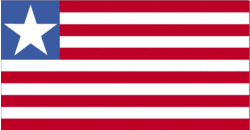 Liberian national flag (Flag of Liberia)
 Liberia country profile
 Travel advice for Liberia
As for the Liberian climate; tropical; hot, humid; dry winters with hot days and cool to cold nights; wet, cloudy summers with frequent heavy showers.
Liberian(s) speak English 20% (official), some 20 ethnic group languages, of which a few can be written and are used in correspondence.
Places of note in Liberia
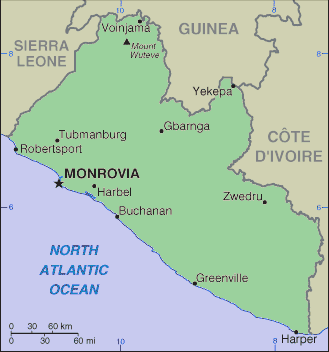 Liberian map
Regions of Liberia
In August 2003, a comprehensive peace agreement ended 14 years of civil war and prompted the resignation of former president Charles TAYLOR, who was exiled to Nigeria. After two years of rule by a transitional government, democratic elections in late 2005 brought President Ellen JOHNSON-SIRLEAF to power. The legislative and presidential polls were broadly deemed free and fair despite fraud allegations from JOHNSON-SIRLEAF's rival George WEAH. The UN Mission in Liberia (UNMIL), which maintains a strong presence throughout the country, completed a disarmament program for former combatants in late 2004, but the security situation is still volatile and the process of rebuilding the social and economic structure of this war-torn country remains sluggish.
Civil war and government mismanagement have destroyed much of Liberia's economy, especially the infrastructure in and around Monrovia, while continued international sanctions on diamonds and timber exports will limit growth prospects for the foreseeable future. Many businessmen have fled the country, taking capital and expertise with them. Some have returned, but many will not. Richly endowed with water, mineral resources, forests, and a climate favorable to agriculture, Liberia had been a producer and exporter of basic products - primarily raw timber and rubber. Local manufacturing, mainly foreign owned, had been small in scope. The departure of the former president, Charles TAYLOR, to Nigeria in August 2003, the establishment of the all-inclusive Transitional Government, and the arrival of a UN mission have helped defuse the political crisis, but have done little to encourage economic development. Wealthy international donors, who are ready to assist reconstruction efforts, are withholding funding until Liberia's National Assembly signs onto a Governance and Economic Management Action Plan (GEMAP). The Plan was created in October 2005 by the International Contact Group for Liberia to help ensure transparent revenue collection and allocation - something that was lacking under the Transitional Government and that has limited Liberia's economic recovery. The reconstruction of infrastructure and the raising of incomes in this ravaged economy will largely depend on generous financial support and technical assistance from donor countries.
Liberian natural resources include iron ore, timber, diamonds, gold, hydropower
facing the Atlantic Ocean, the coastline is characterized by lagoons, mangrove swamps, and river-deposited sandbars; the inland grassy plateau supports limited agriculture
Liberian religion is indigenous beliefs 40%, Christian 40%, Muslim 20%.
Natural hazards in Liberia include dust-laden harmattan winds blow from the Sahara (December to March).
Travel Advice for Liberia
LiberiaSUMMARY
- We advise against all but essential travel to Liberia.
- Former Liberian President Charles Taylor was transferred to the Special Court for Sierra Leone in The Hague on 20 June 2006. The possibility of protests regarding developments in his case remains. You should avoid public demonstrations or large crowds.
- UN peacekeepers are deployed to the main population centres and patrol major roads, but the security situation remains unpredictable. There are sporadic demonstrations, and the possibility of violence remains.
- You should avoid travelling alone, particularly at night and to secluded places.
- If you decide to travel outside Monrovia, we recommend that you do not overnight outside the city and that you check the security situation before travelling.
- There are approx. 60 British nationals working in Liberia with the United Nations or other NGOs. The main type of incident for which British nationals require consular assistance in Liberia is lost or stolen passports. Crime, including violent crime, is high.
- The British Ambassador to Liberia resides in Freetown, Sierra Leone. The British Government has limited ability to assist British nationals in Liberia.
- The threat from terrorism is low.
- You should carry photographic identification with you at all times.
- We strongly recommend that you obtain comprehensive travel and medical insurance before travelling. You should check any exclusions, and that your policy covers you for the activities you want to undertake. Please see: Travel Insurance.
SAFETY AND SECURITY
Crime – including violent crime – is high and has increased in Monrovia and elsewhere, and is often directed against foreigners. In May 2004, a guest was killed at the Mamba Point Hotel in Monrovia in an attempted robbery. There have been incidents of muggings of foreigners on beaches around Monrovia. You should avoid carrying valuables in public and be vigilant at all times, especially at night. The UN and some other international organisations impose a curfew on their international staff.
There is a high incidence of rape in Liberia and in the summer 2006 there was an increase in the number of rapes and attempted rapes involving expatriate women. A number of hospitals and clinics, notably those run by Medicins Sans Frontiere, offer free specialised treatment to victims of rape and sexual violence.
You should not become involved with drugs of any kind. Local prison conditions are harsh.
Liberia is subject to UN sanctions, which prohibit the export of diamonds and the import of arms.
Political Situation
Liberia Country Profile
Following elections in October and November 2005, the new Liberian government is working with the UN and the international community to provide increased stability and development.
However, the situation remains volatile, with further outbreaks of violence possible. Despite the end of the voluntary disarmament programme, and the ban on carrying weapons, some firearms are still in circulation. UN Peacekeepers are deployed to the main population centres around Liberia, and patrol the principle roads, but some areas of the country are not completely under their control. If you travel outside Monrovia you should check the latest security situation (e.g. with UNMIL) before departing and should avoid spending the night outside the city. Rioting by armed mobs after the elections in November 2005 left 2 people dead.
Former President Charles Taylor was captured on 29 March 2006, in north-eastern Nigeria while fleeing from his residence in Calabar, Nigeria. On 30 March 2006, Charles Taylor was taken into custody by UNMIL for transfer to the Special Court for Sierra Leone to face charges related to his involvement in the civil war in that country. On 20 June 2006, the location of Charles Taylor's trial was moved to The Hague and Taylor was transferred there from Sierra Leone. However, the possibility of disturbances related to the detention and trial of Charles Taylor remains. You are advised to remain vigilant, avoid large crowds and demonstrations.
In case of unrest you should remain indoors in a secure location. You are recommended to maintain at least a three-day supply of food, water and other essentials in your home and office.
The situation in some other countries in West Africa is also volatile. You should avoid areas in Liberia bordering neighbouring countries and exercise particular caution in the counties bordering Ivory Coast (Nimba, Grand Gedeh, River Gee and Maryland). Check the Travel Advice and latest situation in any countries that you will be transiting on your way to/from Liberia.
Local Travel
We advise against all but essential travel to Liberia. If on essential business, you should ensure that you are supported by a reliable organisation with a comprehensive and adequate security plan. You should familiarise yourself with your organisation's security plan and follow it at all times, and monitor the security situation (e.g. on UNMIL radio, 91.5FM). We advise against spending the night outside Monrovia.
Many organisations, including the UN and the US Embassy, impose restrictions on staff travel outside Monrovia. You should avoid travelling alone, particularly at night and to secluded places.
Public transport, where it exists, is neither reliable nor necessarily safe. The rainy season (May to November) makes travel to outlying areas particularly difficult and hazardous.
Road Safety
Roads outside Monrovia are often in very poor condition: almost all roads are unlit and potholes are common. Driving and road conditions deteriorate significantly during the rainy season (May to November). Travel after dark should be avoided.
Air Safety
The European Commission has published a list of air carriers that are subject to an operating ban or restrictions within the European Union. You should check the following link to see whether this will affect your travel: http://europa.eu.int/comm/transport/air/safety/flywell_en.htm.
Any airline from outside the EU or European Economic area, which wishes to pick up or put down passengers or cargo in the UK, requires a permit from the Secretary of State. It is a condition of the permit that the airline should be operated in accordance with international safety standards established by the International Civil Aviation Organisation. No airline registered in Liberia currently has a permit to land in the UK.
Following the October 2006 crash (cause unknown) of a Boeing 737 operated by Bellview Airlines en route from Lagos to Abuja (killing all 117 passengers and crew) and a more recent emergency landing (hydraulic failure) by another Bellview operated Boeing 737, the airline was grounded for a week by Nigerian authorities. This affected regional flights to Monrovia. We advise that these incidents are taken into consideration when planning any regional travel in West Africa.
ENTRY REQUIREMENTS
Single parents or other adults travelling alone with children should be aware that some countries require documentary evidence of parental responsibility before allowing lone parents to enter the country. For further information on exactly what will be required at immigration, please contact the Liberian representation in the UK.
HEALTH
GENERAL
The Atlantic Ocean can be unpredictable and subject to riptides and other dangerous currents. If visiting the beach you should exercise great caution as to where, when and whether you swim.
British nationals are advised to register with the British Honorary Consul, Mr Roy Chalkley, is the first contact for consular issues. His contact details in Liberia are: UMARCO, Clara Town, UN Drive, Bushrod Island, Monrovia. Telephone (+231) 226 056 or Mobile: (+ 231) 6 516 973; Fax: (+ 231) 226 061; E-mail: chalkleyroy@aol.com
The British High Commission in Freetown, Sierra Leone is responsible for Liberia.