World index ... Europe ... Malta
Travelers word index

Malta

Continents
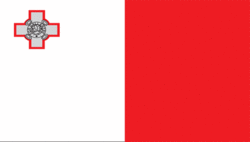
Maltese flag

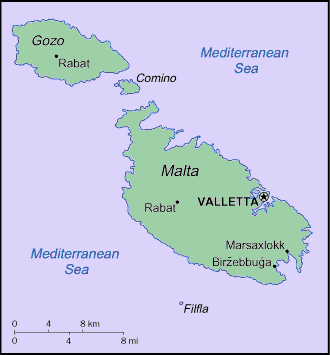
Malta is located in Southern Europe, islands in the Mediterranean Sea, south of Sicily (Italy).

Land in Malta is mostly low, rocky, flat to dissected plains; many coastal cliffs.

Maltese land covers an area of 316 square kilometers which is slightly less than twice the size of Washington, DC
As for the Maltese climate; Mediterranean; mild, rainy winters; hot, dry summers.

Maltese (singular and plural) speak Maltese (official), English (official).

Malta country profile, Travel advice for Malta

Maltese Map
Places of note in Malta
Birkirkara
Qormi
Mosta
Żabbar
Rabat
San Ġwann
Fgura
Żejtun
Sliema
Żebbuġ
Ħamrun
Naxxar
Attard
Paola
Żurrieq
Tarxien
Siġġiewi
Il-Gżira
San Pawl il-Baħar
Msida
San Ġiljan
Valletta
Victoria
Santa Vennera
Cospicua
Mellieħa
Is-Swieqi
Marsa
Luqa
Għaxaq
Nadur
Santa Luċija
Xagħra
Senglea
L-Iklin
Regions of Malta
Malta (general)

Great Britain formally acquired possession of Malta in 1814. The island staunchly supported the UK through both World Wars and remained in the Commonwealth when it became independent in 1964. A decade later Malta became a republic. Since about the mid-1980s, the island has transformed itself into a freight transshipment point, a financial center, and a tourist destination. Malta became an EU member in May 2004.

Country profile: Malta

map of MaltaThe Maltese archipelago includes the islands of Malta, Gozo, Comino, Comminotto and Filfla.

It has a history of colonial control spanning centuries.

Located south of the Italian island of Sicily between Europe and North Africa, it has been occupied by Phoenicians, Greeks, Romans, Arabs and latterly France and Britain.

Independence from Britain was achieved in 1964, after the Maltese people were awarded the George Cross for defending the island during World War II.

Forty years on Malta was the smallest of the 10 countries to join the EU in May 2004. It aims to join the eurozone in 2008.

Valletta

Since becoming an EU member, the tiny island has reported an increasing problem with immigration from north Africa and has requested more help to deal with it. The UN refugee agency has criticised the island's policy of keeping asylum seekers in detention for 18 months.

Over the centuries, Malta's strategic position fostered its development as an important trading post and it remains a leading centre for container and freight transhipment.

Malta is a popular holiday destination and tourism is the nation's main source of incomce.

President: Edward Fenech Adami

Prime minister: Lawrence Gonzi

Lawrence Gonzi took office in March 2004, just before Malta entered the EU.

Maltese prime minister He said Malta should seize the opportunities afforded by membership. The country was "at the beginning of a new road", he added.

Mr Gonzi was elected as head of the ruling Nationalist Party after veteran leader Edward Fenech Adami announced his retirement.

He promised to boost tourism and to create favourable conditions for investment.

A lawyer by profession, he became a government minister in 1998.

Many of Malta's newspapers and broadcasters have strong political affiliations. Dailies and weeklies appear in Maltese and English.

Maltese radio began in the mid-1930s, partly to counter Fascist propaganda broadcasts from Italy. Malta Television launched in 1962, five years after the islanders started receiving television signals from Italy. Italian TV channels remain popular.

The first private broadcasting licences were granted to the two major political parties and the Catholic Church. More stations followed and there is now a proliferation of privately-run radio stations and several TV channels.

Since Malta is a member of the Council of Europe, media laws are based on European law.

Cable TV was introduced in 1992 and satellite TV is widely-watched.

The press

  • Times of Malta - daily
  • Malta Independent - daily
  • It-Torca - weekly, owned by General Workers' Union
  • Il-Mument - weekly, owned by Nationalist Party
  • In-Nazzjon - daily, owned by Nationalist Party
  • L-Orrizont - daily, owned by General Workers' Union
  • Malta Today

    Television

  • Television Malta (TVM) - public
  • Super One TV - owned by Malta Labour Party
  • Net TV - owned by Nationalist Party

    Radio

  • Radio Malta - public
  • Super One Radio - owned by Malta Labour Party
  • Radio 101 - owned by Nationalist Party
  • Bay Radio - private, FM music station
  • RTK - Catholic Church station

    Internet

  • MaltaMedia
  • di-ve.com
  • maltarightnow.com
  • maltastar.com

    Major resources are limestone, a favorable geographic location, and a productive labor force. Malta produces only about 20% of its food needs, has limited fresh water supplies, and has few domestic energy sources. The economy is dependent on foreign trade, manufacturing (especially electronics and textiles), and tourism. Continued sluggishness in the European economy is holding back exports, tourism, and overall growth.

    Maltese natural resources include limestone, salt, arable land

    the country comprises an archipelago, with only the three largest islands (Malta, Ghawdex or Gozo, and Kemmuna or Comino) being inhabited; numerous bays provide good harbors; Malta and Tunisia are discussing the commercial exploitation of the continental shelf between their countries, particularly for oil exploration

    Maltese religion is Roman Catholic 98%.

    Natural hazards in Malta include NA.

    Travel Advice on Malta

    Malta

    This advice has been reviewed and reissued with amendments to the Health section (EHIC) and General section (EU Aviation Regulations).  The overall level of the advice has not changed.

    SUMMARY

    • The threat from terrorism is low.  But, you should be aware of the global risk of indiscriminate terrorist attacks, which could be against civilian targets, including places visited by foreigners.

    • Around 400,000 British tourists visit Malta every year.  Most visits are trouble-free.  The main type of incidents for which British nationals require consular assistance in Malta are for replacing lost/stolen passports and financial assistance.

    • We strongly recommend that you obtain comprehensive travel and medical insurance before travelling.  You should check any exclusions, and that your policy covers you for the activities you want to undertake.  Please see Travel Insurance.


    SAFETY AND SECURITY


    Crime

    Crime against tourists is rare although robberies, handbag snatching, pickpocketing and theft from parked cars can occur.  Visitors should safeguard passports, money and other valuables; for example by using hotel safety deposit boxes.

    Political Situation

    Malta Country Profile

    Road Safety

    Caution should be exercised whilst driving as some roads are in a poor state of repair.  Main arterial roads are in reasonable condition.  You should keep to the speed limits.  Local standards of driving are poor.


    LOCAL LAWS AND CUSTOMS

    Penalties for possession, use, or trafficking in illegal drugs in Malta are strict and convicted offenders can expect jail sentences and heavy fines.


    ENTRY REQUIREMENTS

    British nationals do not require a visa to visit Malta.

    Single parents or other adults travelling alone with children should be aware that some countries require documentary evidence of parental responsibility before allowing lone parents to enter the country or, in some cases, before permitting the children to leave the country.  This does not apply to Malta.


    HEALTH

    We strongly recommend that you obtain comprehensive travel and medical insurance before travelling.  You should check any exclusions, and that your policy covers you for the activities you want to undertake.  Please see:  Travel Insurance.
    The Form E111 is no longer valid.  You should obtain a European Health Insurance Card (EHIC) before leaving the UK.  The EHIC is not a substitute for medical and travel insurance, but entitles you to emergency medical treatment on the same terms as Maltese nationals.  You will not be covered for medical repatriation, on-going medical treatment or treatment of a non-urgent nature.  For more information about how to obtain the EHIC please see:  Europe and the EHIC.

    For further information on health, check the Department of Health’s website at: www.dh.gov.uk.


    GENERAL

    If things go wrong when overseas, please see What We Can Do To Help.
    EU Aviation Regulations
    The revised EU-wide security measures that came into effect for all passengers departing from UK airports in November 2006 are also being implemented in Malta.  For more details about this please see:  DfT - Airline Security Update.


  • What is this world index all about?