
 Search
Traveling Luck for Luxembourg. Luxembourg, Europe
Luxembourg is located in Western Europe, between France and Germany.
Land in Luxembourg is mostly gently rolling uplands with broad, shallow valleys; uplands to slightly mountainous in the north; steep slope down to Moselle flood plain in the southeast.
Luxembourg land covers an area of 2586 square kilometers which is slightly smaller than Rhode Island
Luxembourg has borders with Belgium for 148km, Germany for 138km and France for 73km.
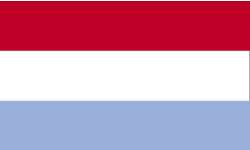 Luxembourg national flag (Flag of Luxembourg)
 Luxembourg country profile
 Travel advice for Luxembourg
As for the Luxembourg climate; modified continental with mild winters, cool summers.
Luxembourger(s) speak Luxembourgish (national language), German (administrative language), French (administrative language).
Places of note in Luxembourg
- Luxembourg
- Esch-sur-Alzette
- Dudelange
- Schifflange
- Bettembourg
- Pétange
- Ettelbruck
- Diekirch
- Strassen
- Bertrange
- Belvaux
- Differdange
- Mamer
- Soleuvre
- Wiltz
- Echternach
- Rodange
- Obercorn
- Bascharage
- Kayl
- Grevenmacher
- Béreldange
- Mersch
- Mondercange
- Remich
- Niedercorn
- Mondorf-les-Bains
- Tétange
- Bissen
- Sandweiler
- Sanem
- Lamadelaine
- Bridel
- Junglinster
- Wasserbillig
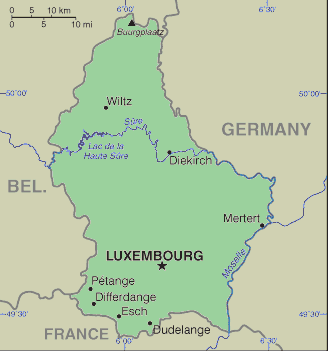 Luxembourg map
Regions of Luxembourg
Founded in 963, Luxembourg became a grand duchy in 1815 and an independent state under the Netherlands. It lost more than half of its territory to Belgium in 1839, but gained a larger measure of autonomy. Full independence was attained in 1867. Overrun by Germany in both World Wars, it ended its neutrality in 1948 when it entered into the Benelux Customs Union and when it joined NATO the following year. In 1957, Luxembourg became one of the six founding countries of the European Economic Community (later the European Union), and in 1999 it joined the euro currency area.
This stable, high-income economy - benefitting from its proximity to France, Belgium, and Germany - features solid growth, low inflation, and low unemployment. The industrial sector, initially dominated by steel, has become increasingly diversified to include chemicals, rubber, and other products. Growth in the financial sector, which now accounts for about 28% of GDP, has more than compensated for the decline in steel. Most banks are foreign-owned and have extensive foreign dealings. Agriculture is based on small family-owned farms. The economy depends on foreign and cross-border workers for more than 30% of its labor force. Although Luxembourg, like all EU members, has suffered from the global economic slump, the country enjoys an extraordinarily high standard of living - GDP per capita ranks first in the world.
Luxembourg natural resources include iron ore (no longer exploited), arable land
landlocked; the only Grand Duchy in the world
Luxembourg religion is 87% Roman Catholic, 13% Protestants, Jews, and Muslims (2000).
Natural hazards in Luxembourg include NA.
Travel Advice for Luxembourg
LuxembourgSUMMARY
- Luxembourg shares with the rest of Europe a threat from international terrorism. Attacks could be indiscriminate and against civilian targets.
- Around 120,000 British nationals visit Luxembourg every year. Most visits to are trouble-free. The main type of incident for which British nationals require consular assistance in Luxembourg is for replacing lost or stolen passports. Luxembourg can only issue Emergency Passports in a genuine emergency. Otherwise, full passport services can be obtained from the British Consulate-General in Paris.
- We strongly recommend that you obtain comprehensive travel and medical insurance before travelling. You should check any exclusions, and that your policy covers you for the activities you want to undertake. Please see: Travel Insurance.
SAFETY AND SECURITY
You are advised to take the usual sensible precautions against crime.
Political Situation
Luxembourg Country Profile
Local Travel
Travel by car, train and bus throughout the country is relatively quick and easy. When you drive, remember that there are different speed restrictions to the UK. ‘On the spot fines’ are common. It is advisable to travel with vehicle registration documents to prove you are the legal owner of the vehicle you are driving. Failure to do so could lead to the police confiscating and impounding your vehicles as well as imposing fines.
ENTRY REQUIREMENTS
Single parents or other adults travelling alone with children should be aware that some countries require documentary evidence of parental responsibility before allowing lone parents to enter the country or, in some cases, before permitting the children to leave the country. For further information on exactly what will be required at immigration please contact the Luxembourg representation to the UK.
HEALTH
In an emergency, telephone 112 for medical treatment and 113 for the Police services.
You should seek medical advice before travelling and ensure that all appropriate vaccinations are up to date. For further information on health, check the Department of Health’s website at: www.dh.gov.uk.
GENERAL
EU Aviation Regulations
French, German and Luxembourgish are the administrative languages. English is spoken in Luxembourg City itself, but less so elsewhere.
When driving, be aware that it is easy to cross into neighbouring countries without realising it. You must have your passport with you for identification.
Contact the Luxembourg Tourist Office at 122 Regent Street, London, W1R 5FE; (tel: +020 7434 2800); website: http://www.luxembourg.co.uk, or the Luxembourg Tourist Office in Luxembourg; http://www.luxembourg-city.lu.
You are reminded that the currency of Luxembourg is the Euro.