
 Search
Traveling Luck for Iceland. Iceland, Europe
Iceland is located in Northern Europe, island between the Greenland Sea and the North Atlantic Ocean, northwest of the UK.
Land in Iceland is mostly plateau interspersed with mountain peaks, icefields; coast deeply indented by bays and fiords.
Icelandic land covers an area of 103000 square kilometers which is slightly smaller than Kentucky
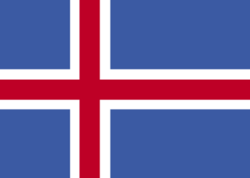 Icelandic national flag (Flag of Iceland)
 Iceland country profile
 Travel advice for Iceland
As for the Icelandic climate; temperate; moderated by North Atlantic Current; mild, windy winters; damp, cool summers.
Icelander(s) speak Icelandic, English, Nordic languages, German widely spoken.
Places of note in Iceland
- Reykjavík
- Kópavogur
- Hafnarfjörður
- Akureyri
- Garðabær
- Keflavík
- Akranes
- Selfoss
- Njarðvík
- Sauðárkrókur
- Grindavík
- Ísafjörður
- Húsavík
- Hveragerði
- Borgarnes
- Höfn
- Neskaupstaður
- Dalvík
- Siglufjörður
- Sandgerði
- Þorlákshöfn
- Stykkishólmur
- Ólafsvík
- Eskifjörður
- Vogar
- Blönduós
- Bolungarvík
- Ólafsfjörður
- Reyðarfjörður
- Hvolsvöllur
- Seyðisfjörður
- Hella
- Patreksfjörður
- Fáskrúðsfjörður
- Eyrarbakki
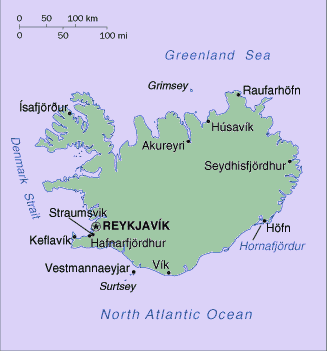 Icelandic map
Regions of Iceland
- Austurland
- Höfuðborgarsvæði
- (IC01)
- (IC02)
- (IC03)
- (IC04)
- (IC05)
- (IC06)
- (IC07)
- (IC08)
- (IC09)
- (IC10)
- (IC11)
- (IC12)
- (IC13)
- (IC14)
- (IC15)
- (IC16)
- (IC17)
- (IC18)
- (IC19)
- (IC20)
- (IC21)
- (IC22)
- (IC23)
- (IC24)
- (IC25)
- (IC26)
- (IC27)
- (IC28)
- (IC29)
- (IC30)
- (IC31)
- (IC32)
- (IC33)
- (IC34)
- (IC35)
- (IC36)
- (IC37)
- Iceland (general)
- Norðurland Eystra
- Norðurland Vestra
- Suðurland
- Suðurnes
- Vestfirðir
- Vesturland
Settled by Norwegian and Celtic (Scottish and Irish) immigrants during the late 9th and 10th centuries A.D., Iceland boasts the world's oldest functioning legislative assembly, the Althing, established in 930. Independent for over 300 years, Iceland was subsequently ruled by Norway and Denmark. Fallout from the Askja volcano of 1875 devastated the Icelandic economy and caused widespread famine. Over the next quarter century, 20% of the island's population emigrated, mostly to Canada and the US. Limited home rule from Denmark was granted in 1874 and complete independence attained in 1944. Literacy, longevity, income, and social cohesion are first-rate by world standards.
Iceland's Scandinavian-type economy is basically capitalistic, yet with an extensive welfare system (including generous housing subsidies), low unemployment, and remarkably even distribution of income. In the absence of other natural resources (except for abundant geothermal power), the economy depends heavily on the fishing industry, which provides 70% of export earnings and employs 4% of the work force. The economy remains sensitive to declining fish stocks as well as to fluctuations in world prices for its main exports: fish and fish products, aluminum, and ferrosilicon. Government policies include reducing the current account deficit, limiting foreign borrowing, containing inflation, revising agricultural and fishing policies, and diversifying the economy. The government remains opposed to EU membership, primarily because of Icelanders' concern about losing control over their fishing resources. Iceland's economy has been diversifying into manufacturing and service industries in the last decade, and new developments in software production, biotechnology, and financial services are taking place. The tourism sector is also expanding, with the recent trends in ecotourism and whale watching. Growth had been remarkably steady in 1996-2001 at 3%-5%, but could not be sustained in 2002 in an environment of global recession. Growth resumed in 2003, and estimates call for strong growth until 2007, slowly dropping until the end of the decade.
Icelandic natural resources include fish, hydropower, geothermal power, diatomite
strategic location between Greenland and Europe; westernmost European country; Reykjavik is the northernmost national capital in the world; more land covered by glaciers than in all of continental Europe
Icelandic religion is Lutheran Church of Iceland 85.5%, Reykjavik Free Church 2.1%, Roman Catholic Church 2%, Hafnarfjorour Free Church 1.5%, other Christian 2.7%, other or unspecified 3.8%, unaffiliated 2.4% (2004).
Natural hazards in Iceland include earthquakes and volcanic activity.
Travel Advice for Iceland
IcelandSUMMARY
- The threat from terrorism in Iceland is low but you should be aware of the global risk of indiscriminate terrorist attacks which could be against civilian targets.
- Around 70,000 British tourists visit Iceland every year. Most visits to Iceland are trouble-free. The main type of incident for which British nationals require consular assistance in Iceland is for replacing lost and stolen passports. Petty crime does occur but at a low level compared to other European countries.
- We strongly recommend that you obtain comprehensive travel and medical insurance before travelling and, if appropriate, that this includes cover for adventure activities. You should check any exclusions, and that your policy covers you for the activities you want to undertake. Please see: Travel Insurance
SAFETY AND SECURITY