Traveling Luck for Denmark. Denmark, Europe
Denmark is located in Northern Europe, bordering the Baltic Sea and the North Sea, on a peninsula north of Germany (Jutland); also includes two major islands (Sjaelland and Fyn).
Land in Denmark is low and flat to gently rolling plains.
Danish land covers an area of 43094 square kilometers which is slightly less than twice the size of Massachusetts
Denmark has borders with Germany for 68km.
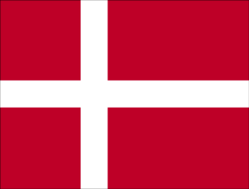 Danish national flag (Flag of Denmark)
As for the Danish climate; temperate; humid and overcast; mild, windy winters and cool summers.
Dane(s) speak Danish, Faroese, Greenlandic (an Inuit dialect), German (small minority)
note: English is the predominant second language.
Places of note in Denmark
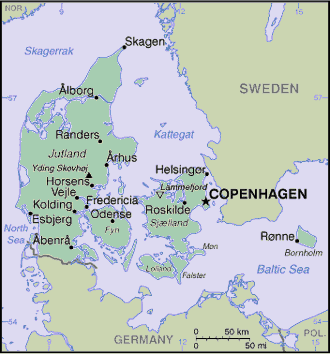 Danish map
Once the seat of Viking raiders and later a major north European power, Denmark has evolved into a modern, prosperous nation that is participating in the general political and economic integration of Europe. It joined NATO in 1949 and the EEC (now the EU) in 1973. However, the country has opted out of certain elements of the European Union's Maastricht Treaty, including the European Economic and Monetary Union (EMU), European defense cooperation, and issues concerning certain justice and home affairs.
Country Profile for Denmark
This thoroughly modern market economy features high-tech agriculture, up-to-date small-scale and corporate industry, extensive government welfare measures, comfortable living standards, a stable currency, and high dependence on foreign trade. Denmark is a net exporter of food and energy and enjoys a comfortable balance of payments surplus. Government objectives include streamlining the bureaucracy and further privatization of state assets. The government has been successful in meeting, and even exceeding, the economic convergence criteria for participating in the third phase (a common European currency) of the European Economic and Monetary Union (EMU), but Denmark has decided not to join 12 other EU members in the euro. Nonetheless, the Danish krone remains pegged to the euro. Economic growth gained momentum in 2004 and the upturn accelerated through 2005. Because of high GDP per capita, welfare benefits, a low Gini index, and political stability, the Danish people enjoy living standards topped by no other nation. A major long-term issue will be the sharp decline in the ratio of workers to retirees.
Danish natural resources include petroleum, natural gas, fish, salt, limestone, chalk, stone, gravel and sand
controls Danish Straits (Skagerrak and Kattegat) linking Baltic and North Seas; about one-quarter of the population lives in greater Copenhagen
Danish religion is Evangelical Lutheran 95%, other Protestant and Roman Catholic 3%, Muslim 2%.
Natural hazards in Denmark include flooding is a threat in some areas of the country (e.g., parts of Jutland, along the southern coast of the island of Lolland) that are protected from the sea by a system of dikes.
Travel Advice for Denmark
DenmarkThis advice has been reviewed and reissued with amendments to the Health section (EHIC) and General section (EU Aviation Regulations). The overall level of the advice has not changed.
SUMMARY
- Denmark shares with the rest of Europe a threat from international terrorism. Attacks could be indiscriminate and against civilian targets.
- Around 100,000 British tourists visit Denmark every year. Most visits are trouble-free. The main type of incident for which British nationals require consular assistance in Denmark is for replacing lost or stolen passports.
- We strongly recommend that you obtain comprehensive travel and medical insurance before travelling. You should check any exclusions, and that your policy covers you for the activities you want to undertake. Please see: Travel Insurance.
SAFETY AND SECURITY
Local Travel
The public transport infrastructure is generally of a very high standard. You can buy a variety of bus, train and metro tickets at train station kiosks and also at a selection of supermarkets. Within the Copenhagen inner city area you can rent city bicycles (available for a token fee). Cyclists found outside the inner city area on these bicycles may be subject to fines. Other outlets hire out better quality bicycles for a reasonable fee. Ferries are available to transport you to Denmark’s many Islands.
Road Safety
Road conditions in Denmark are very good and driving standards are high. You should carry a warning triangle in case of breakdowns. You must wear seatbelts. You must drive with dipped headlights at all times (day and night) and they should be masked with special European opaque material available from most garages in the UK and Ireland. It is now law in Denmark (not just good driving practice) to indicate before changing lanes on a motorway. Since 1 September 2005 Denmark implemented new measures that could result in driving offences committed in Denmark being reported to the UK authorities. You should therefore take extra care when driving in Denmark.
Cycling is very popular in Denmark. Cyclists often have the right of way. It is particularly important that you check cycle lanes before turning right. You must give due consideration to the many cyclists present in Danish cities.
LOCAL LAWS AND CUSTOMS
You should not become involved with drugs of any kind. Although Denmark is generally a liberal society, drug use is illegal and laws are enforced. You will not be treated more leniently than residents and drug dealers in particular can receive heavy sentences. You should be aware that Danish law changed on 1 July 2004 so that anyone found in possession of illegal drugs, deemed to be for personal consumption, will receive a police fine of DKK 500
Homosexuality is legal and Danish law allows same sex marriages.
ENTRY REQUIREMENTS
Visas are not required to enter Denmark. As a British passport holder you may stay for a period of three months. For longer stays, you should apply to the appropriate office for a residence permit.
You should note that Greenland and the Faroes are not members of the European Union and although visas are not required for tourist purposes, you should obtain work and residence permits prior to entry if you are intending to live and work there.
You should be in possession of a valid passport, with a minimum validity of three months. For further advice on requirements please contact the Danish Embassy in London: Danish representation to the UK.
If you lose your passport in Denmark, you should contact the British Embassy in Copenhagen (contact details below).
HEALTH
We strongly recommend that you obtain comprehensive travel and medical insurance before travelling. You should check any exclusions, and that your policy covers you for the activities you want to undertake. Please see: Travel Insurance
The standard of healthcare is high. A reciprocal healthcare agreement exists between UK and Denmark by which British nationals are covered for emergency treatment whilst visiting Denmark. The Form E111 is no longer valid. You should obtain a European Health Insurance Card (EHIC) before leaving the UK. The EHIC is not a substitute for medical and travel insurance, but entitles you to emergency medical treatment on the same terms as Danish nationals. You will not be covered for medical repatriation, on-going medical treatment or treatment of a non-urgent nature. For more information about how to obtain the EHIC please see: Europe and the EHIC.
There are also agreements for the same EHIC facilities in the Faroe Islands and Greenland.
The telephone number for emergencies is 112.
You should seek medical advice before travelling and ensure that all appropriate vaccinations are up-to-date. For further information on health, check the Department of Health’s website at www.dh.gov.uk
Avian Influenza
The Danish authorities have confirmed that there have been outbreaks of Avian Influenza (Bird Flu) in wild birds and domestic birds in Denmark. No human infections or deaths have been reported.
The risk to humans from Avian Influenza is believed to be very low. As a precaution, you should avoid visiting live animal markets, poultry farms and other places where you may come into close contact with domestic, caged or wild birds; and ensure poultry and egg dishes are thoroughly cooked.
You should read this advice in conjunction with the FCO’s Avian and Pandemic Influenza Factsheet which gives more detailed advice and information.
GENERAL
If things go wrong when overseas, please see: What We Can Do To Help
EU Aviation Regulations
The revised EU-wide security measures that came into effect for all passengers departing from UK airports in November 2006 are also being implemented in Denmark. For more details about this please see: DfT - Airline Security Update.
Remember the currency for Denmark is the Danish Kroner and not the Euro.
You should check carefully on bona fides of anyone offering employment opportunities involving asphalting or seasonal work.
European Union
Information on the EU can be found at: Travelling and Living in the EU (pdf) and Britain in the EU.

 Search
 Denmark country profile
 Travel advice for Denmark