World index ... Africa ... Swaziland
Travelers word index

Swaziland

Continents
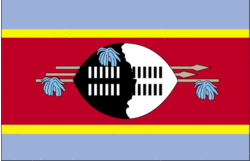
Swazi flag

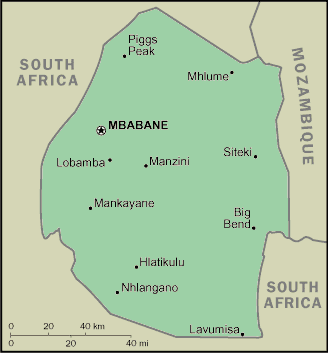
Swaziland is located in Southern Africa, between Mozambique and South Africa.

Swaziland has borders with Mozambique for 105km and South Africa for 430km.
Land in Swaziland is mostly mountains and hills; some moderately sloping plains.

Swazi land covers an area of 17363 square kilometers which is slightly smaller than New Jersey

As for the Swazi climate; varies from tropical to near temperate.

Swazi(s) speak English (official, government business conducted in English), siSwati (official).

Swaziland country profile, Travel advice for Swaziland

Swazi Map
Places of note in Swaziland
Manzini
Mbabane
Big Bend
Malkerns
Mhlume
Hluti
Siteki
Piggs Peak
Lobamba
Kwaluseni
Bhunya
Mhlambanyatsi
Hlatikulu
Bulembu
Kubuta
Tshaneni
Sidvokodvo
Lavumisa
Darkton
Nsoko
Regions of Swaziland
Hhohho
Lubombo
Manzini
Shiselweni
Swaziland (general)

Autonomy for the Swazis of southern Africa was guaranteed by the British in the late 19th century; independence was granted in 1968. Student and labor unrest during the 1990s pressured the monarchy (one of the oldest on the continent) to grudgingly allow political reform and greater democracy. Swaziland recently surpassed Botswana as the country with the world's highest known rates of HIV/AIDS infection.

Country profile: Swaziland

Map of SwazilandThe kingdom of Swaziland is one of the world's last remaining absolute monarchies.

Its king rules by decree over his million subjects, most of whom live in the countryside and follow traditional ways of life.

The power of the throne, however, has not gone unchallenged.

King Mswati III, on the throne since 1986, is upholding the tradition of his father, King Sobhuza II, who reigned for almost 61 years and had scores of wives.

AT-A-GLANCE


King Sobhuza scrapped the constitution in 1973 and banned political parties.

King Mswati has shown no enthusiasm for sharing power, but banned opposition parties and trade unions have been vocal in their demands for greater democracy and limits on the king's power.

With peaceful change in neighbouring South Africa and Mozambique, Swaziland has been described as an island of dictatorship in a sea of democracy. Royalists have argued that democracy creates division, and that a monarch is a strong unifying force.

A long-awaited constitution, signed by the king in 2005 and introduced in 2006, cemented his rule.

Swaziland is virtually homogenous, most of the population being of the same tribe. Economically, it relies on South Africa, which receives almost half of Swazi exports and supplies most of its imports.

Many Swazis live in chronic poverty and food shortages are widespread. Aids is taking a heavy toll with more than 40% of the population believed infected with HIV. The virus has killed many workers and farmers and has created thousands of orphans. Life expectancy has plummeted.

King: Mswati III

Swaziland's king King Mswati III was crowned in 1986 at the age of 18, succeeding his long-serving father King Sobhuza II, who died at the age of 82.

The king, who is known as Ngweyama - "the lion" - often appears in public in traditional dress and has many wives.

He rules by decree and has been criticised for the heavy-handed treatment of opponents. The king has also been criticised for requesting public money to pay for new palaces, a personal jet and luxury cars. Street protests led him to abandon the aircraft purchase.

  • Prime minister: Absalom Themba Dlamini
  • Foreign minister: Mabili David Dlamini

    State control of the media is strong. The government controls all radio and TV stations with the exception of a Christian radio station.

    Freedom of expression in the press is seriously restricted. Media watchdog Reporters Without Borders reports that the sole private daily is largely given over to "news trivia, entertainment and sports". "Criticising the king is inconceivable," it adds.

    The press

  • The Times of Swaziland - privately-owned daily
  • The Swazi Observer - pro-government daily

    Television

  • Swazi TV - operated by state-run Swaziland Television Authority

    Radio

  • Swaziland Broadcasting and Information Service - state-run operator of three channels: The Siswati Channel, The English Channel and The Information Service
  • Trans World Radio - US-based evangelistic broadcaster uses transmitters in Swaziland for regional broadcasts

    In this small, landlocked economy, subsistence agriculture occupies more than 80% of the population. The manufacturing sector has diversified since the mid-1980s. Sugar and wood pulp remain important foreign exchange earners. Mining has declined in importance in recent years with only coal and quarry stone mines remaining active. Surrounded by South Africa, except for a short border with Mozambique, Swaziland is heavily dependent on South Africa from which it receives about nine-tenths of its imports and to which it sends nearly two-thirds of its exports. Customs duties from the Southern African Customs Union and worker remittances from South Africa substantially supplement domestically earned income. The government is trying to improve the atmosphere for foreign investment. Overgrazing, soil depletion, drought, and sometimes floods persist as problems for the future. More than one-fourth of the population needed emergency food aid in 2004-05 because of drought, and nearly two-fifths of the adult population has been infected by HIV/AIDS.

    Swazi natural resources include asbestos, coal, clay, cassiterite, hydropower, forests, small gold and diamond deposits, quarry stone, and talc

    landlocked; almost completely surrounded by South Africa

    Swazi religion is Zionist 40% (a blend of Christianity and indigenous ancestral worship), Roman Catholic 20%, Muslim 10%, Anglican, Bahai, Methodist, Mormon, Jewish and other 30%.

    Natural hazards in Swaziland include drought.

    Travel Advice on Swaziland

    Swaziland

    This advice has been reviewed and reissued with amendments to the Health section (rabies).  The overall level of the advice has not changed.

    SUMMARY

    • There is no British High Commission in Swaziland, but there is an Honorary British Consul in Mbabane who can be contacted for emergency consular assistance only (see contact details below).  All other enquiries should be directed to the British High Commission in Pretoria.

    • Do not drive at night along the N4 or other isolated roads, as there is a risk of being hijacked. Livestock and unlit parked vehicles pose additional hazards.

    • HIV/AIDS prevalence is high –around 43% of the local population are infected.

    • The threat from terrorism is low. But you should be aware of the global risk of indiscriminate terrorist attacks which could be against civilian targets, including places frequented by foreigners.

    • Around 40,000 British tourists visit Swaziland every year.  Most visits are trouble free. The main type of incident for which British nationals require consular assistance in Swaziland is for replacing lost or stolen passports.  You should keep a photocopy of your passport with you and keep the original in a safe place.

    • Crime levels are low but sensible precautions are needed.

    • We strongly recommend that you obtain comprehensive travel and medical insurance before travelling.  You should check any exclusions, and that your policy covers you for the activities you want to undertake.  Please see: Travel Insurance.


    SAFETY AND SECURITY

    The political situation is stable, but demonstrations do occur.  You should avoid any large public gathering.
    Local Travel
    All areas of Swaziland are accessible, though care should be taken in rural areas (see Road Safety below).
    Road Safety
    The standard of driving is lower than in the UK.  Drivers often cross the central reservation to avoid obstructions.  Speeding (the maximum speed limit is 120 km) by other drivers is a problem on the good tarmac roads.  The minor roads are not well maintained and road markings are poor.
    On rural roads there have been a number of serious accidents and deaths as a result of animals straying onto roads.  Avoid driving on rural roads at night.  As well as the risk of hitting animals, there is the additional risk of abandoned unlit trailers and poorly lit heavy vehicles.
    Do not use public transport (buses and taxis).  Vehicles are poorly maintained and overloaded.
    Be wary of anyone who offers you help if you breakdown or need to change a tyre as it presents the opportunity for theft, muggings and hijackings.  You should park in well-lit areas.  Do not pick up strangers. Do not stop to assist (apparently) distressed motorists, as these are all techniques sometimes used by hijackers.  It is better to report the incident to the police.
    UK or international driving licences (provided the latter are in English) are acceptable.
    Air Safety
    The EU has published a list of air carriers that are subject to an operating ban or restrictions within the community.  You should check the following link to see whether this will affect your travel: http://europa.eu.int/comm/transport/air/safety/flywell_en.htm


    LOCAL LAWS AND CUSTOMS

    Drug taking (dagga/marijuana) and smuggling, though common in local culture, is illegal.  Foreign nationals have been imprisoned on drug offences.  Penalties can be severe.
    Homosexuality is legal.


    ENTRY REQUIREMENTS

    Visa
    British passport holders and most Commonwealth citizens do not require visas for Swaziland.  Visitors will normally be given entry permission for up to fourteen days.  This can be extended at the Swaziland Immigration Department in Mbabane.  All Swaziland border posts open daily throughout the year but hours of operation are variable.
    Vehicles
    If you travel in a vehicle other than one registered in South Africa, you will have to complete Form 36 at Swazi border posts on entry and departure for customs purposes.
    Vehicles may be searched at the borders.
    Single parents or other adults travelling alone with children should be aware that some countries require documentary evidence of parental responsibility before allowing lone parents to enter the country or, in some cases, before permitting the children to leave the country.  For further information on exactly what will be required at immigration, please contact: Swaziland's representation in the UK


    HEALTH

    We strongly recommend that you obtain comprehensive travel and medical insurance before travelling, including cover for medical evacuation.  You should check any exclusions, and that your policy covers you for the activities you want to undertake.  Please see: Travel Insurance
    Basic healthcare is available, but there are increasing shortages of even basic medications.  Medical evacuation to South Africa is necessary for serious accidents and emergencies. Local private hospitals can arrange evacuation but only if you are fully insured or you can produce funds in advance to pay for evacuation and treatment.

    There is a high prevalence of HIV/AIDS in Swaziland.  You should be aware of the dangers of infection from unprotected sex.

    Bilharzia, a tropical flat worm found in water and which is parasitic in humans, exist in some rivers.

    Malaria is common in most parts of the country apart from Mbabane and other parts of the highveld. More than three-quarters of British travellers who contracted malaria in 2005 did not take preventive measures, such as taking malaria prevention tablets. However, malaria can occur despite appropriate prevention, and therefore you should promptly seek medical care in the event of a fever or flu-like illness in the first year following your return from travelling to a malaria risk country.  Before travelling you should seek medical advice about the malaria risk in Swaziland.

    Anyone intending to camp or walk in the bush should be aware of the risk of tick bites.

    Rabies is endemic in most African countries.  The rabies virus is transmitted through the saliva of infected animals and transmitted to humans through bites, scratches or contact of saliva with broken skin and can be fatal once symptoms manifest themselves.  All travellers who have possibly been exposed to the rabies virus, whether by bites, scratches or other exposure, should seek medical advice without delay (even if pre-exposure vaccine was received).  This also applies to travellers in low risk areas in case other animal-transmitted infections are present, or the animal may have strayed across the border from an endemic country.  More information can be found o9n the National Travel Health Network and Centre website at:  http://www.nathnac.org.

    You should take good hygiene precautions, such as washing fruit and vegetables.  Drinking water may not be safe, especially in rural areas.
    You should seek medical advice before travelling and ensure that all appropriate vaccinations are up-to-date.  For further information on health check the Department of Health website at: www.dh.gov.uk.
    NATURAL DISASTERS
    Swaziland has suffered from a drought in the lowveld in the past two years.  In the wet summer months (November to April) violent thunderstorms with lightning and heavy rains are common in the highveld areas.


    GENERAL

    If things go wrong when overseas, please see: What We Can Do To Help
    There is no British High Commission in Swaziland, but there is an Honorary British Consul in Mbabane, who can be contacted  for assistance with consular emergencies only.

    Frank Pettit
    PO Box A 41
    Eveni
    Mbabane
    H103
    Swaziland

    Telephone/Fax: +268 551 6247

    E-mail: honbritcon@realnet.co.sz

    All other enquiries should be directed to the British High Commission in Pretoria, who cover Swaziland.
    Before you set off, you should ensure that your passport retains sufficient validity for your stay and has several unused pages remaining. Applications for new passports are accepted by the Consular Section at the British High Commission in Pretoria in person or by courier (if a courier is used, the cost is borne by the applicant).

    Money

    The local currency (Emalangeni) is not convertible. South African Rands are accepted, as are most major credit cards. ATM machines are readily available.


  • What is this world index all about?